
AskSia
Plus

Air at 27.0°C and at atmospheric pressure is drawn into a bicycle pump that has ...
May 26, 2024

Air at 27.0°C and at atmospheric pressure is drawn into a bicycle pump that has a cylinder with an inner diameter of2.50 cm and a length of 50.0 cm. The down stroke adiabatically compresses the air, which reaches a gauge pressure of 800 kPa before
entering the tire. Determine (a) the volume of the compressed air and (b) the temperature of the compressed air. (c) The pump is made of steel and has an inner wall that is 2.00 mm thick. Assume that 4.00 cm ofthe cylinder’s length is allowed to come to thermal
equilibrium with the air. What will be the increase in wall temperature?

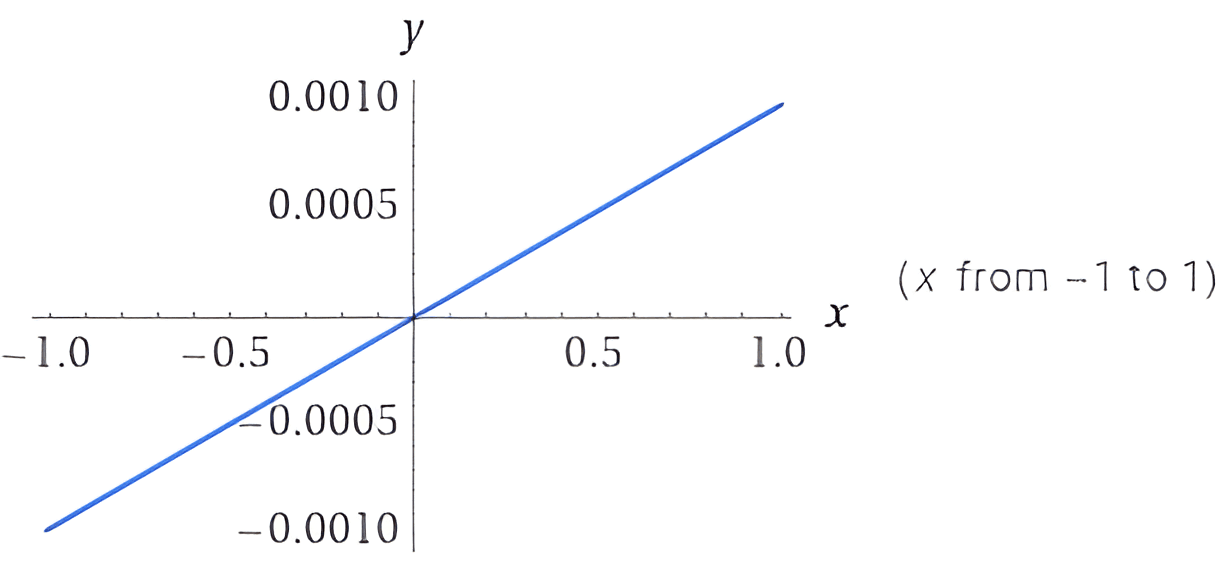
Generated Graph
Solution by Steps
step 1
Calculate the initial volume of the air in the pump cylinder using the formula for the volume of a cylinder: V=πr2h. Here, r=22.5cm=1.25cm and h=50cm
step 2
V=π(1.25cm)2(50cm)=π(1.5625cm2)(50cm)=78.54cm3
step 3
Convert the volume to cubic meters: V=78.54cm3×10−6m3/cm3=7.854×10−5m3
step 4
Calculate the final volume of the compressed air using the adiabatic process formula: P1V1γ=P2V2γ. Here, P1=101.3kPa, P2=800kPa, and γ=1.4
step 5
V2=V1(P2P1)1/γ=7.854×10−5m3(800101.3)1/1.4=2.56×10−5m3
step 6
Calculate the temperature of the compressed air using the adiabatic process formula: T2=T1(V2V1)γ−1. Here, T1=27+273.15=300.15K
step 7
T2=300.15K(2.56×10−57.854×10−5)0.4=300.15K×2.45=735.37K
step 8
Convert the temperature back to Celsius: T2−273.15=735.37−273.15=462.22°C
step 9
Calculate the increase in wall temperature using the heat transfer formula: Q=mcΔT. Here, m=ρV, ρ=7850kg/m3, V=πr2h=π(0.0125m)2(0.04m)=1.96×10⁻⁵m3, and c = 500 \, \text{J/kg·K}
step 10
m=7850kg/m3×1.96×10−5m3=0.154kg
step 11
ΔT=mcQ=mcP2V2−P1V1=0.154×500800×103×2.56×10−5−101.3×103×7.854×10−5=2.56K
Answer
(a) The volume of the compressed air is 2.56×10⁻⁵m3. (b) The temperature of the compressed air is 462.22°C. (c) The increase in wall temperature is 2.56K.
Key Concept
Adiabatic Process
Explanation
In an adiabatic process, there is no heat exchange with the surroundings, and the relationship between pressure, volume, and temperature can be used to determine the final state of the gas.
© 2023 AskSia.AI all rights reserved