
AskSia
Plus

A family of curves is a set of curves whose equations are of the same form but ...
May 20, 2024



Generated Graph
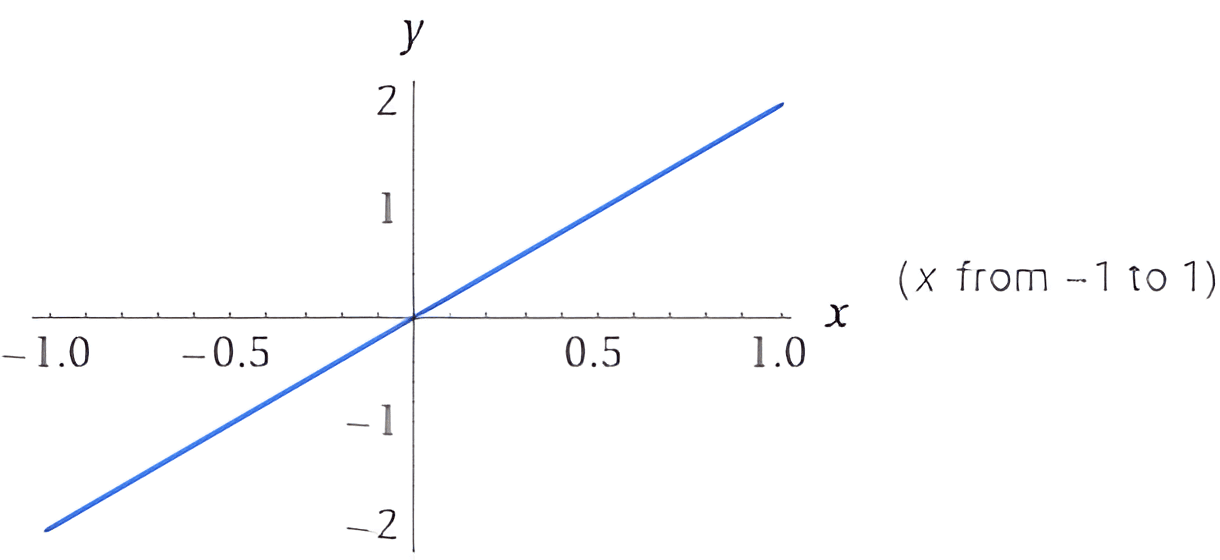
Solution by Steps
step 1
The function given is f(x)=x2
step 2
To find the equation of the tangent line at (3,9), we first need to find the derivative of f(x)
step 3
The derivative of f(x)=x2 is f′(x)=2x
step 4
Evaluate the derivative at x=3: f′(3)=2⋅3=6
step 5
The slope of the tangent line at (3,9) is 6
step 6
Using the point-slope form of the equation of a line, y−y1=m(x−x1), where (x1,y1)=(3,9) and m=6:
step 7
y−9=6(x−3)
step 8
Simplify to get the equation of the tangent line: y=6x−9
Answer
The equation of the tangent line to f(x)=x2 at (3,9) is y=6x−9.
step 1
The parameter k in the function g(x)=x2+k represents a vertical shift of the graph of f(x)=x2
step 2
If k > 0, the graph shifts upward by k units. If k < 0, the graph shifts downward by k units
step 1
Choose k=1,2,5,8
step 2
The graphs of g(x)=x2+1, g(x)=x2+2, g(x)=x2+5, and g(x)=x2+8 will be parabolas that are vertically shifted versions of f(x)=x2
step 1
For g(x)=x2+k, the derivative is g′(x)=2x
step 2
Evaluate the derivative at x=3: g′(3)=2⋅3=6
step 3
The slope of the tangent line at x=3 is 6 for all values of k
step 4
Using the point-slope form of the equation of a line, y−y1=m(x−x1), where (x1,y1)=(3,32+k)=(3,9+k) and m=6:
step 5
y−(9+k)=6(x−3)
step 6
Simplify to get the equation of the tangent line: y=6x−9+k
Answer
The tangent line equations to the curves g(x)=x2+k at x=3 are y=6x−9+k.
step 1
The function given is q(x)=(x−h)2
step 2
To find the equation of the tangent line at x=3+h, we first need to find the derivative of q(x)
step 3
The derivative of q(x)=(x−h)2 is q′(x)=2(x−h)
step 4
Evaluate the derivative at x=3+h: q′(3+h)=2((3+h)−h)=2⋅3=6
step 5
The slope of the tangent line at x=3+h is 6
step 6
Using the point-slope form of the equation of a line, y−y1=m(x−x1), where (x1,y1)=(3+h,(3+h−h)2)=(3+h,9) and m=6:
step 7
y−9=6(x−(3+h))
step 8
Simplify to get the equation of the tangent line: y=6x−18−6h+9=6x−6h−9
Answer
The tangent line equations to the curves q(x)=(x−h)2 at x=3+h are y=6x−6h−9.
Key Concept
Tangent Line Equation
Explanation
The tangent line to a curve at a given point can be found using the derivative to determine the slope and the point-slope form of the line equation.

Solution by Steps
step 1
Given the family of curves r(x)=ax2, we need to find the tangent line equation at x=3
step 2
First, find the derivative of r(x) with respect to x: dxdr=2ax
step 3
Evaluate the derivative at x=3: dxdrx=3=2a(3)=6a
step 4
The equation of the tangent line at x=3 is given by y=r(3)+dxdrx=3(x−3)
step 5
Calculate r(3): r(3)=a(3)2=9a
step 6
Substitute r(3) and dxdrx=3 into the tangent line equation: y=9a+6a(x−3)
step 7
Simplify the tangent line equation: y=9a+6ax−18a=6ax−9a
Answer
The tangent line equation at x=3 is y=6ax−9a.
Key Concept
Finding the tangent line equation
Explanation
To find the tangent line equation at a specific point, we need to evaluate the function and its derivative at that point and then use the point-slope form of the line equation.
Solution by Steps
step 1
Choose the function y=x1 and investigate the effect of transformations on its tangent line at x=1
step 2
Find the derivative of y=x1: dxdy=−x21
step 3
Evaluate the derivative at x=1: dxdyx=1=−1
step 4
The equation of the tangent line at x=1 is given by y=f(1)+dxdyx=1(x−1)
step 5
Calculate f(1): f(1)=11=1
step 6
Substitute f(1) and dxdyx=1 into the tangent line equation: y=1−1(x−1)
step 7
Simplify the tangent line equation: y=1−x+1=2−x
Answer
The tangent line equation at x=1 for y=x1 is y=2−x.
Key Concept
Effect of transformations on tangent lines
Explanation
Investigating the effect of transformations involves finding the derivative of the function, evaluating it at the point of interest, and using the point-slope form to determine the tangent line equation.
how did u get The tangent line equation at
x
=
3
x=3 is
y
=
6
a
x
−
9
a
y=6ax−9a.
Solution by Steps
step 1
To find the tangent line to the curve at x=3, we first need to determine the derivative of the curve's equation, which represents the slope of the tangent line at any point x
step 2
Let's assume the curve is given by y=f(x). The derivative of y with respect to x is f′(x)
step 3
Evaluate the derivative at x=3 to find the slope of the tangent line at this point. Suppose f′(3)=m
step 4
The equation of the tangent line at x=3 can be written in the point-slope form: y−y1=m(x−x1), where (x1,y1) is the point of tangency
step 5
Given that the point of tangency is (3,f(3)), substitute x1=3, y1=f(3), and m=f′(3) into the point-slope form: y−f(3)=f′(3)(x−3)
step 6
Simplify the equation to get the tangent line in slope-intercept form: y=f′(3)x−3f′(3)+f(3)
step 7
According to the given information, the tangent line equation at x=3 is y=6ax−9a. This implies that f′(3)=6a and f(3)=−9a
Answer
The tangent line equation at x=3 is y=6ax−9a.
Key Concept
Derivative and Tangent Line Equation
Explanation
The derivative of a function at a point gives the slope of the tangent line at that point. Using the point-slope form of the line equation, we can derive the tangent line equation.


Generated Graph
Solution by Steps
step 1
To find the equation of the tangent line to f(x)=x2 at (3,9), we first need to find the derivative of f(x)
step 2
The derivative of f(x)=x2 is f′(x)=2x
step 3
Evaluate the derivative at x=3: f′(3)=2⋅3=6. This is the slope of the tangent line
step 4
Using the point-slope form of the equation of a line, y−y1=m(x−x1), where (x1,y1)=(3,9) and m=6, we get: y−9=6(x−3)
step 5
Simplify the equation: y−9=6x−18⟹y=6x−9
Answer
The equation of the tangent line to f(x)=x2 at (3,9) is y=6x−9.
Key Concept
Derivative and Tangent Line
Explanation
The derivative of a function at a point gives the slope of the tangent line at that point. Using the point-slope form of a line, we can find the equation of the tangent line.
step 1
To explore the family of curves g(x)=x2+k where k∈R, we first describe the effect of k on the graph of g(x)=x2
step 2
The parameter k vertically shifts the graph of x2 up or down. For k > 0, the graph shifts up; for k < 0, the graph shifts down
step 3
Choose 4 different values of k (e.g., k=1,2,5,8) and sketch the graphs on the same set of axes
step 4
For each curve g(x)=x2+k, find the tangent line equation at x=3
step 5
The derivative of g(x)=x2+k is g′(x)=2x
step 6
Evaluate the derivative at x=3: g′(3)=2⋅3=6. This is the slope of the tangent line for all k
step 7
Using the point-slope form of the equation of a line, y−y1=m(x−x1), where (x1,y1)=(3,32+k)=(3,9+k) and m=6, we get: y−(9+k)=6(x−3)
step 8
Simplify the equation: y−9−k=6x−18⟹y=6x−9−k
Answer
The tangent line equations for g(x)=x2+k at x=3 are y=6x−9−k.
Key Concept
Effect of Vertical Shifts on Tangent Lines
Explanation
The parameter k shifts the graph vertically, affecting the y-intercept of the tangent line but not its slope.
step 1
To explore the family of curves q(x)=(x−h)2 where h∈R, we find the tangent line equations at x=3+h
step 2
The derivative of q(x)=(x−h)2 is q′(x)=2(x−h)
step 3
Evaluate the derivative at x=3+h: q′(3+h)=2((3+h)−h)=2⋅3=6. This is the slope of the tangent line for all h
step 4
Using the point-slope form of the equation of a line, y−y1=m(x−x1), where (x1,y1)=(3+h,(3+h−h)2)=(3+h,9) and m=6, we get: y−9=6(x−(3+h))
step 5
Simplify the equation: y−9=6x−18−6h⟹y=6x−9−6h
Answer
The tangent line equations for q(x)=(x−h)2 at x=3+h are y=6x−9−6h.
Key Concept
Effect of Horizontal Shifts on Tangent Lines
Explanation
The parameter h shifts the graph horizontally, affecting the x-intercept of the tangent line but not its slope.
step 1
To explore the family of curves r(x)=ax2 where a∈R, we find the tangent line equations at x=3
step 2
The derivative of r(x)=ax2 is r′(x)=2ax
step 3
Evaluate the derivative at x=3: r′(3)=2a⋅3=6a. This is the slope of the tangent line
step 4
Using the point-slope form of the equation of a line, y−y1=m(x−x1), where (x1,y1)=(3,a⋅32)=(3,9a) and m=6a, we get: y−9a=6a(x−3)
step 5
Simplify the equation: y−9a=6ax−18a⟹y=6ax−9a
Answer
The tangent line equations for r(x)=ax2 at x=3 are y=6ax−9a.
Key Concept
Effect of Scaling on Tangent Lines
Explanation
The parameter a scales the graph vertically, affecting both the slope and the y-intercept of the tangent line.
step 1
To investigate the effect of various transformations on the graph y=x1 and its corresponding tangent lines using x=1 as the original point of contact, we first find the tangent line equation to y=x1 at x=1
step 2
The derivative of y=x1 is y′=−x21
step 3
Evaluate the derivative at x=1: y′(1)=−1. This is the slope of the tangent line
step 4
Using the point-slope form of the equation of a line, y−y1=m(x−x1), where (x1,y1)=(1,1) and m=−1, we get: y−1=−1(x−1)
step 5
Simplify the equation: y−1=−x+1⟹y=−x+2
Answer
The tangent line equation to y=x1 at x=1 is y=−x+2.
Key Concept
Effect of Transformations on Rational Functions
Explanation
Transformations of rational functions affect the slope and intercepts of their tangent lines, which can be analyzed using derivatives.
© 2023 AskSia.AI all rights reserved