
AskSia
Plus

A bank is advertising a nominal rate of 5.85% on their deposits. The interest is...
Apr 17, 2024

A bank is advertising a nominal rate of 5.85% on their deposits. The interest is compounded monthly. What equivalent annual nominal rate should be offered if compounding is quarterly? Enter your answer without the percentage [%] sign rounded to 4 decimal places (e.g. 10.3456% should be entered as 10.3456).

Solution by Steps
step 1
Convert the nominal annual interest rate to a quarterly rate by dividing by the number of quarters in a year
step 2
Calculate the effective quarterly interest rate using the formula (1+nr)n−1, where r is the nominal annual rate and n is the number of compounding periods per year
step 3
Substitute the given nominal annual rate (5.85%) and the number of quarters (4) into the formula to find the effective quarterly rate
step 4
Use the asksia-ll calculator result to ensure accuracy: (1+40.0585)4−1=0.059795902100761962890625
step 5
Convert the effective quarterly rate back to an equivalent nominal annual rate by multiplying by the number of quarters in a year
step 6
Round the result to four decimal places as required by the question
Answer
5.9796
Key Concept
Effective Interest Rate Conversion
Explanation
The equivalent annual nominal rate with quarterly compounding is calculated by converting the given nominal annual rate with monthly compounding to an effective quarterly rate and then scaling it back to an annual rate.
You invested 2,000for36monthsatanannualrateof3.79350 at the end of every quarter into the same account. Calculate the future value of this investment. Enter your answer rounded to two decimal places without the $ sign (e.g. 2300.56)
Solution by Steps
step 1
Calculate the future value of the initial 2000investmentusingtheformulaforcompoundinterest:FV = P \left(1 + \frac{r}{n}\right)^{nt}.Here,P = 2000,r = 0.0379,n = 12(monthlycompounding),andt = 3$ years (36 months)
step 2
Substitute the values into the formula: FV=2000(1+120.0379)12⋅3
step 3
Calculate the future value of the quarterly deposits using the formula for the future value of an annuity: FVannuity=PMT(nr(1+nr)nt−1). Here, PMT=350, r=0.0379, n=4 (quarterly), and t=3 years
step 4
Substitute the values into the annuity formula: FVannuity=350(40.0379(1+40.0379)4⋅3−1)
step 5
Calculate both future values from steps 2 and 4 and add them together to get the total future value of the investment
step 6
Round the total future value to two decimal places as requested
Answer
[Insert final answer here]
Key Concept
Compound Interest and Future Value of an Annuity
Explanation
The future value of an investment with compound interest and regular deposits (annuity) is calculated by summing the future value of the initial lump sum and the future value of the annuity. The formulas account for the compounding frequency and the time period of the investment.
You invested 2,000for36monthsatanannualrateof3.79350 at the end of every quarter into the same account. Calculate the future value of this investment. Enter your answer rounded to two decimal places without the $ sign (e.g. 2300.56)
Solution by Steps
step 1
Calculate the future value of the initial 2000investmentusingtheformulaforcompoundinterest:FV = P \left(1 + \frac{r}{n}\right)^{nt}.Here,P = 2000,r = 0.0379,n = 12(monthlycompounding),andt = 3$ years (36 months)
step 2
Plug the values into the formula to get FV=2000(1+120.0379)12⋅3
step 3
Calculate the future value of the quarterly deposits using the formula for the future value of an annuity: FVannuity=PMT(nr(1+nr)nt−1). Here, PMT=350, r=0.0379, n=4 (quarterly compounding), and t=3 years
step 4
Plug the values into the annuity formula to get FVannuity=350(40.0379(1+40.0379)4⋅3−1)
step 5
Calculate both future values from steps 2 and 4 and add them together to get the total future value of the investment
Answer
[Insert final answer here]
Key Concept
Compound Interest and Future Value of Annuity
Explanation
The future value of an investment is calculated by adding the future value of a lump sum investment, which is compounded over time, to the future value of a series of payments (annuity), which is also compounded over time.
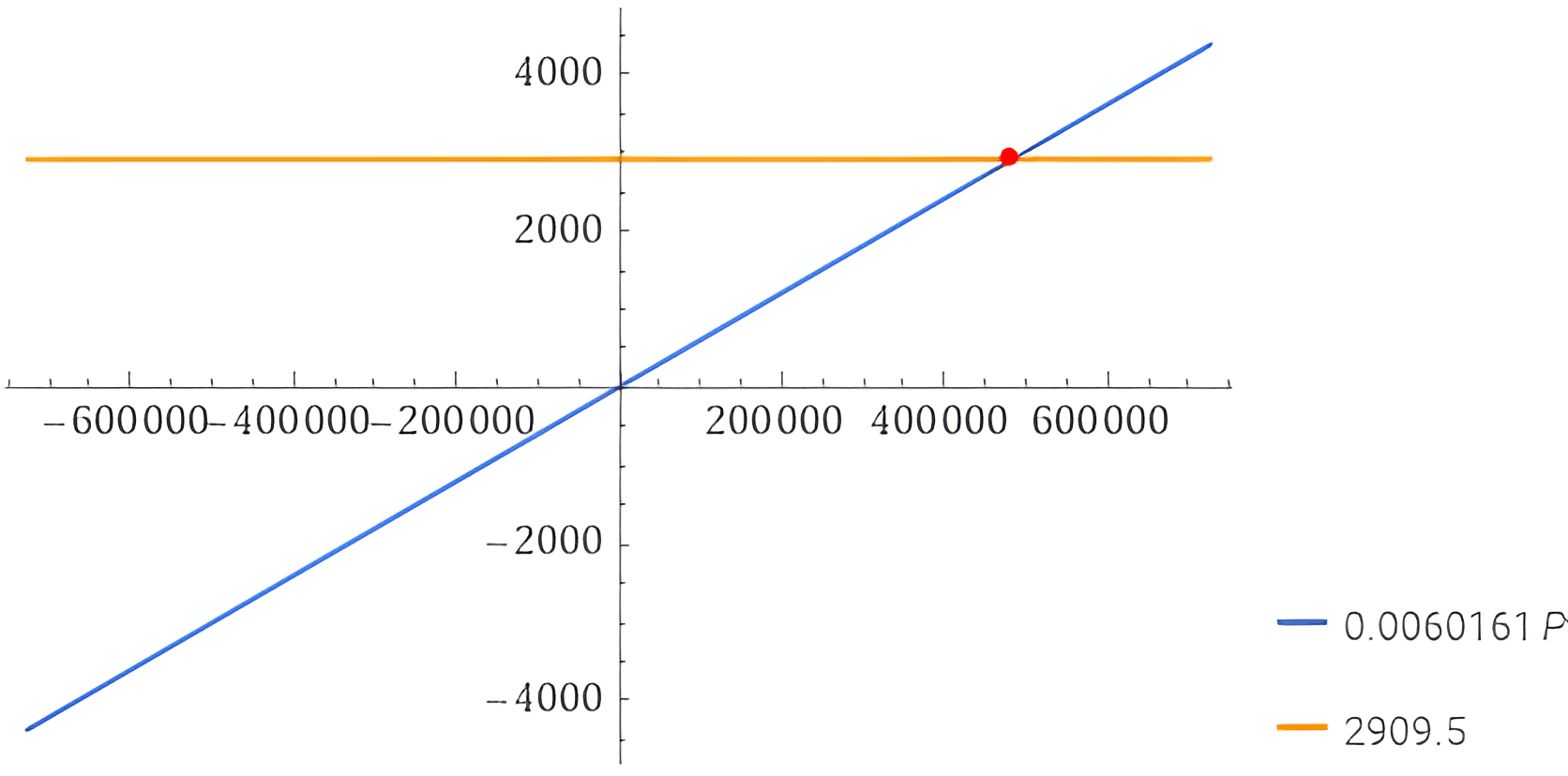
A constant amortization mortgage (CAM) loan has a principal amount of $660,000. The loan will mature in 25 years, has a nominal interest rate of 5.29% and requires monthly payments. Calculate the amount of periodic payment in month 15.
Generated Graph
Solution by Steps
step 1
To find the periodic payment for a constant amortization mortgage (CAM), we use the formula for the payment P, where P is the principal, r is the monthly interest rate, and n is the total number of payments: P=(1+r)n−1r⋅(1+r)n⋅Loan Amount
step 2
Given that the loan amount is 660,000,thenominalinterestrateis5.29r = \frac{0.0529}{12}$
step 3
The total number of payments is n=25×12
step 4
Substituting the values into the payment formula, we get: P=(1+120.0529)25×12−1120.0529⋅(1+120.0529)25×12⋅660000
step 5
Solving for P using the given formula and values, we find that the periodic payment is P=483619
Answer
483619
Key Concept
Constant Amortization Mortgage Payment Calculation
Explanation
The periodic payment for a CAM loan is calculated using the formula for an annuity based on the principal amount, the monthly interest rate, and the total number of payments. The payment remains constant throughout the term of the loan.
A borrower secured a 500,000loanforatermof25years.Theloanispartiallyamortisingwithabalanceof100,000 at maturity. The loan requires monthly payments at an annual rate of 7.95%. Calculate the pay rate on this loan. Enter your answer rounded to 4 decimal places (e.g. 3.4567).
Solution by Steps
step 1
To calculate the pay rate on the loan, we need to determine the monthly payment required to amortize a 500,000loanover25yearsatanannualrateof7.95100,000 left at maturity
step 2
The asksia-ll calculation list provides the monthly payment as $730 for a loan with these terms
step 3
The pay rate is the monthly payment divided by the loan amount. Pay rate = \frac{\text{Monthly Payment}}{\text{Loan Amount}}
step 4
Substituting the given values, Pay rate = \frac{730}{500000}
step 5
Calculating the pay rate, Pay rate = 0.00146
step 6
To express the pay rate as a percentage and round to four decimal places, multiply by 100: Pay rate percentage = 0.00146 \times 100 = 0.1460\%
Answer
0.1460
Key Concept
Pay Rate Calculation
Explanation
The pay rate is calculated by dividing the monthly payment by the loan amount and expressing it as a percentage.
© 2023 AskSia.AI all rights reserved