
AskSia
Plus

9 (a) Find the range of values of p for which 2x2+5x=px−8 is always p...
Jun 26, 2024



Generated Graph
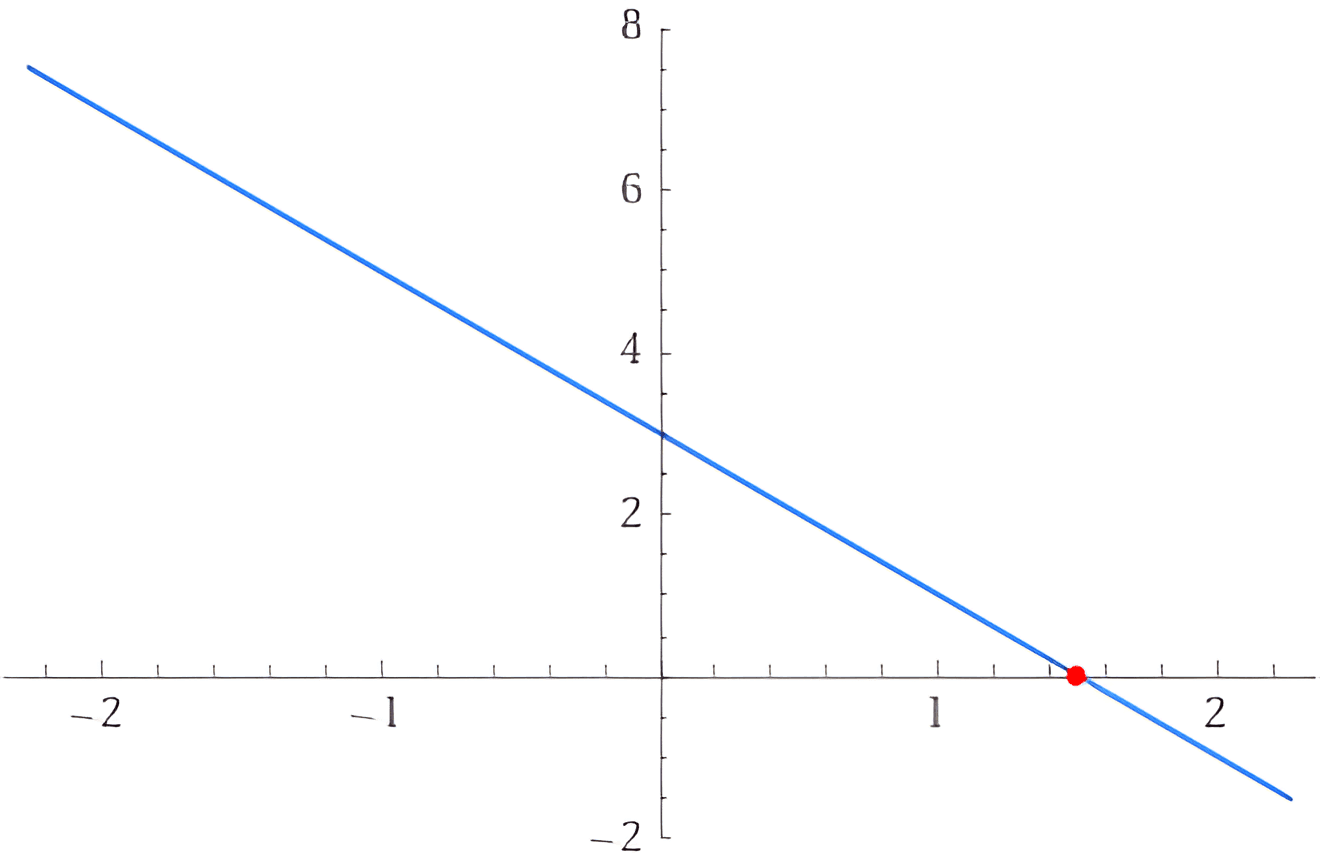
Solution by Steps
step 1
Given the inequality 2 x^{2}+5 x=p x-8>0, we need to solve for p
step 2
Rearrange the inequality: 2 x^{2} + 5 x - p x + 8 > 0
step 3
Combine like terms: 2 x^{2} + (5 - p) x + 8 > 0
step 4
For the quadratic expression to be always positive, its discriminant must be less than zero: (5 - p)^2 - 4 \cdot 2 \cdot 8 < 0
step 5
Simplify the discriminant inequality: (5 - p)^2 - 64 < 0
step 6
Solve for p: (5 - p)^2 < 64
step 7
Take the square root of both sides: |5 - p| < 8
step 8
Solve the absolute value inequality: -8 < 5 - p < 8
step 9
Isolate p: -3 < p < 13
Answer
-3 < p < 13
step 1
Given the curve y=−x2+3x−1, we need to find the equation of the tangent to the curve that is parallel to the x-axis
step 2
The slope of the tangent line parallel to the x-axis is 0
step 3
Find the derivative of the curve: dxd(−x2+3x−1)=−2x+3
step 4
Set the derivative equal to 0 to find the x-coordinate where the slope is 0: −2x+3=0
step 5
Solve for x: x=23
step 6
Substitute x=23 back into the original equation to find the y-coordinate: y=−(23)2+3(23)−1
step 7
Simplify: y=−49+29−1=−49+418−44=45
step 8
The point of tangency is (23,45)
step 9
The equation of the tangent line parallel to the x-axis is y=45
Answer
y=45
Key Concept
Quadratic Inequality and Tangent Line
Explanation
For part (a), the quadratic expression must have a negative discriminant to be always positive. For part (b), the tangent line parallel to the x-axis has a slope of zero, and we find the point of tangency by setting the derivative to zero.

Generated Graph
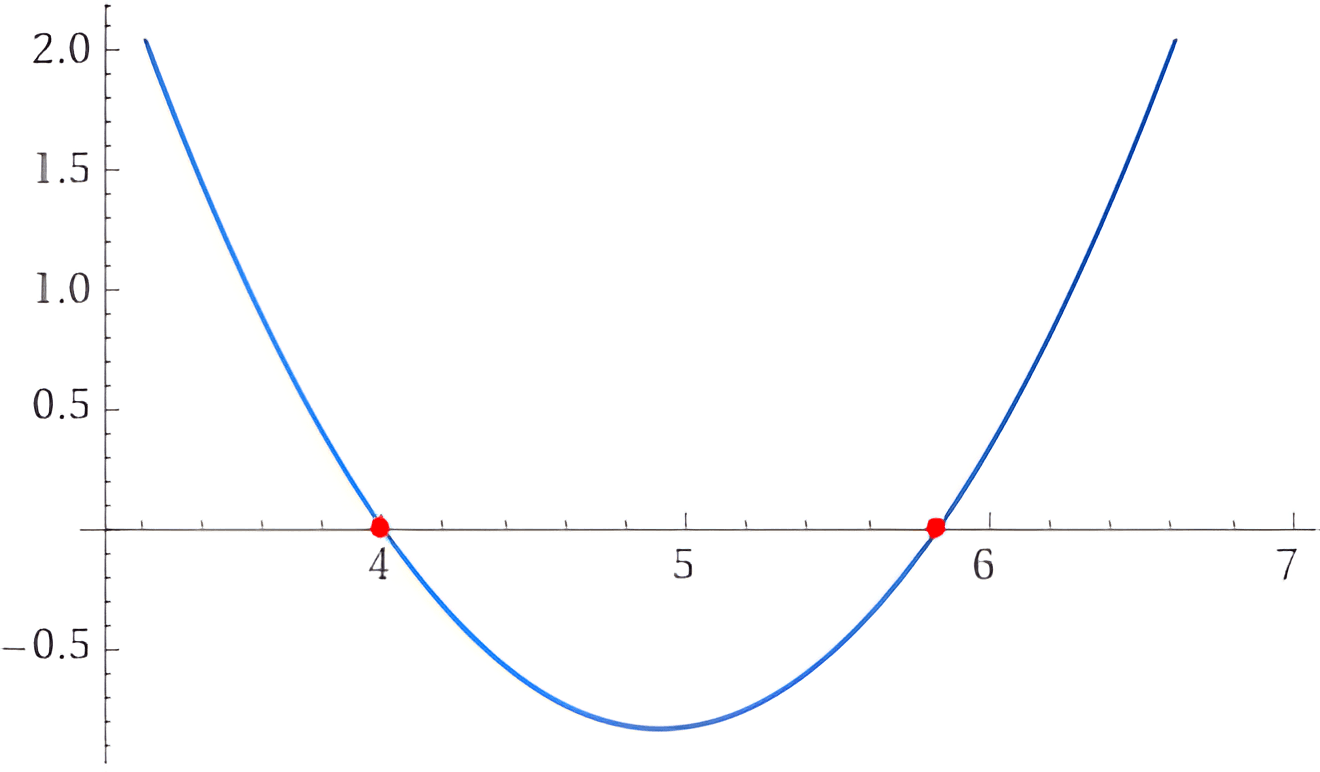
Solution by Steps
step 1
Given the roots of the equation 3x2−5x+9=0 are α+1 and β+1, we need to find the quadratic equation whose roots are α2 and β2
step 2
Let α+1 and β+1 be the roots of the given equation. Then, the sum of the roots is (α+1)+(β+1)=α+β+2 and the product of the roots is (α+1)(β+1)=αβ+α+β+1
step 3
For the quadratic equation 3x2−5x+9=0, the sum of the roots is 3−(−5)=35 and the product of the roots is 39=3
step 4
Therefore, α+β+2=35 and αβ+α+β+1=3. Solving these, we get α+β=3−1 and αβ=310
step 5
The quadratic equation with roots α2 and β2 is x2−(α2+β2)x+α2β2=0
step 6
Using the identity (α+β)2=α2+β2+2αβ, we get α2+β2=(α+β)2−2αβ=(3−1)2−2(310)=91−320=91−60=9−59
step 7
Also, α2β2=(αβ)2=(310)2=9100
step 8
Therefore, the quadratic equation is x2−(9−59)x+9100=0. Multiplying through by 9 to clear the fractions, we get 9x2+59x+100=0
Answer
The quadratic equation is 9x2+59x+100=0.
Key Concept
Finding a new quadratic equation based on transformed roots.
Explanation
We used the relationships between the sums and products of the roots of the original and new equations to derive the new quadratic equation.
step 1
Rewrite the expression using the same base: 42x=(22)2x=24x and 8x+2=(23)x+2=23(x+2)=23x+6
step 2
Substitute these into the original expression: 2x−3⋅23x+620⋅24x
step 3
Combine the exponents in the denominator: 2x−3⋅23x+6=2(x−3)+(3x+6)=24x+3
step 4
Simplify the expression: 24x+320⋅24x=20⋅24x−(4x+3)=20⋅2−3=20⋅81=820=25
Answer
The simplified expression is 25.
Key Concept
Simplifying expressions with exponents.
Explanation
We used properties of exponents to rewrite and simplify the given expression.
step 1
Given the area of the triangle is (63−8)cm2 and the base length is (1+23)cm, we use the formula for the area of a triangle: Area=21×base×height
step 2
Let the height be h. Then, (63−8)=21×(1+23)×h
step 3
Multiply both sides by 2 to clear the fraction: 2(63−8)=(1+23)×h
step 4
Simplify: 123−16=(1+23)×h
step 5
Divide both sides by (1+23): h=1+23123−16
step 6
Rationalize the denominator: h=(1+23)(1−23)(123−16)(1−23)=1−(23)2(123−16)(1−23)=1−12(123−16)(1−23)=−11(123−16)(1−23)
step 7
Expand the numerator: (123−16)(1−23)=123−24⋅3−16+323=123−72−16+323=443−88
step 8
Simplify: h=−11443−88=−43+8
Answer
The height of the triangle is 8−43cm.
Key Concept
Using the area formula to find the height of a triangle.
Explanation
We used the given area and base length to solve for the height by rationalizing the denominator.
© 2023 AskSia.AI all rights reserved