
AskSia
Plus

9 A machine dispenses soft drink into cylindrical cans of diameter 6 cm.The mach...
May 7, 2024

9 A machine dispenses soft drink into cylindrical cans of diameter 6 cm.The machine has an automatic switch that stops the liquid flowing when it reaches a depth of X cm in the can. The random variable X has a mean of 15 cm and a standard deviation of 2 mm. Let V mL be the volume of soft drink in a can. (Note that 1 mL=1cm3.)
a Find the expected value of V. Give your answer correct to one decimal place.
b Find the variance of V. Give your answer correct to one decimal place.

Solution by Steps
step 1
To find the expected value of V, we use the volume of the cylinder with the mean height
step 2
The volume of a cylinder is given by V=πr2h, where r is the radius and h is the height
step 3
The diameter is 6 cm, so the radius r is 3 cm. The mean height h is 15 cm
step 4
Substituting r and h into the volume formula gives V=π(3)2(15)=135π cm3
step 5
Since 1 mL = 1 cm3, the expected value of V is 135π mL
step 6
Calculating the numerical value gives V≈424.115 mL
[question 1] Answer
The expected value of V is approximately 424.1 mL.
Key Concept
Expected Value of a Random Variable
Explanation
The expected value of the volume V is found by calculating the volume of the cylinder using the mean height.
step 7
To find the variance of V, we need to consider how changes in height affect the volume
step 8
The volume of a cylinder as a function of its height is V(h)=πr2h
step 9
The variance of V is found by squaring the derivative of the volume with respect to height, multiplied by the variance of the height
step 10
The derivative of V with respect to h is dV/dh=πr2
step 11
Substituting r=3 cm into the derivative gives dV/dh=π(3)2=9π
step 12
The standard deviation of height is 2 mm, which is 0.2 cm
step 13
The variance of height is the square of the standard deviation, so it is (0.2)2=0.04 cm2
step 14
The variance of V is (dV/dh)2×variance of height=(9π)2×0.04
step 15
Calculating the variance of V gives (9π)2×0.04≈10.179 mL2
[question 2] Answer
The variance of V is approximately 10.2 mL2.
Key Concept
Variance of a Function of a Random Variable
Explanation
The variance of the volume V is calculated by squaring the derivative of the volume with respect to the height and multiplying by the variance of the height.
Many functions can be considered to be the product of two functions. The resultant function will reflect the attributes of the two functions being multiplied. In the most simple form the function f(x)=(x-1)(2-x) can be considered to be the product of g(x)=x-1 and h(x)=2-x.
g and h are simple linear functions and their product is a parabola. However more interesting graphs can be found by combining functions such as exponential graphs, power functions and trigonometric functions. Question 1
A pendulum's motion relative to an equilibrium point can be modelled by the rule
f(x)= cos(x)*3e^(-x), for 0 ≤x ≤π.
Where f is the displacement in centimetres from the equilibrium point and x is measured in seconds.
a) Using algebra, find any axial intercepts.
b) Use calculus to differentiate f(x) = cos(x)*3e^(-x) and hence, find any turning points.c) Sketch the graph of the pendulum's motion. labelling intercepts, turning points and end
points.
d) Determine the greatest distance the end of the pendulum travels before changing direction.
After how long does this occur?
e) Find the average rate of change of the function between x =0 and x =3π/4.Express your
answer, correct to two decimal places.
f)Find the instantaneous velocity when x = π/2 as an exact value.
g) For this function determine the maximum instantaneous rate of change - label this point on
the graph in part c. with its coordinates, correct to 2 decimal places.Apart from showing this on the sketch above how else could this maximum rate be shown.
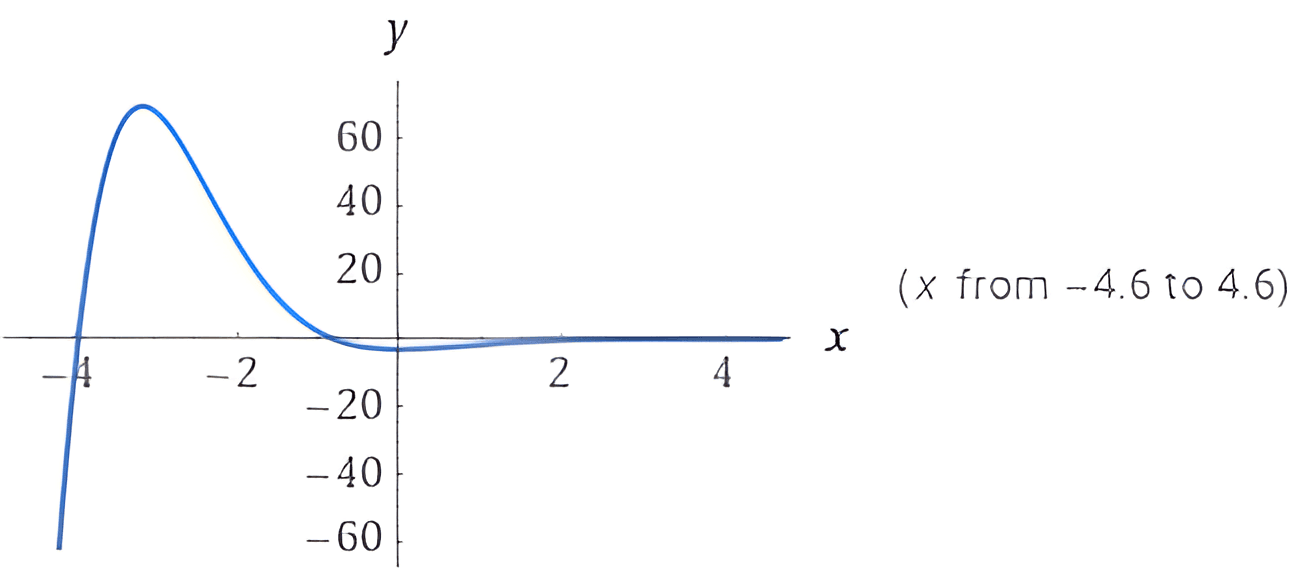
Generated Graph
Solution by Steps
step 1
To find the axial intercepts, we set f(x)=cos(x)⋅3e−x equal to zero and solve for x
step 2
The function f(x) is zero when cos(x)=0 within the interval 0≤x≤π
step 3
The x-intercept occurs at x=2π, since cos(2π)=0. There is no y-intercept because the function is not defined at x=0
step 4
To find the turning points, we differentiate f(x) and set the derivative equal to zero
step 5
The derivative of f(x) is f′(x)=−3e−x(sin(x)+cos(x))
step 6
We set f′(x)=0 and solve for x to find the turning points
step 7
To sketch the graph, we plot the intercepts, turning points, and endpoints at x=0 and x=π
step 8
The greatest distance before changing direction is the maximum value of f(x) on the interval 0≤x≤π
step 9
The maximum value occurs at a turning point where the derivative is zero. From the asksia-ll calculator, this is at x=π with f(x)=3e−π
step 10
The average rate of change from x=0 to x=43π is given by the change in f(x) over the change in x
step 11
Using the asksia-ll calculator result, the average rate of change is 3π4(−3−23e−43π)
step 12
The instantaneous velocity at x=2π is the value of the derivative at that point, which is −3e−2π
step 13
The maximum instantaneous rate of change is the maximum value of the derivative, which is 3e−π at x=π
[question 1a] Answer
The axial intercept is at x=2π.
[question 1b] Answer
The turning points are found by setting the derivative f′(x)=−3e−x(sin(x)+cos(x)) equal to zero and solving for x.
[question 1c] Answer
The graph of f(x) is a damped cosine wave with an intercept at x=2π, turning points, and endpoints at x=0 and x=π.
[question 1d] Answer
The greatest distance is 3e−π cm, occurring at x=π seconds.
[question 1e] Answer
The average rate of change is approximately 3π4(−3−23e−43π).
[question 1f] Answer
The instantaneous velocity at x=2π is −3e−2π.
[question 1g] Answer
The maximum instantaneous rate of change is 3e−π at x=π.
Key Concept
Combining functions such as exponential, power, and trigonometric functions can create complex graphs with interesting properties.
Explanation
The function f(x)=cos(x)⋅3e−x combines a trigonometric function with an exponential decay, resulting in a damped oscillation that models the motion of a pendulum. Calculus is used to find intercepts, turning points, and rates of change.
© 2023 AskSia.AI all rights reserved