
AskSia
Plus

81. The rational functions f and g are defined by $f(x)=\frac{30 x}{x^{2}+1...
May 11, 2024



Generated Graph
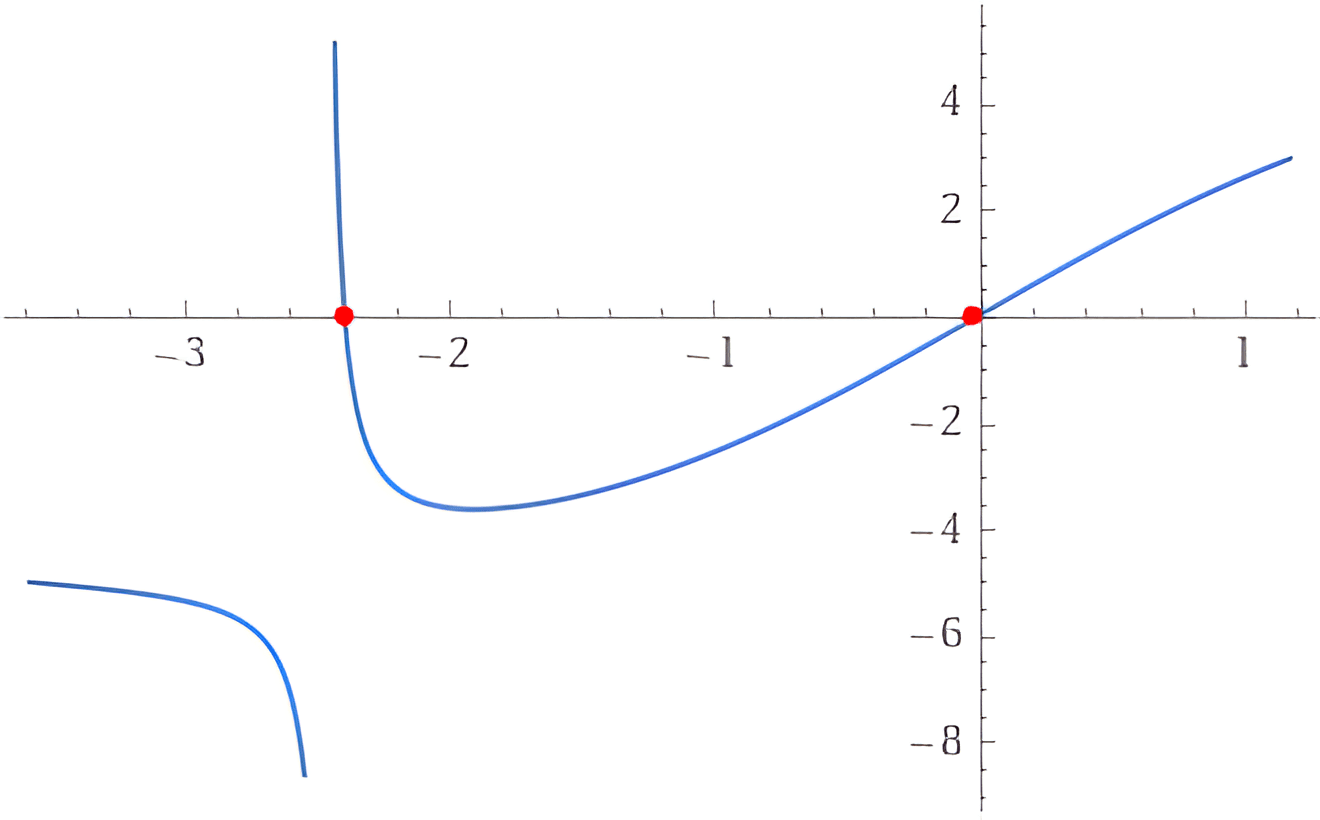
Solution by Steps
step 1
To find the real zeros of h(x), we need to solve the equation h(x)=f(x)−g(x)=0
step 2
Given f(x)=x2+1030x and g(x)=x3+152x−1, we set up the equation x2+1030x−x3+152x−1=0
step 3
To solve the equation, we can use the Asksia-LL calculator result which provides the approximate real solutions: x≈−2.3947 and x≈−0.023257
Answer
The real zeros of h are approximately x≈−2.3947 and x≈−0.023257.
Key Concept
Finding Real Zeros of a Function
Explanation
The real zeros of the function h(x) are the values of x for which h(x)=0. These are found by setting the function equal to zero and solving for x.

Generated Graph
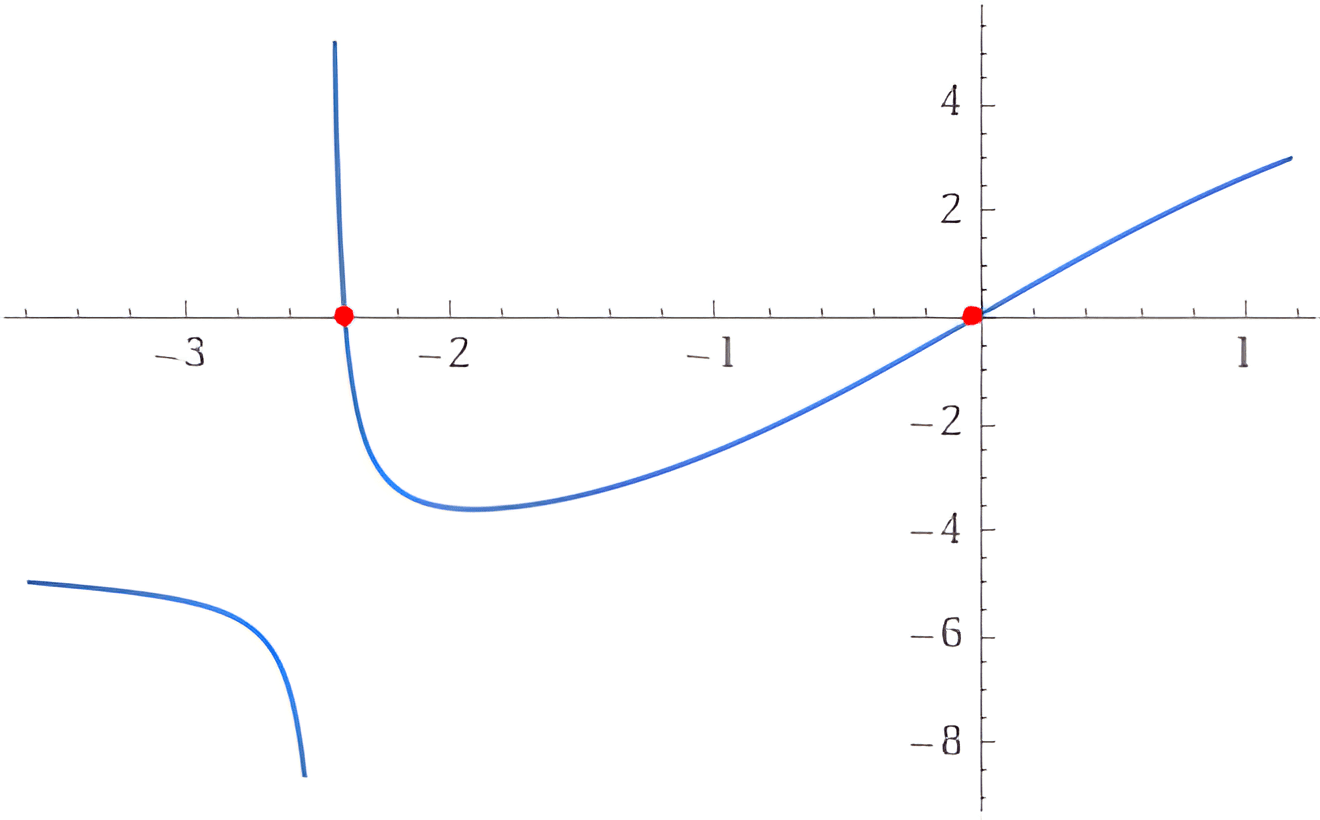
Solution by Steps
step 1
To find the real zeros of h(x), we need to solve the equation h(x)=f(x)−g(x)=0
step 2
Given f(x)=x2+1030x and g(x)=x3+152x−1, we set up the equation x2+1030x−x3+152x−1=0
step 3
To solve the equation, we can use the Asksia-LL calculator result which provides the approximate solutions: x≈−2.3947 and x≈−0.023257
[question number] Answer
The real zeros of h are approximately x≈−2.3947 and x≈−0.023257.
Key Concept
Finding Real Zeros of a Function
Explanation
The real zeros of a function are the x-values for which the function equals zero. These can be found by setting the function equal to zero and solving for x.

Solution by Steps
step 2
For a function to be decreasing, as x increases, f(x) must decrease. This means that for any two values a and b where a < b, it must be true that f(a) > f(b)
step 3
For a function to be concave up, the rate of decrease of f(x) must be slowing down as x increases. This means the difference between successive f(x) values should be getting smaller
step 4
Evaluate each table to see if it meets the criteria. Table (A) shows f(x) decreasing as x increases, and the differences between successive f(x) values are 1, 2, and 2, which are not getting smaller
step 5
Table (B) shows f(x) decreasing as x increases, and the differences between successive f(x) values are 1.7, 2.7, and 3.7, which are getting larger, not smaller
step 6
Table (C) shows f(x) increasing as x increases, which does not meet the criteria for a decreasing function
step 7
Table (D) shows f(x) decreasing as x increases, and the differences between successive f(x) values are 2.47, 1.07, and 0.45, which are getting smaller. This table meets both criteria for f
D
Key Concept
Decreasing Function and Concavity
Explanation
A decreasing function has output values that decrease as the input values increase, and a function that is concave up has a rate of decrease that slows down as the input values increase.

Solution by Steps
step 1
To find h(6), we first need to find f(6) from the table and then apply g to that value
step 2
From the table, f(6)=30.375
step 3
Now we calculate g(f(6))=g(30.375)
step 4
Substitute 30.375 into g(x): g(30.375)=(30.375+2)(30.375−5)12(30.375−2)
step 5
Simplify the expression to find the decimal approximation of h(6)
[1(i) Answer]
The value of h(6) is [insert decimal approximation here].
step 1
To find f−1(4), we look for the x value in the table such that f(x)=4
step 2
From the table, when x=1, f(x)=4
[1(ii) Answer]
The value of f−1(4) is 1.
step 1
To find the values of x for which g(x)=5, set g(x) equal to 5 and solve for x
step 2
Set up the equation (x+2)(x−5)12(x−2)=5 and solve for x
step 3
Simplify and solve the resulting quadratic equation to find the decimal approximations of x
[2(i) Answer]
The values of x for which g(x)=5 are [insert decimal approximations here].
step 1
To determine the end behavior of g as x increases without bound, we analyze the degrees of the numerator and denominator
step 2
Since the degrees are the same, the end behavior is determined by the leading coefficients
step 3
Calculate the limit limx→∞g(x)
[2(ii) Answer]
The end behavior of g as x increases without bound is [insert limit notation here].
step 1
To determine the best model for f(x), analyze the rate of change between consecutive f(x) values
step 2
If the rate of change increases at a constant rate, it suggests a quadratic model. If the rate of change increases exponentially, it suggests an exponential model
step 3
Compare the differences between consecutive output values to determine the pattern
[3(i) Answer]
The function f is best modeled by a [insert model type here] function.
step 1
To justify the model type, explain the observed pattern in the rate of change of f(x)
[3(ii) Answer]
The reason for choosing the [insert model type here] model is based on the [insert explanation of the pattern here].
Key Concept
Composition of functions and inverse functions
Explanation
To find h(x), we compose g with f. To find f−1(x), we look for the input that gives the desired output.
Key Concept
Solving equations and end behavior of rational functions
Explanation
To find where g(x)=5, we solve the equation. The end behavior is found by analyzing the leading terms as x approaches infinity.
Key Concept
Modeling functions based on rate of change
Explanation
The best model for f(x) is determined by the pattern of change in the output values as the input values increase.
© 2023 AskSia.AI all rights reserved