
AskSia
Plus

80. Marginal-Revenue Product A monopolist who employs m workers finds that th...
Nov 29, 2024



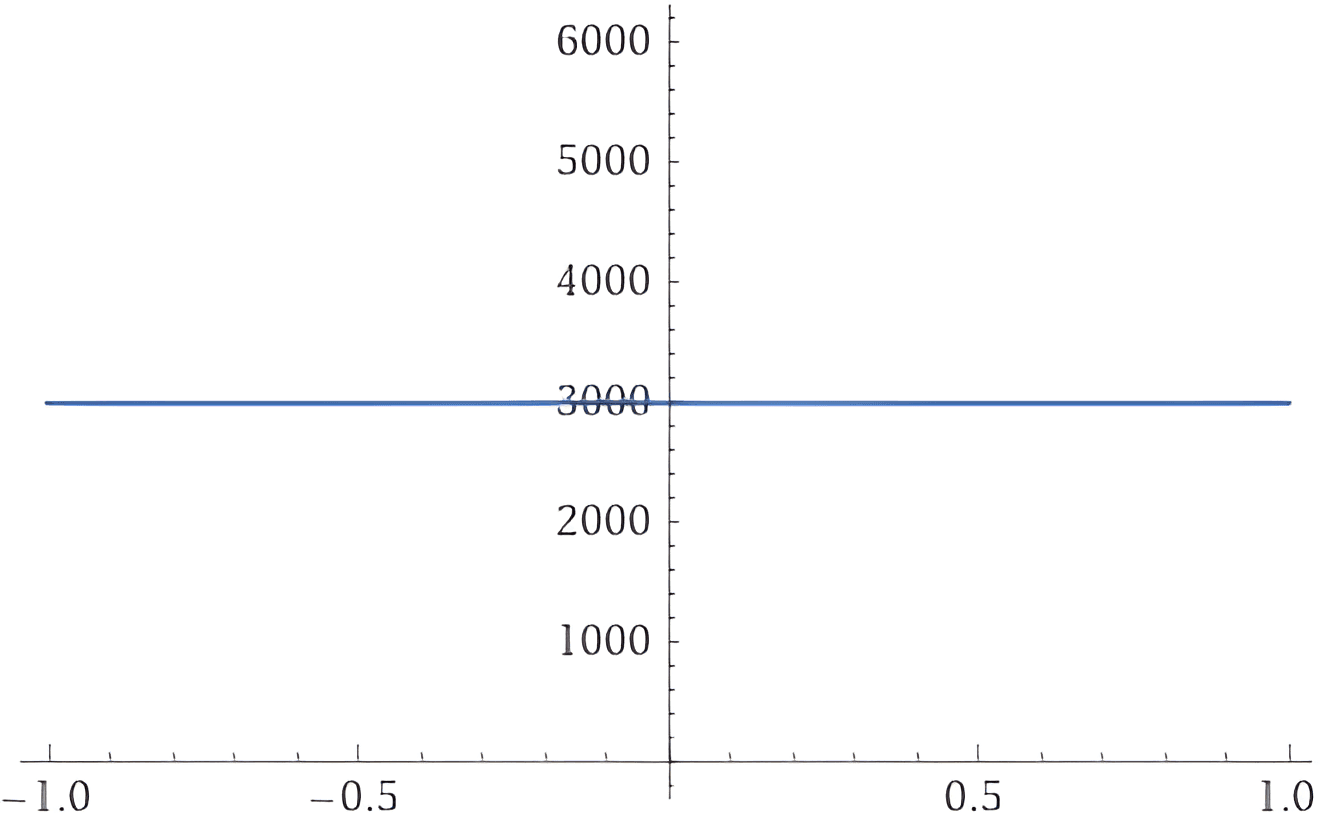
Generated Graph
Solution by Steps
step 1
To find the price per unit when m=12, we first calculate q using the equation q=2m(2m+1)3/2. Substituting m=12:
q = 2(12)(2(12) + 1)^{3/2} = 2(12)(25)^{3/2} = 3000
step 2
Next, we calculate the total revenue r using the equation r=1000+3q50q. Substituting q=3000:
r = \frac{50 \times 3000}{\sqrt{1000 + 3 \times 3000}} = 1500
step 3
The price per unit is then calculated as Price=qr. Substituting r=1500 and q=3000:
\text{Price} = \frac{1500}{3000} = 0.50 \text{ dollars}
Answer
The price per unit when there are 12 workers is $0.50
Key Concept
Price per unit is determined by dividing total revenue by the quantity produced.
Explanation
The price per unit reflects how much revenue is generated for each unit sold, which is crucial for understanding profitability.
Solution by Steps
step 1
To determine the marginal revenue when m=12, we first need to find the derivative of the revenue function r with respect to q. The revenue function is r=1000+3q50q
\frac{dr}{dq} = \frac{50 \sqrt{1000 + 3q} - \frac{50q \cdot \frac{3}{2\sqrt{1000 + 3q}}}{1}}{1000 + 3q}
step 2
We substitute q=3000 into the derivative to find the marginal revenue
\text{Marginal Revenue} = \frac{dr}{dq} \text{ at } q = 3000
Answer
The marginal revenue when there are 12 workers is calculated from the derivative of the revenue function.
Key Concept
Marginal revenue is the additional revenue generated from selling one more unit of product.
Explanation
Understanding marginal revenue helps businesses make informed decisions about production levels and pricing strategies.
Solution by Steps
step 1
To find the marginal-revenue product when m=12, we first calculate the marginal product of labor, which is the derivative of q with respect to m. The function is q=2m(2m+1)3/2
\frac{dq}{dm} = 2(2m + 1)^{3/2} + 2m \cdot \frac{3}{2}(2m + 1)^{1/2} \cdot 2 = 2(2m + 1)^{3/2} + 6m(2m + 1)^{1/2}
step 2
We substitute m=12 into the derivative to find the marginal product
\text{Marginal Product} = \frac{dq}{dm} \text{ at } m = 12
step 3
The marginal-revenue product is then calculated as Marginal Revenue Product=Marginal Product×Price
\text{Marginal Revenue Product} = \text{Marginal Product} \times 0.50
Answer
The marginal-revenue product when there are 12 workers is determined by multiplying the marginal product by the price per unit.
Key Concept
Marginal-revenue product measures the additional revenue generated by employing one more unit of labor.
Explanation
This concept is essential for understanding how labor affects production and revenue in a monopolistic market.

Solution by Steps
step 1
The total profit function for the first 600 units is given by P(q)=(40)q for q≤600. For q > 600 , the profit per unit decreases by 0.05 for each additional unit produced, so the profit function becomes P(q)=(40−0.05(q−600))q. Thus, the complete profit function is:
P(q)={(40)q(40−0.05(q−600))qamp;if q≤600amp;if qgt;600
step 2
To find the level of output that maximizes profit, we need to find the derivative P′(q) and set it to zero. For q > 600 , we differentiate P(q)=(40−0.05(q−600))q:
P′(q)=40−0.05(q−600)−0.05q=40−0.05q+30=70−0.05q
Setting P′(q)=0:
70−0.05q=0⟹q=1400
step 3
To verify that this is a maximum, we calculate the second derivative P′′(q):
P′′(q)=−0.05
Since P''(q) < 0 , this confirms that q=1400 is a maximum
step 4
To find the maximum profit, we substitute q=1400 back into the profit function:
P(1400)=(40−0.05(1400−600))(1400)=(40−0.05(800))(1400)=(40−40)(1400)=0
Thus, the maximum profit is 0
Answer
The maximum profit is $0.
Key Concept
Understanding profit functions and their maximization through derivatives.
Explanation
The profit function was derived based on production levels, and the maximum profit was found by analyzing the first and second derivatives. The maximum profit occurs at a production level where the profit per unit decreases to zero.

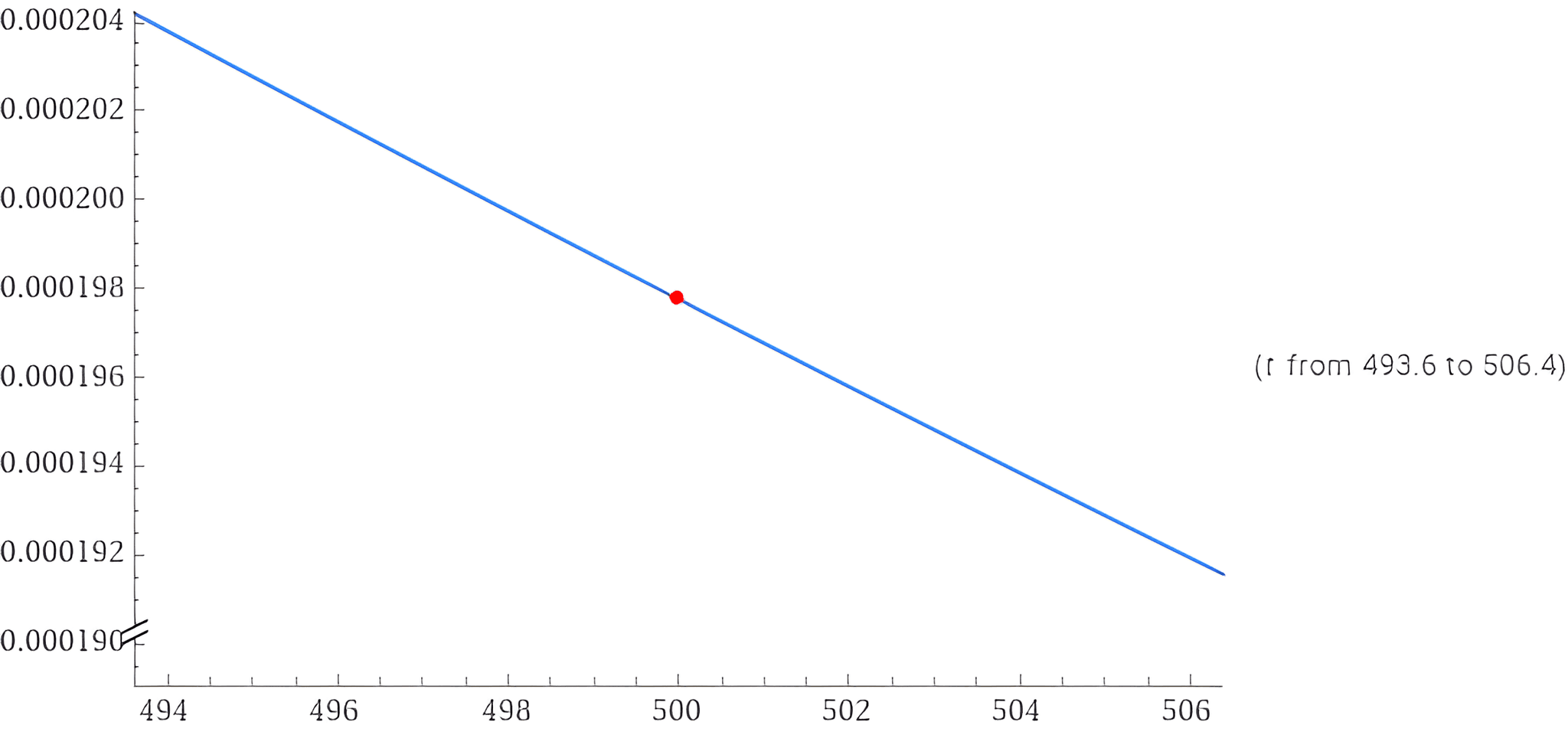
Generated Graph
Solution by Steps
step 2
Substituting t=500 gives us f(500)=(300+500)481×106=800481×106
step 3
Calculating 8004=409600000000, we find f(500)=40960000000081×106=40960081
step 4
Evaluating 40960081 gives approximately 0.000197, which is equivalent to 0.0197 when expressed as a proportion
step 5
Therefore, the proportion discharged after 500 days is 0.0197 or approximately 2.0%
C
Key Concept
Proportion Calculation
Explanation
This problem involves evaluating a function that models the discharge rate from a hospital, requiring substitution and simplification to find the proportion discharged after a specified time.
© 2023 AskSia.AI all rights reserved