
AskSia
Plus

8. 已知函数 f(x) 的定义域为 R,f(x)>f(x−1)+f(x−2), 且当 x<3 时, f(x)=x,则下列...
Aug 14, 2024



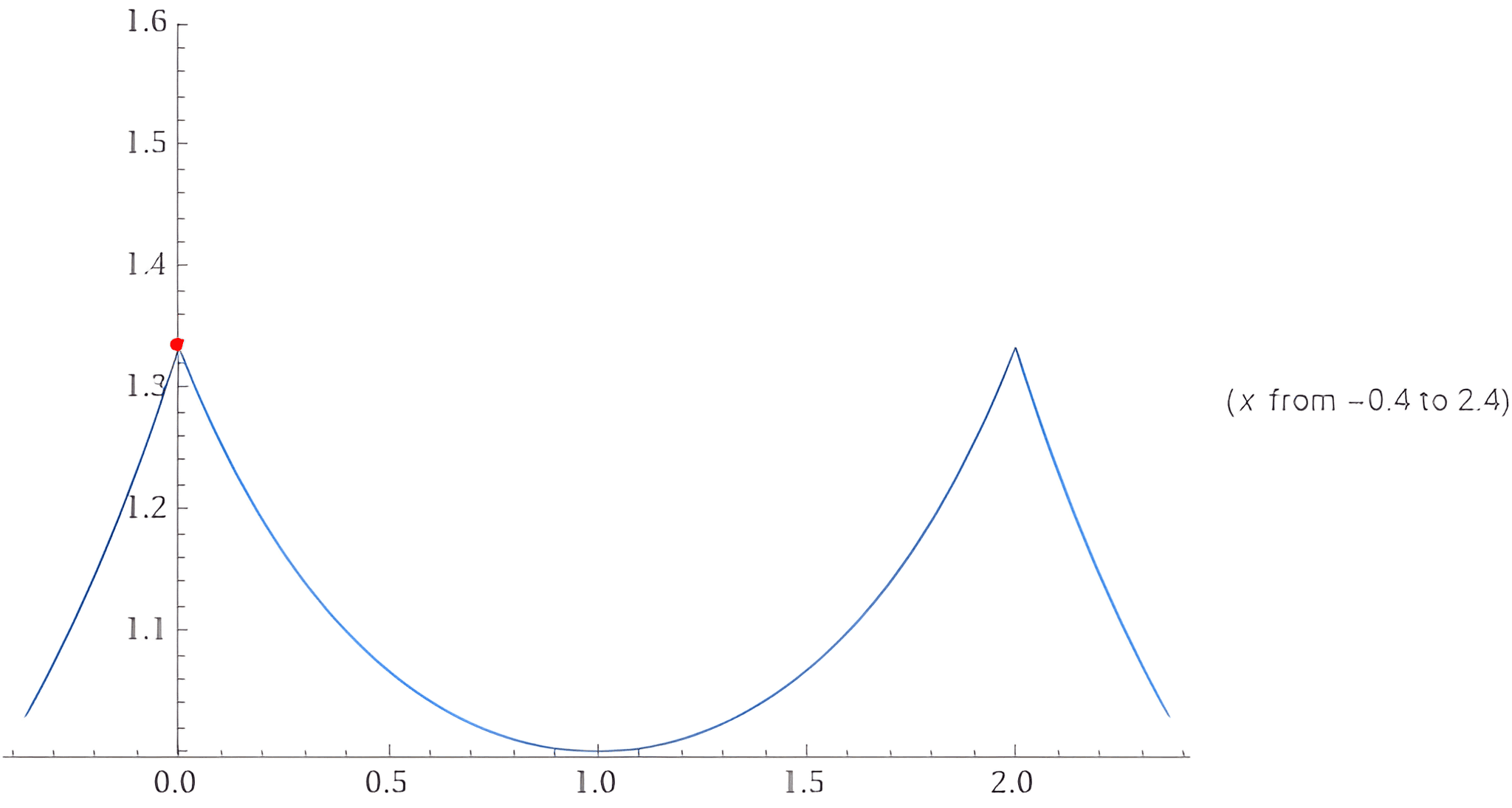
Generated Graph
Solution by Steps
step 2
For x=0,1,2, we have f(0)=0, f(1)=1, and f(2)=2. We can calculate f(3) using the inequality: f(3) > f(2) + f(1) = 2 + 1 = 3. Thus, f(3)≥4
step 3
Continuing this process, we find that f(4) > f(3) + f(2) \geq 4 + 2 = 6, so f(4)≥7
step 4
By induction, we can show that f(n) > f(n-1) + f(n-2) leads to f(n)≥2n−2 for n≥3
step 5
Therefore, for n=10, f(10)≥210−2=28=256, and for n=20, f(20)≥220−2=218=262144. Thus, f(10) < 1000 and f(20) > 1000
C
Key Concept
Inequalities and recursive functions
Explanation
The function's growth is determined by its recursive definition, leading to exponential growth beyond certain points. This allows us to evaluate the function's values at specific points.
© 2023 AskSia.AI all rights reserved