
AskSia
Plus

7. The complete graph K2n+1 has no perfect matching since it has an odd nu...
May 3, 2024

7. The complete graph K2n+1 has no perfect matching since it has an odd number of vertices. Convince yourself that the complete graph K2n has perfect matchings. How many perfect matchings are there in K2n ?

Solution by Steps
step 1
Consider the complete graph K2n which has 2n vertices. A perfect matching in a graph is a set of edges without common vertices that covers all vertices of the graph
step 2
The first vertex can be matched with any of the remaining 2n−1 vertices
step 3
After matching the first vertex, we are left with a complete graph of 2n−2 vertices
step 4
Now, we can apply this reasoning recursively. The next vertex can be matched with any of the remaining 2n−3 vertices
step 5
The number of perfect matchings is therefore (2n−1)×(2n−3)×⋯×3×1. This is the product of all odd numbers up to 2n−1 and is known as the double factorial of (2n−1)
step 6
The number of perfect matchings in K2n is given by (2n−1)!!
Answer
The number of perfect matchings in K2n is (2n−1)!!.
Key Concept
Perfect Matchings in Complete Graphs
Explanation
In a complete graph with an even number of vertices 2n, a perfect matching is a set of n edges which covers all vertices exactly once. The number of perfect matchings is given by the double factorial of (2n−1).
Prove that every tree has at most one perfect matching.
Solution by Steps
step 1
To prove that every tree has at most one perfect matching, we need to understand the structure of a tree and the definition of a perfect matching
step 2
A tree is a connected graph with no cycles, and a perfect matching is a set of edges where every vertex is incident to exactly one edge in the set
step 3
Assume for contradiction that a tree has two different perfect matchings, M1 and M2
step 4
There must be at least one edge in M1 that is not in M2. Let's call this edge e1, and it connects two vertices, say v1 and v2
step 5
Since M2 is also a perfect matching, there must be edges e2 and e3 in M2 that are incident to v1 and v2, respectively, but not in M1
step 6
Now, consider the subgraph formed by the edges e1, e2, and e3. This subgraph contains a cycle, which contradicts the definition of a tree
step 7
Therefore, our assumption is wrong, and a tree cannot have two different perfect matchings
Answer
Every tree has at most one perfect matching.
Key Concept
Perfect Matching in Trees
Explanation
A tree, being cycle-free, cannot accommodate two distinct perfect matchings without creating a cycle, which contradicts its acyclic nature.
1. A random variable X has a probability density function given by
f_{X}(x)=\frac{2 x+6}{25}, \quad-3<x<2, \quad f_{X}(x)=0 \text { elsewhere. }
Let Y=∣X∣.
(a) What is SY ?
Generated Graph
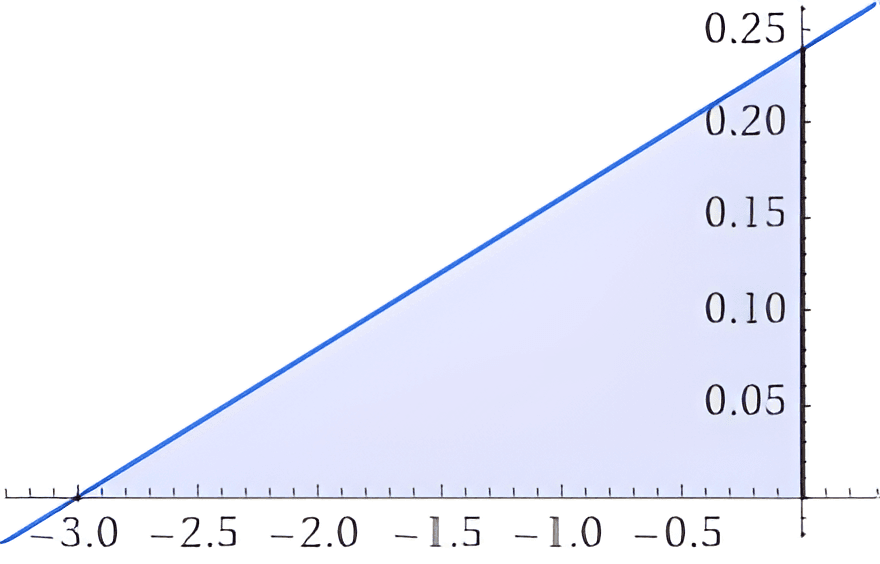
Solution by Steps
step 1
Identify the support of the random variable Y=∣X∣
step 2
Since X ranges from −3 to 2, Y will range from 0 to 3 for X negative and from 0 to 2 for X positive
step 3
Combine the ranges to find the support SY for Y
Answer
SY=[0,3]
Key Concept
Support of a Random Variable
Explanation
The support of a random variable is the set of values where the random variable has a non-zero probability density. For Y=∣X∣, the support is all non-negative values that X can take, which are from 0 to 3.
1. A random variable X has a probability density function given by
f_{X}(x)=\frac{2 x+6}{25}, \quad-3<x<2, \quad f_{X}(x)=0 \text { elsewhere. }
Let Y=∣X∣.
(c) Derive the cumulative distribution function of Y.
Solution by Steps
step 1
To find the cumulative distribution function (CDF) of Y, we first need to understand that Y=∣X∣ implies Y takes values from 0 to 3 since the support of X is from −3 to 2
step 2
For y < 0, the CDF FY(y)=P(Y≤y)=0 since Y cannot take negative values
step 3
For 0 \leq y < 2, FY(y)=P(Y≤y)=P(−y≤X≤y) because Y=∣X∣ and X can take values between −y and y
step 4
To calculate P(−y≤X≤y) for 0 \leq y < 2, we integrate the PDF of X from −y to y. This is the sum of the integrals from −3 to −y and from −y to y since the PDF is symmetric around 0
step 5
Using the result from asksia-ll calculator, the integral from −3 to y is 1/25(y+3)2. Since the PDF is symmetric and Y is non-negative, we need to double the integral from 0 to y
step 6
Therefore, for 0 \leq y < 2, FY(y)=2×[251(y+3)2−251(0+3)2]
step 7
For y≥2, FY(y)=1 because the entire probability mass has been accumulated
step 8
Simplifying the expression from step 6, we get FY(y)=252y2+2512y for 0 \leq y < 2
Answer
The cumulative distribution function of Y is given by:
FY(y)=⎩⎨⎧0252y2+2512y1amp;for yamp;for 0≤yamp;for y≥2.lt;0,lt;2,
Key Concept
Cumulative Distribution Function (CDF) of a Random Variable
Explanation
The CDF of a random variable Y is found by integrating its probability density function (PDF) over its domain. For Y=∣X∣, we consider the symmetry of X's PDF and the non-negativity of Y.
1. A random variable X has a probability density function given by
f_{X}(x)=\frac{2 x+6}{25}, \quad-3<x<2, \quad f_{X}(x)=0 \text { elsewhere. }
Let Y=∣X∣.
(a) What is SY ?
Generated Graph
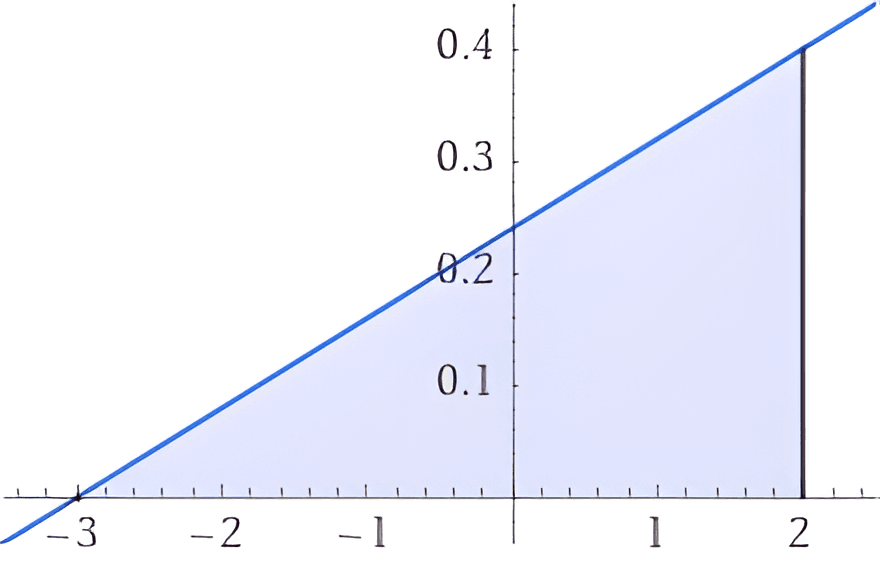
Solution by Steps
step 1
To find the support SY of the random variable Y=∣X∣, we consider the range of values that X can take
step 2
Since X is defined on the interval -3 < x < 2, the absolute value ∣X∣ will be defined on 0≤y≤3
step 3
Therefore, the support SY is the set of all possible values that Y can take, which is [0,3]
Answer
SY=[0,3]
Key Concept
Support of a Random Variable
Explanation
The support of a random variable is the set of values where the random variable has a non-zero probability density. For Y=∣X∣, the support is the non-negative range of X.
1. A random variable X has a probability density function given by
f_{X}(x)=\frac{2 x+6}{25}, \quad-3<x<2, \quad f_{X}(x)=0 \text { elsewhere. }
Let Y=∣X∣.
(d) Derive the probability density function of Y.
Generated Graph
Solution by Steps
step 1
Identify the range of X and the corresponding probability density function (pdf) for X
step 2
Recognize that Y=∣X∣ implies the pdf of Y will be symmetrical around 0
step 3
Split the range of X into two parts: -3 < x < 0 and 0 \leq x < 2
step 4
For x < 0, use the pdf of X to find the pdf of Y when Y > 0. This is because Y=∣X∣=−X for x < 0
step 5
For x≥0, use the pdf of X to find the pdf of Y when Y≥0. This is because Y=∣X∣=X for x≥0
step 6
Combine the results from step 4 and step 5 to get the full pdf of Y
step 7
The pdf of Y for y > 0 is the sum of the pdfs of X for x=y and x=−y
step 8
Calculate the pdf of Y using the formula fY(y)=fX(y)+fX(−y) for 0 < y < 3
step 9
For 0 < y < 2, fY(y)=252y+6+25−2y+6
step 10
Simplify the expression for fY(y) in the range 0 < y < 2
step 11
For 2 \leq y < 3, fY(y)=25−2y+6, since fX(y)=0 for y≥2
step 12
Simplify the expression for fY(y) in the range 2 \leq y < 3
step 13
Combine the simplified expressions for fY(y) to write the piecewise function for the pdf of Y
Answer
The probability density function of Y is given by:
fY(y)=⎩⎨⎧2512,25−2y+6,0,amp;0amp;2≤yamp;elsewherelt;ylt;3lt;2
Key Concept
Transformation of Random Variables
Explanation
When transforming a random variable, in this case using the absolute value, the pdf of the new variable is derived by considering the contributions from both sides of the original variable's pdf. The new pdf is then a piecewise function that accounts for the different behaviors in different intervals of the original variable's domain.
1. A random variable X has a probability density function given by
f_{X}(x)=\frac{2 x+6}{25}, \quad-3<x<2, \quad f_{X}(x)=0 \text { elsewhere. }
Let Y=∣X∣.
) Comment on the continuity of the cdf and the pdf of Y.
© 2023 AskSia.AI all rights reserved