
AskSia
Plus

7. Discuss the continuity of the function
\[
f(x)=\left\{\begin{array}{ll}
x^{2...
Oct 6, 2024



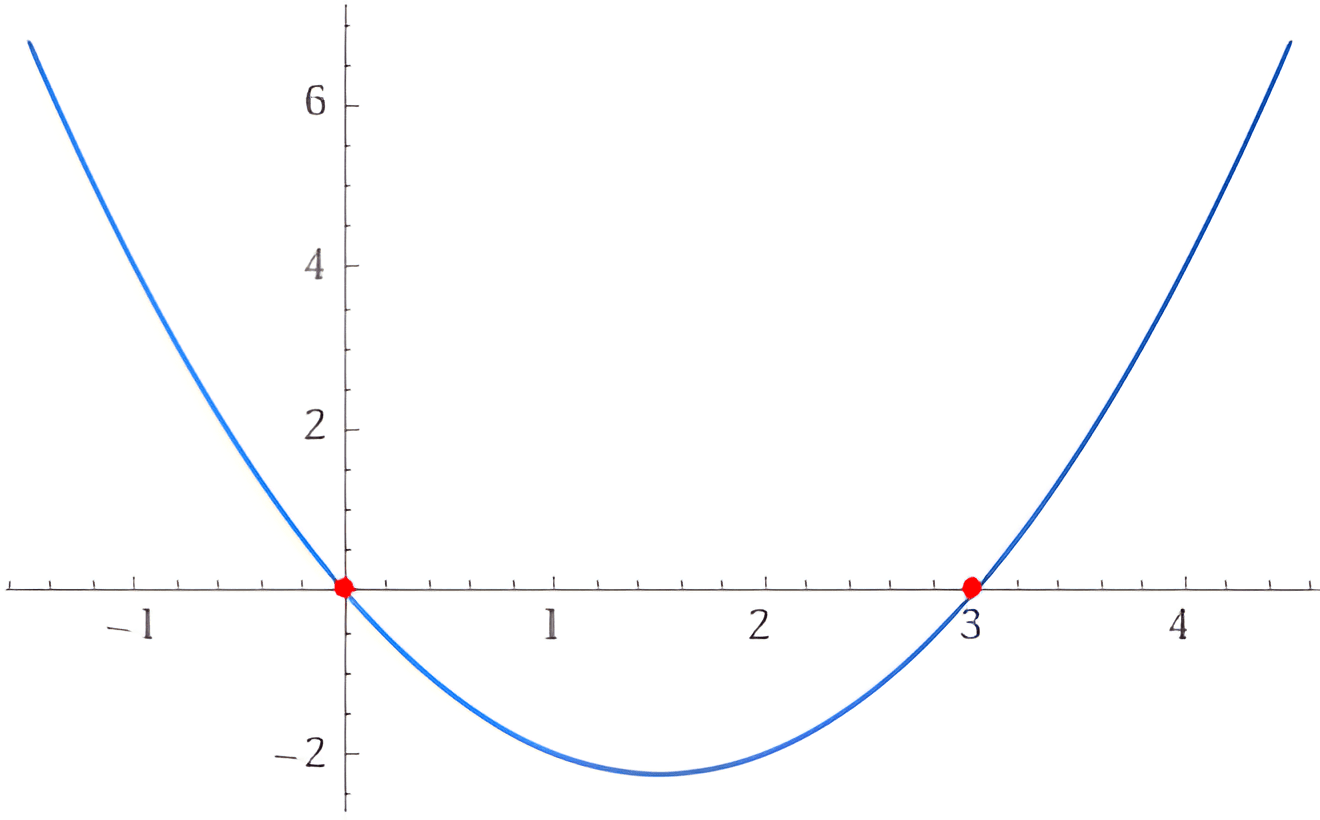
Generated Graph
Solution by Steps
step 1
To discuss the continuity of the function f(x)={x2−3x4+2xamp;if xamp;if x≥2lt;2, we first need to check the continuity on the open interval 0 < x < 2
step 2
The function f(x)=x2−3x is a polynomial for x < 2 , which is continuous everywhere in its domain. Thus, it is continuous on (0,2)
step 3
Next, we check the continuity at the point x=2 for the closed interval [0,2]. We need to evaluate f(2) using the second piece of the function: f(2)=4+2(2)=8
step 4
We also need to find the limit of f(x) as x approaches 2 from the left: limx→2−f(x)=22−3(2)=4−6=−2. Since limx→2−f(x)=f(2), the function is not continuous at x=2
step 5
Therefore, f(x) is continuous on the open interval (0,2) but not continuous on the closed interval [0,2] due to the discontinuity at x=2
Answer
The function is continuous on (0,2) but not on [0,2] due to a discontinuity at x=2.
Key Concept
Continuity of piecewise functions
Explanation
A function is continuous at a point if the limit as you approach that point equals the function's value at that point. In this case, the limit from the left does not equal the function value at x=2.

Solution by Steps
step 1
To find the derivative of f(x)=1−x4 using the definition of derivative, we use the limit definition: f′(a)=limh→0hf(a+h)−f(a)
step 2
Substituting a into the limit, we have f′(a)=limh→0h1−(a+h)4−1−a4
step 3
Simplifying the expression, we find a common denominator and evaluate the limit as h approaches 0
step 4
The derivative f′(a) is calculated to be (1−a)3/22
step 5
For f(t)=t+32t+1, we apply the same limit definition: f′(a)=limh→0hf(a+h)−f(a)
step 6
Substituting a into the limit gives f′(a)=limh→0h(a+h)+32(a+h)+1−a+32a+1
step 7
After simplifying, we find f′(a)=(a+3)25
step 8
For f(x)=1−2x, we again use the limit definition: f′(a)=limh→0hf(a+h)−f(a)
step 9
Substituting a gives f′(a)=limh→0h1−2(a+h)−1−2a
step 10
Simplifying this expression leads to f′(a)=1−2a−1
step 11
To find the equation of the tangent line to y=3x2−x3 at the point (1,2), we first find f′(1) using the definition of derivative
step 12
We calculate f′(1)=limh→0hf(1+h)−f(1)=limh→0h(3(1+h)2−(1+h)3)−2
step 13
After simplifying, we find f′(1)=3
step 14
The equation of the tangent line at the point (1,2) is given by y−2=3(x−1), which simplifies to y=3x−1
Answer
The derivatives are f′(a)=(1−a)3/22, f′(a)=(a+3)25, f′(a)=1−2a−1, and the tangent line is y=3x−1
Key Concept
The definition of the derivative provides a way to find the slope of a function at a given point.
Explanation
By applying the limit definition of the derivative, we can find the slopes of the given functions and the equation of the tangent line at a specific point.
© 2023 AskSia.AI all rights reserved