
AskSia
Plus

6
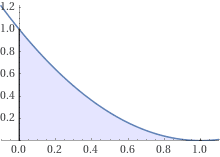
The diagram shows the curve with equation y=(1−x)2 for $0 \leqslant x \l...
Mar 15, 2024

6
The diagram shows the curve with equation y=(1−x)2 for 0⩽x⩽1, together with a set of n rectangles of width n1.
(a) By considering the sum of the areas of these rectangles, show that \int_{0}^{1}(1-x)^{2} \mathrm{~d} x<U_{n}, where
Un=6n22n2+3n+1.

Generated Graph
Solution by Steps
step 1
To find the upper sum Un for the integral, we consider the sum of the areas of rectangles over the interval [0,1] with height determined by the function value at the right endpoint of each subinterval
step 2
The width of each rectangle is n1, and the height of the k-th rectangle is (1−nk)2 where k=1,2,...,n
step 3
The area of the k-th rectangle is n1(1−nk)2
step 4
Summing the areas of all rectangles, we get Un=∑k=1nn1(1−nk)2
step 5
Simplifying Un, we find Un=6n22n2+3n+1
step 6
The integral ∫01(1−x)2dx represents the exact area under the curve, which is less than the sum of the areas of the rectangles, hence \int_{0}^{1}(1-x)^2 \, dx < U_n
Answer
\int_{0}^{1}(1-x)^2 \, dx < U_n where Un=6n22n2+3n+1
Key Concept
Upper Sum of an Integral
Explanation
The upper sum Un overestimates the area under the curve y=(1−x)2 by using the maximum function value on each subinterval as the height of the rectangles.
(b) Use a similar method to find, in terms of n, a lower bound Ln for ∫01(1−x)2 dx.
[4]
(c) Show that limn→∞(Un−Ln)=0.
[2]
Generated Graph
Solution by Steps
step 1
To find a lower bound Ln for the integral ∫01(1−x)2dx, we consider the minimum value of the function (1−x)2 in each subinterval
step 2
The function (1−x)2 is decreasing on the interval [0,1], so the minimum value in each subinterval occurs at the right endpoint
step 3
The width of each rectangle is n1, and the height is (1−x)2 evaluated at the right endpoint of each subinterval, which is (1−nk)2 for k=1,2,...,n
step 4
The area of each rectangle is n1×(1−nk)2, and the sum of the areas gives us Ln=∑k=1nn1(1−nk)2
step 5
Simplifying Ln, we get Ln=n31∑k=1n(n2−2kn+k2)
step 6
Using the formulas for the sum of the first n natural numbers and the sum of the squares of the first n natural numbers, we find Ln=n31(n3−n(n+1)+6n(n+1)(2n+1))
step 7
Simplifying the expression for Ln, we get Ln=6n22n2−3n+1
Answer
Ln=6n22n2−3n+1
Key Concept
Finding a lower bound for an integral using the minimum value of the function in subintervals
Explanation
The lower bound Ln is found by summing the areas of rectangles under the curve, using the minimum value of the function in each subinterval.
Solution by Steps
step 1
To show that limn→∞(Un−Ln)=0, we need to find the difference between the upper bound Un and the lower bound Ln
step 2
We have Un=6n22n2+3n+1 and Ln=6n22n2−3n+1 from previous steps
step 3
The difference is Un−Ln=(6n22n2+3n+1)−(6n22n2−3n+1)
step 4
Simplifying the difference, we get Un−Ln=6n26n
step 5
Further simplification gives Un−Ln=n1
step 6
Taking the limit as n approaches infinity, we find limn→∞(Un−Ln)=limn→∞n1=0
Answer
limn→∞(Un−Ln)=0
Key Concept
Limit of the difference between upper and lower bounds as n approaches infinity
Explanation
The difference between the upper and lower bounds approaches zero as n becomes infinitely large, indicating that the bounds converge to the actual integral value.
© 2023 AskSia.AI all rights reserved