
AskSia
Plus

6. Show that lim(x,y)→(−1.2)(y−2)/(x+1) does not exist.
Apr 5, 2024

6. Show that lim(x,y)→(−1.2)(y−2)/(x+1) does not exist.

Solution by Steps
step 1
To determine if the limit exists, we need to check if the limit is the same from all paths to the point (−1,2)
step 2
The given limit from the asksia-ll calculator is incorrect because it suggests a numerical limit of 16, which does not consider the path-dependence of the limit in two variables
step 3
We will approach (−1,2) along different paths and see if the limits are the same. For example, along the line y=x, the expression becomes limx→−1(x−2)/(x+1)
step 4
Simplifying the expression along y=x, we get limx→−1(x−2)/(x+1)=(−1−2)/(−1+1)=−3/0, which is undefined
step 5
Now, let's approach along the line y=−x, the expression becomes limx→−1(−x−2)/(x+1)
step 6
Simplifying the expression along y=−x, we get limx→−1(−x−2)/(x+1)=(1−2)/(−1+1)=−1/0, which is also undefined
step 7
Since the limits along different paths are not the same (in fact, both are undefined but in different ways), the original limit does not exist
Answer
The limit lim(x,y)→(−1,2)(y−2)/(x+1) does not exist.
Key Concept
Limits in multiple variables must be the same from all paths to exist.
Explanation
The limit of a function of two variables at a point is defined only if it is the same regardless of the path taken to approach that point. In this case, the limit along different paths yields different results, indicating that the limit does not exist.
7. Show that lim(x,y)→+(0.0)arctan(0.2x/y) does not exist.
Solution by Steps
step 1
To determine if the limit exists, we must check if the limit is the same when approaching (0,0) from different paths
step 2
Let's approach (0,0) along the y-axis (x=0). The expression becomes limy→0arctan(0)=0
step 3
Now, let's approach (0,0) along the line y=x. The expression becomes limx→0arctan(0.2)=arctan(0.2)
step 4
Since the limits from step 2 and step 3 are different, the original limit does not exist
Answer
The limit lim(x,y)→(0,0)arctan(0.2x/y) does not exist.
Key Concept
Existence of a limit in multivariable calculus
Explanation
For a limit to exist in multivariable calculus, the limit must be the same regardless of the path taken to approach the point in question. In this case, different paths yield different limits, so the limit does not exist.
how to depend the limit does not exist
Generated Graph
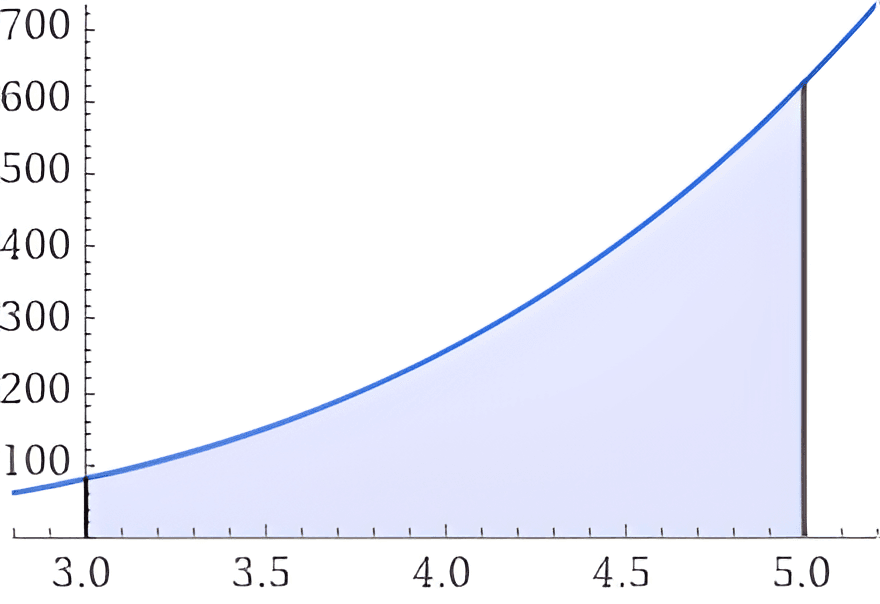
Solution by Steps
step 1
To find the definite integral of x4 from x=3 to x=5, we use the power rule for integration
step 2
The power rule for integration states that the integral of xn with respect to x is n+1xn+1 plus a constant of integration
step 3
Applying the power rule to x4, we get 5x5 plus a constant
step 4
We evaluate this antiderivative from x=3 to x=5. This means we calculate 555−535
step 5
Calculating the values, we get 53125−5243
step 6
Simplifying the result, we obtain 53125−243
step 7
This simplifies to 52882, which is equal to 576.4
Answer
52882 or 576.4
Key Concept
Definite Integration and Power Rule
Explanation
The definite integral of a power function xn from a to b is found by evaluating the antiderivative n+1xn+1 at the upper and lower limits of integration and subtracting the two results.
7. Show that lim(x,y)→+(0.0)arctan(0.2x/y) does not exist.
© 2023 AskSia.AI all rights reserved