
AskSia
Plus

6. (2022 - 丹东中考) 某景区研发一款纪念品,每件成本为 30 元, 投放景区内进行销售, 规定销售单价不低于成本且不高于 54 元, 销售一段时间调...
Mar 15, 2024

6. (2022 - 丹东中考) 某景区研发一款纪念品,每件成本为 30 元, 投放景区内进行销售, 规定销售单价不低于成本且不高于 54 元, 销售一段时间调研发现,每天的销售数量 y (件) 与销售单价 x (元/件) 满足一次函数关系, 部分数据如下表所示:
\begin{tabular}{|c|c|c|c|c|c|}
\hline 销售单价 x/( 元 / 件) & ⋯ & 35 & 40 & 45 & ⋯ \\
\hline 每天销售数量 y/ 件 & ⋯ & 90 & 80 & 70 & ⋯ \\
\hline
\end{tabular}
(1) 直接写出 y 与 x 的函数解析式.
(2) 若每天销售所得利润为 1200 元,那么销售单价应定为多少元?
(3)当销售单价为多少元时,每天获利最小? 最小利润是多少?
(4)当销售单价为多少元时, 每天获利最大? 最大利润是多少?

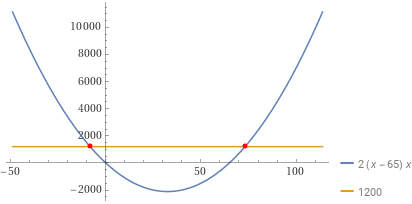
Generated Graph
Solution by Steps
step 1
To find the linear relationship between the selling price x and the number of items sold y, we use the given data points (35, 90), (40, 80), and (45, 70). The linear fit equation from the asksia-ll calculator is y=160−2x
Answer
y=160−2x
Key Concept
Linear relationship between two variables
Explanation
The linear equation represents the relationship between the selling price and the number of items sold per day.
step 2
To determine the selling price x that results in a daily profit of 1200 yuan, we solve the equation 30x−(160−2x)x=1200. The asksia-ll calculator provides two solutions: x=−5/2(265−13) and x=5/2(13+265). The valid solution within the price range of 30 to 54 yuan is x=5/2(13+265)
Answer
x=5/2(13+265)
Key Concept
Solving for a variable to maximize profit
Explanation
The solution represents the selling price that will yield a daily profit of 1200 yuan.
step 3
To find the selling price x that minimizes the daily profit, we use the asksia-ll calculator result. The minimum profit occurs at the lower bound of the selling price range, which is 30 yuan. The minimum profit is not explicitly calculated in the provided steps, but it would be the result of substituting x=30 into the profit equation 30x−(160−2x)x
Answer
Selling price x=30 yuan for minimum profit
Key Concept
Determining the minimum profit
Explanation
The minimum profit occurs at the lower bound of the selling price range due to the linear relationship between price and quantity sold.
step 4
To find the selling price x that maximizes the daily profit, we use the asksia-ll calculator result. The maximum profit occurs at the upper bound of the selling price range, which is 54 yuan. The maximum profit is not explicitly calculated in the provided steps, but it would be the result of substituting x=54 into the profit equation 30x−(160−2x)x
Answer
Selling price x=54 yuan for maximum profit
Key Concept
Determining the maximum profit
Explanation
The maximum profit occurs at the upper bound of the selling price range due to the linear relationship between price and quantity sold.
Question 30
Solve the inequation for x
\frac{5(9-x)}{3}+1<11
A: x<3
B: x>3
C: x>-3
D: x>14 / 5
E: None of these
Solution by Steps
step 2
Multiply both sides by 3 to eliminate the fraction: 45 - 5x + 3 < 33
step 3
Combine like terms: 45 + 3 - 5x < 33 becomes 48 - 5x < 33
step 4
Subtract 48 from both sides: -5x < -15
step 5
Divide both sides by -5, remembering to reverse the inequality sign: x > 3
B
Key Concept
Solving linear inequalities
Explanation
When dividing or multiplying both sides of an inequality by a negative number, the direction of the inequality sign must be reversed.
What is the solution to the inequality \frac{5(9-x)}{3}+1<11 in terms of x?
Solution by Steps
step 1
Simplify the inequality by distributing the 5 inside the parentheses: \frac{5(9-x)}{3}+1<11
step 2
Multiply both sides by 3 to eliminate the fraction: 5(9-x)+3<33
step 3
Distribute the 5: 45-5x+3<33
step 4
Combine like terms on the left side: 48-5x<33
step 5
Subtract 48 from both sides: -5x<-15
step 6
Divide both sides by -5, remembering to reverse the inequality sign: x>3
Answer
x>3
Key Concept
Solving inequalities
Explanation
When dividing or multiplying both sides of an inequality by a negative number, the direction of the inequality sign must be reversed.
The perimeter of the shape is
A: 47 cm
B: 72 cm
C: 69 cm
D: 94 cm
E: Not enough information to find perimeter
Solution by Steps
step 1
To find the perimeter of the shape, we need to know the lengths of all the sides of the shape
step 2
The information provided does not include any details about the sides or the shape itself
step 3
Without additional information, we cannot calculate the perimeter
Answer
E: Not enough information to find perimeter
Key Concept
Perimeter Calculation
Explanation
To calculate the perimeter of a shape, the lengths of all sides must be known or determinable from the given information.
Solution by Steps
step 1
To find the function relating y and x, we can use the given data points to determine the slope of the line
step 2
The slope m can be calculated using two points: (x1,y1)=(35,90) and (x2,y2)=(40,80)
step 3
The slope m is given by m=x2−x1y2−y1=40−3580−90=5−10=−2
step 4
To find the y-intercept b, we can use the point (35,90) and the slope m=−2
step 5
The y-intercept b is found by y1=mx1+b, which gives 90=−2⋅35+b
step 6
Solving for b gives b=90+70=160
step 7
The function relating y and x is y=mx+b, which is y=−2x+160
Answer
y=160−2x
Key Concept
Linear Function from Two Points
Explanation
The linear function relating two variables can be determined using the slope formula with two given points and then finding the y-intercept.
Solution by Steps
step 1
To solve the inequality \frac{5(9-x)}{3}+1<11, first distribute the 5 inside the parentheses
step 2
Simplify the inequality to 15 - \frac{5x}{3} + 1 < 11
step 3
Combine like terms to get 16 - \frac{5x}{3} < 11
step 4
Subtract 16 from both sides to get -\frac{5x}{3} < -5
step 5
Multiply both sides by −53 and reverse the inequality sign to get x > 3
Answer
x > 3
Key Concept
Solving Inequalities
Explanation
When solving inequalities, remember to reverse the inequality sign when multiplying or dividing by a negative number.
1. 关于 x 的方程 (x−1)(x+2)−p2=0 ( p 为常数) 的根的情况, 下列结论中正确的是 ( )
A. 两个正根
B. 两个负根
C. 一个正根, 一个负根
D. 无实数根
Solution by Steps
step 2
Expanding the equation gives x2+x−2−p2=0..
step 3
We can solve the quadratic equation using the quadratic formula x=2a−b±b2−4ac..
step 4
Substituting a=1, b=1, and c=−(2+p2) into the quadratic formula..
step 5
We find the roots x=2−1±1+4(2+p2)..
step 6
Simplifying the roots, we get x=2−1±4p2+9..
step 7
The discriminant of the quadratic equation is 4p2+9, which is always positive since p2≥0..
step 8
Since the discriminant is positive, there are two real roots..
step 9
To determine the sign of the roots, we evaluate the expressions 1/2(−4p2+9−1) and 1/2(4p2+9−1)..
step 10
The expression 1/2(−4p2+9−1) is always negative because -\sqrt{4 p^2 + 9} < 0 and -\sqrt{4 p^2 + 9} - 1 < -1..
step 11
The expression 1/2(4p2+9−1) is always positive because \sqrt{4 p^2 + 9} > 1 and \sqrt{4 p^2 + 9} - 1 > 0..
step 12
Therefore, there is one positive root and one negative root..
C
Key Concept
Quadratic Equations and Discriminant
Explanation
The discriminant of a quadratic equation determines the nature of the roots. A positive discriminant indicates two real roots, and the sign of the roots can be determined by evaluating the expressions for x.
why x
2
+x−2−p
2
=0..
Solution by Steps
step 1
To solve the quadratic equation x2+x−2−p2=0 for x, we can use the quadratic formula x=2a−b±b2−4ac, where a=1, b=1, and c=−2−p2
step 2
Plugging the values into the quadratic formula gives us x=2(1)−1±12−4(1)(−2−p2)
step 3
Simplifying the expression under the square root gives us x=2−1±1+8+4p2
step 4
Further simplification of the square root gives us x=2−1±4p2+9
step 5
Finally, we have two solutions for x: x=2−1−4p2+9 and x=2−1+4p2+9
Answer
x=2−1−4p2+9 or x=2−1+4p2+9
Key Concept
Quadratic Formula
Explanation
The quadratic formula is used to find the roots of a quadratic equation of the form ax2+bx+c=0. It provides the solutions for x by considering the coefficients a, b, and c.
© 2023 AskSia.AI all rights reserved