
AskSia
Plus

4.
(a) Given that y=sinhx, use the definition of sinhx in terms of $\ma...
Apr 25, 2024

4.
(a) Given that y=sinhx, use the definition of sinhx in terms of ex and e−x to show that x=ln(y+y2+1).
[4 marks]
(b) A curve has equation y=6cosh2x+5sinhx.
(i) Show that the curve has a single stationary point and find its x-coordinate, giving your answer in the form lnp, where p is a rational number.
[5 marks]
(ii) The curve lies entirely above the x-axis. The region bounded by the curve, the coordinate axes and the line x=cosh−12 has area A.
Show that
A=acosh−12+b3+c
where a,b and c are integers.
[5 marks]

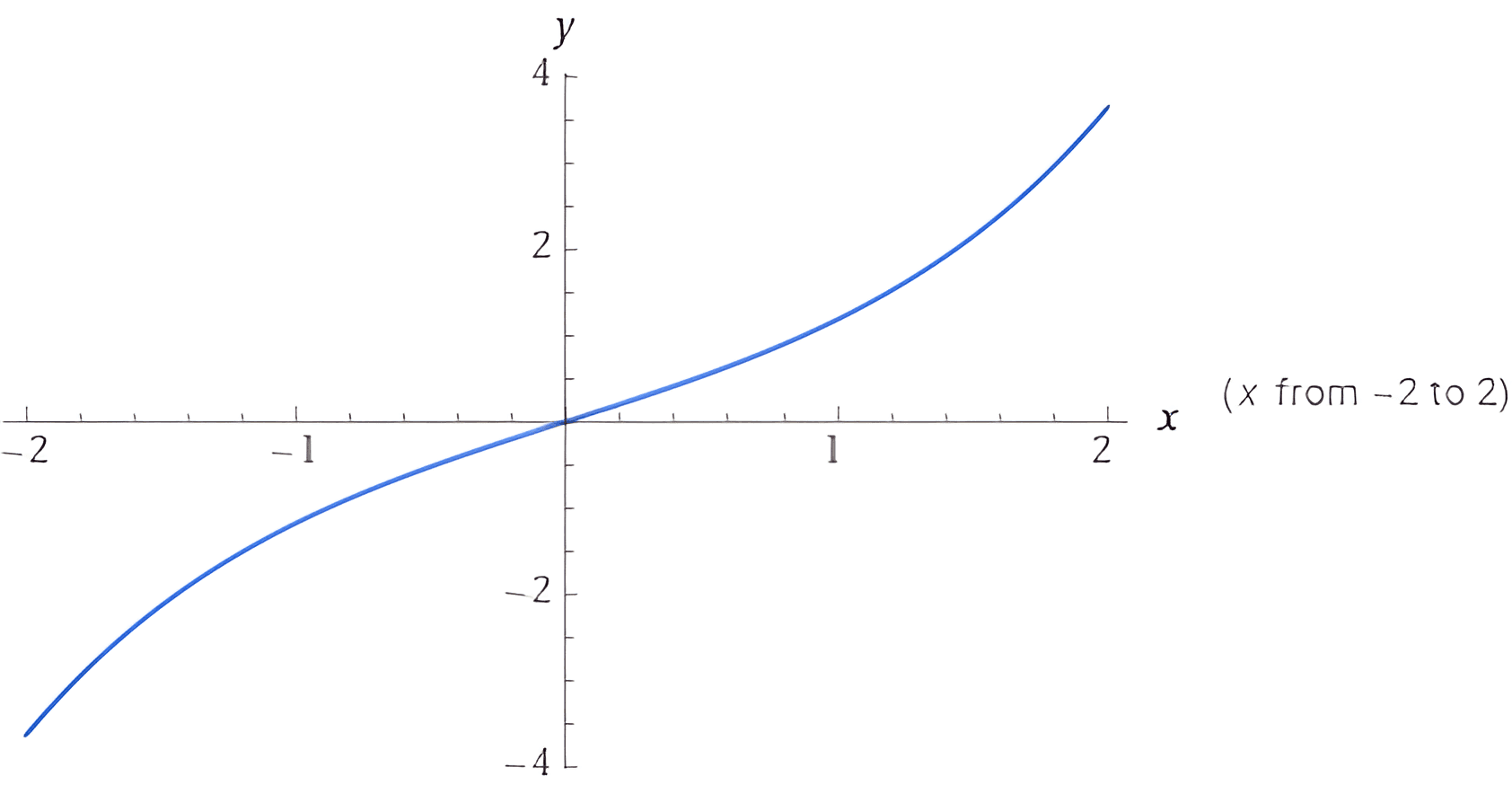
Generated Graph
Solution by Steps
step 1
To show that x=ln(y+y2+1), start with the definition of sinhx in terms of exponential functions: sinhx=2ex−e−x
step 2
Given y=sinhx, we can express x in terms of y: y=2ex−e−x
step 3
Multiply both sides by 2 and rearrange: 2y=ex−e−x
step 4
Add e−x to both sides and then square both sides: (2y+e−x)2=e2x
step 5
Expand the left side and use the identity e−x=ex1: 4y2+4ye−x+e−2x=e2x
step 6
Recognize that e2x−e−2x=4y2 and add e−2x to both sides: e2x+e−2x=4y2+e−2x+1
step 7
Simplify to get e2x+1=4y2+1 and then take the square root of both sides: ex=y2+1
step 8
Finally, take the natural logarithm of both sides to solve for x: x=ln(y2+1+y)
Answer
x=ln(y+y2+1)
Key Concept
Expressing hyperbolic functions in terms of exponential functions and solving for x.
Explanation
The key to solving for x is to manipulate the equation using algebraic identities and properties of exponential functions, ultimately taking the natural logarithm to isolate x.
Solution by Steps
step 1
To find the stationary point, differentiate the curve y=6cosh2x+5sinhx
step 2
The derivative is dxdy=12sinhxcoshx+5coshx
step 3
Set the derivative equal to zero to find the stationary point: 0=12sinhxcoshx+5coshx
step 4
Factor out coshx: 0=coshx(12sinhx+5)
step 5
Since coshx is never zero, solve 12sinhx+5=0 for x
step 6
Rearrange to get sinhx=−125 and use the definition of sinh−1 to solve for x
step 7
The solution is x=sinh−1(−125), which can be expressed in terms of natural logarithms
step 8
Using the identity sinh−1y=ln(y+y2+1), substitute y=−125 to find x
step 9
Thus, x=ln(−125+(−125)2+1)
Answer
x=ln(−125+(−125)2+1)
Key Concept
Finding the stationary point of a curve by setting its derivative equal to zero.
Explanation
The stationary point occurs where the derivative of the curve is zero. By factoring and solving the resulting equation, we find the x-coordinate of the stationary point.
Solution by Steps
step 1
To find the area A under the curve y=6cosh2x+5sinhx from x=0 to x=cosh−12, integrate the function
step 2
The integral is ∫0cosh−1(2)(6cosh2x+5sinhx)dx
step 3
Use the identity cosh2x=21(cosh(2x)+1) to simplify the integral
step 4
The integral becomes ∫0cosh−1(2)(3(cosh(2x)+1)+5sinhx)dx
step 5
Integrate term by term to find A=3x+23sinh(2x)+5cosh(x) evaluated from 0 to cosh−1(2)
step 6
Substitute the limits of integration to find the exact area: A=3cosh−1(2)+23sinh(2cosh−1(2))+5cosh(cosh−1(2))−(3⋅0+23sinh(0)+5cosh(0))
step 7
Simplify using the identities sinh(2cosh−1(2))=23 and cosh(cosh−1(2))=2
step 8
The final expression for the area is A=3cosh−1(2)+33+10−5
Answer
A=3cosh−1(2)+33+5
Key Concept
Calculating the area under a curve using definite integration.
Explanation
The area under the curve from x=0 to x=cosh−1(2) is found by integrating the function and evaluating it at the given limits. The result is expressed in terms of cosh−1(2) and 3.
© 2023 AskSia.AI all rights reserved