
AskSia
Plus

3 The extension, y, of a material with an applied force, F, is given by $y=e...
Feb 2, 2024

3 The extension, y, of a material with an applied force, F, is given by y=eF×1×10⁻³.
a) Calculate the work done if the force increases from 100 N to 500 N using:
i) An analytical integration technique
ii) A num erical integration technique
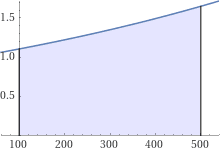
[Note: the work done is given by the area under the curve]
b) Compare the two answers
c) Using a computer spreadsheet increase the number of values used for your num erical method
d) Analyse any affect the size of num erical step has on the result.

Generated Graph
Solution by Steps
step 1
To find the work done analytically, we integrate the function y=eF×1×10⁻³ with respect to F from 100 to 500
step 2
The indefinite integral of eF×1×10⁻³ with respect to F is 1000eF/1000+C, where C is the constant of integration
step 3
Evaluating the definite integral from 100 to 500, we get ∫100500eF×1×10−3dF=1000(e2/5−1)e1/10
step 4
The numerical value of the definite integral is approximately 543.55
Answer
The work done using an analytical integration technique is approximately 543.55 J.
Key Concept
Analytical integration of an exponential function
Explanation
The work done is calculated by integrating the force-extension function over the given range of force. The analytical method provides an exact solution.
Solution by Steps
step 1
To find the work done numerically, we use numerical integration techniques such as the left sum method
step 2
The left sum approximation is given by \( \frac{400 (e^{2/5} - 1) e^{1/10}}{((e^{2/(5 n)) - 1) n)} \), where \( n \) is the number of subintervals
step 3
As n increases, the numerical approximation becomes more accurate, approaching the value of the analytical integral
step 4
The numerical value of the definite integral using the left sum method is also approximately 543.55, assuming a large enough n
Answer
The work done using a numerical integration technique is approximately 543.55 J, similar to the analytical method.
Key Concept
Numerical integration approximation
Explanation
Numerical methods approximate the integral by summing the values of the function at discrete points. The accuracy depends on the number of subintervals used.
Solution by Steps
step 1
To compare the two answers, we look at the numerical values obtained from both the analytical and numerical integration techniques
step 2
Both methods yielded a value of approximately 543.55 J for the work done
Answer
The work done calculated by both analytical and numerical integration techniques is approximately the same, 543.55 J.
Key Concept
Comparison of integration methods
Explanation
When the numerical method is performed with a sufficient number of subintervals, it can provide an approximation very close to the exact analytical result.
Solution by Steps
step 1
To analyze the effect of the numerical step size on the result, we can vary the number of subintervals n in the numerical method
step 2
As n increases, the size of each subinterval decreases, which generally increases the accuracy of the numerical integration
step 3
Conversely, if n is too small, the numerical approximation will be less accurate due to the larger step size
Answer
The size of the numerical step has an inverse relationship with the accuracy of the result; smaller steps yield more accurate results.
Key Concept
Effect of step size on numerical integration accuracy
Explanation
The accuracy of numerical integration is affected by the step size; smaller steps (larger n) lead to results that are closer to the true value of the integral.
© 2023 AskSia.AI all rights reserved