
AskSia
Plus

2x−5=3x+1
Jan 29, 2024

2x−5=3x+1

Generated Graph
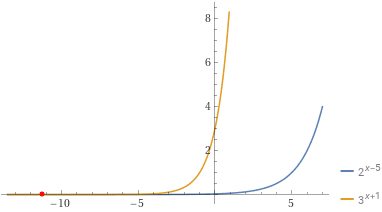
Solution by Steps
step 1
To solve the equation 2x−5=3x+1, we need to find a common base or use logarithms
step 2
Taking the logarithm of both sides of the equation, we get log(2x−5)=log(3x+1)
step 3
Applying the power rule of logarithms, we can rewrite the equation as (x−5)log(2)=(x+1)log(3)
step 4
Expanding both sides gives xlog(2)−5log(2)=xlog(3)+log(3)
step 5
Rearranging the terms to isolate x, we get xlog(2)−xlog(3)=5log(2)+log(3)
step 6
Factoring out x from the left side, we have x(log(2)−log(3))=5log(2)+log(3)
step 7
Dividing both sides by (log(2)−log(3)), we find x=log(2)−log(3)5log(2)+log(3)
Answer
x=log(2)−log(3)5log(2)+log(3)
Key Concept
Logarithmic Equations
Explanation
To solve an equation where the variable is in the exponent, we use logarithms to bring the variable down to a solvable form. By applying the properties of logarithms, we can isolate the variable and solve for it.
© 2023 AskSia.AI all rights reserved