
AskSia
Plus

【2021 - Kibaha】 (3 marks) X is normally distributed variable, with mean 80 an...
Jun 10, 2024



Generated Graph
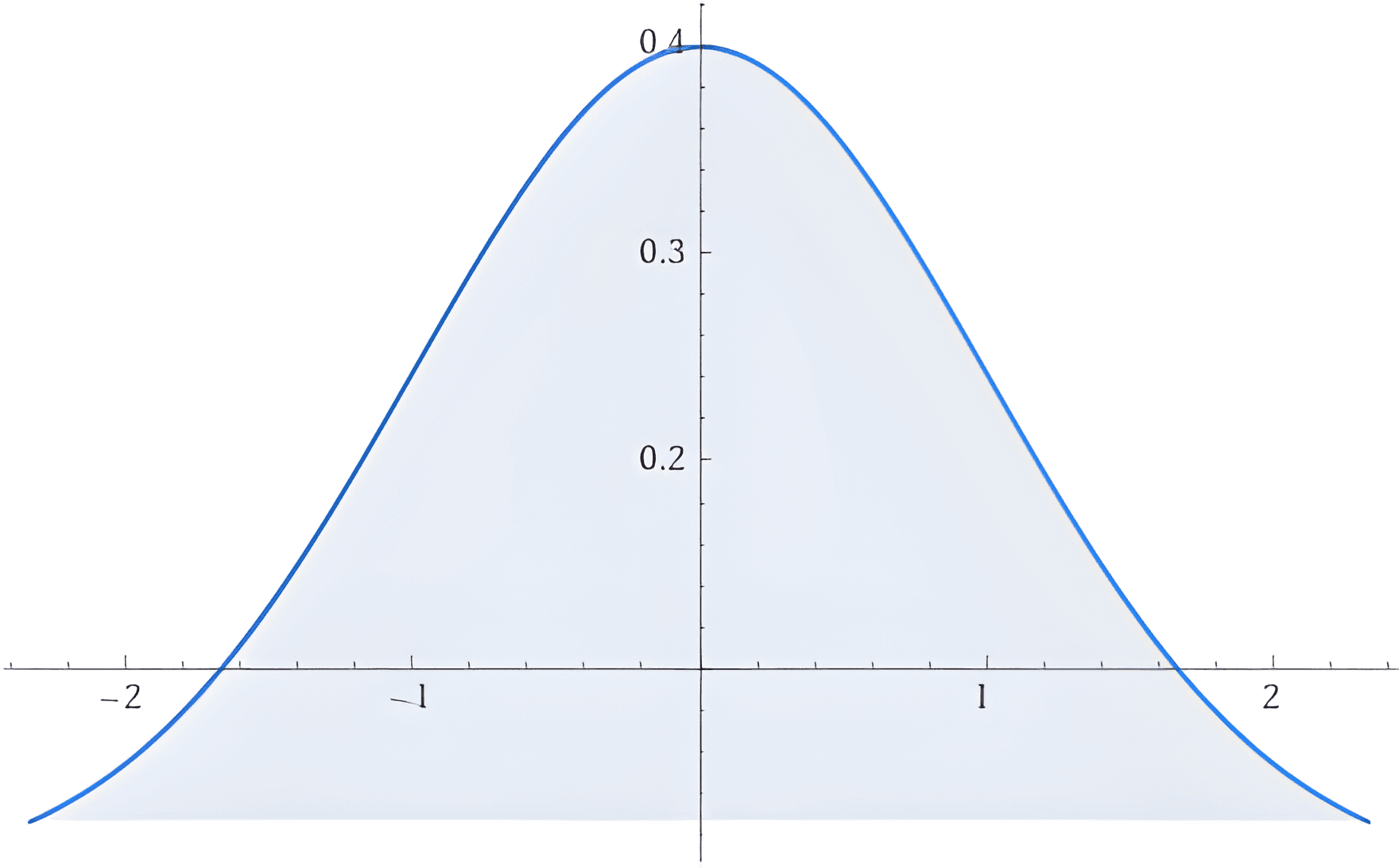
Solution by Steps
Given:
- X is normally distributed with mean 80 and variance 36.
- Z is the standard normal random variable.
- \operatorname{Pr}(Z<-2.5)=p
- \operatorname{Pr}(-2.5<Z<-1.5)=q
To find:
- \operatorname{Pr}(X>7 \mid X<95) in terms of p and q.
step 1
Convert X to the standard normal variable Z using Z=σX−μ. Here, μ=80 and σ=36=6
step 2
For X > 7: Z=67−80=6−73
step 3
For X < 95: Z=695−80=615=2.5
step 4
\operatorname{Pr}(X > 7 \mid X < 95) = \frac{\operatorname{Pr}(7 < X < 95)}{\operatorname{Pr}(X < 95)}
step 5
\operatorname{Pr}(7 < X < 95) = \operatorname{Pr}(-\frac{73}{6} < Z < 2.5) = \operatorname{Pr}(Z < 2.5) - \operatorname{Pr}(Z < -\frac{73}{6})
step 6
\operatorname{Pr}(X < 95) = \operatorname{Pr}(Z < 2.5)
step 7
\operatorname{Pr}(Z < 2.5) = 1 - \operatorname{Pr}(Z > 2.5) = 1 - \frac{1}{2} \operatorname{erfc}(\frac{5}{2 \sqrt{2}})
step 8
\operatorname{Pr}(Z < -\frac{73}{6}) \approx 0 (since 673 is very large)
step 9
\operatorname{Pr}(7 < X < 95) \approx \operatorname{Pr}(Z < 2.5)
step 10
\operatorname{Pr}(X > 7 \mid X < 95) \approx \frac{\operatorname{Pr}(Z < 2.5)}{\operatorname{Pr}(Z < 2.5)} = 1
Answer
\operatorname{Pr}(X > 7 \mid X < 95) \approx 1
Key Concept
Conditional Probability in Normal Distribution
Explanation
The probability \operatorname{Pr}(X > 7 \mid X < 95) is approximately 1 because the probability of X being less than 7 is extremely small compared to the probability of X being less than 95.
step 1
Convert X to the standard normal variable Z using Z=σX−μ. Here, μ=10 and σ=0.5
step 2
For X < 10: Z=0.510−10=0
step 3
\operatorname{Pr}(X < 10) = \operatorname{Pr}(Z < 0) = 0.5
step 1
Convert X to the standard normal variable ZX using ZX=0.5X−10. For X < 12: ZX=0.512−10=4
step 2
Convert Y to the standard normal variable ZY using ZY=σY−15. For Y > 12: ZY=σ12−15=−σ3
step 3
\operatorname{Pr}(X < 12) = \operatorname{Pr}(Z_X < 4) \approx 1
step 4
\operatorname{Pr}(Y > 12) = \operatorname{Pr}(Z_Y > -\frac{3}{\sigma}) = 1 - \operatorname{Pr}(Z_Y < -\frac{3}{\sigma})
step 5
Since \operatorname{Pr}(X < 12) = \operatorname{Pr}(Y > 12), we have 1 \approx 1 - \operatorname{Pr}(Z_Y < -\frac{3}{\sigma})
step 6
\operatorname{Pr}(Z_Y < -\frac{3}{\sigma}) \approx 0
step 7
For \operatorname{Pr}(Z_Y < -\frac{3}{\sigma}) \approx 0, σ must be very large
Answer
\operatorname{Pr}(X < 10) = 0.5 and σ must be very large
Key Concept
Standard Normal Distribution and Conditional Probability
Explanation
The probability \operatorname{Pr}(X < 10) is 0.5 because 10 is the mean of X. For \operatorname{Pr}(X < 12) = \operatorname{Pr}(Y > 12), σ must be very large to make \operatorname{Pr}(Z_Y < -\frac{3}{\sigma}) \approx 0.
step 1
Convert X to the standard normal variable Z using Z=σX−μ. Here, μ=6 and σ=4=2
step 2
For X > 6: Z=26−6=0
step 3
\operatorname{Pr}(X > 6) = \operatorname{Pr}(Z > 0) = 0.5
step 1
For X > 7: Z=27−6=0.5
step 2
\operatorname{Pr}(X > 7) = \operatorname{Pr}(Z > 0.5) = 1 - \operatorname{Pr}(Z < 0.5)
step 3
\operatorname{Pr}(Z < 0.5) \approx 0.6915
step 4
\operatorname{Pr}(X > 7) = 1 - 0.6915 = 0.3085
step 5
Therefore, b=0.5
Answer
\operatorname{Pr}(X > 6) = 0.5 and b=0.5
Key Concept
Standard Normal Distribution and Probability Calculation
Explanation
The probability \operatorname{Pr}(X > 6) is 0.5 because 6 is the mean of X. For \operatorname{Pr}(X > 7) = \operatorname{Pr}(Z < b), b is found by converting X to the standard normal variable Z.

Generated Graph
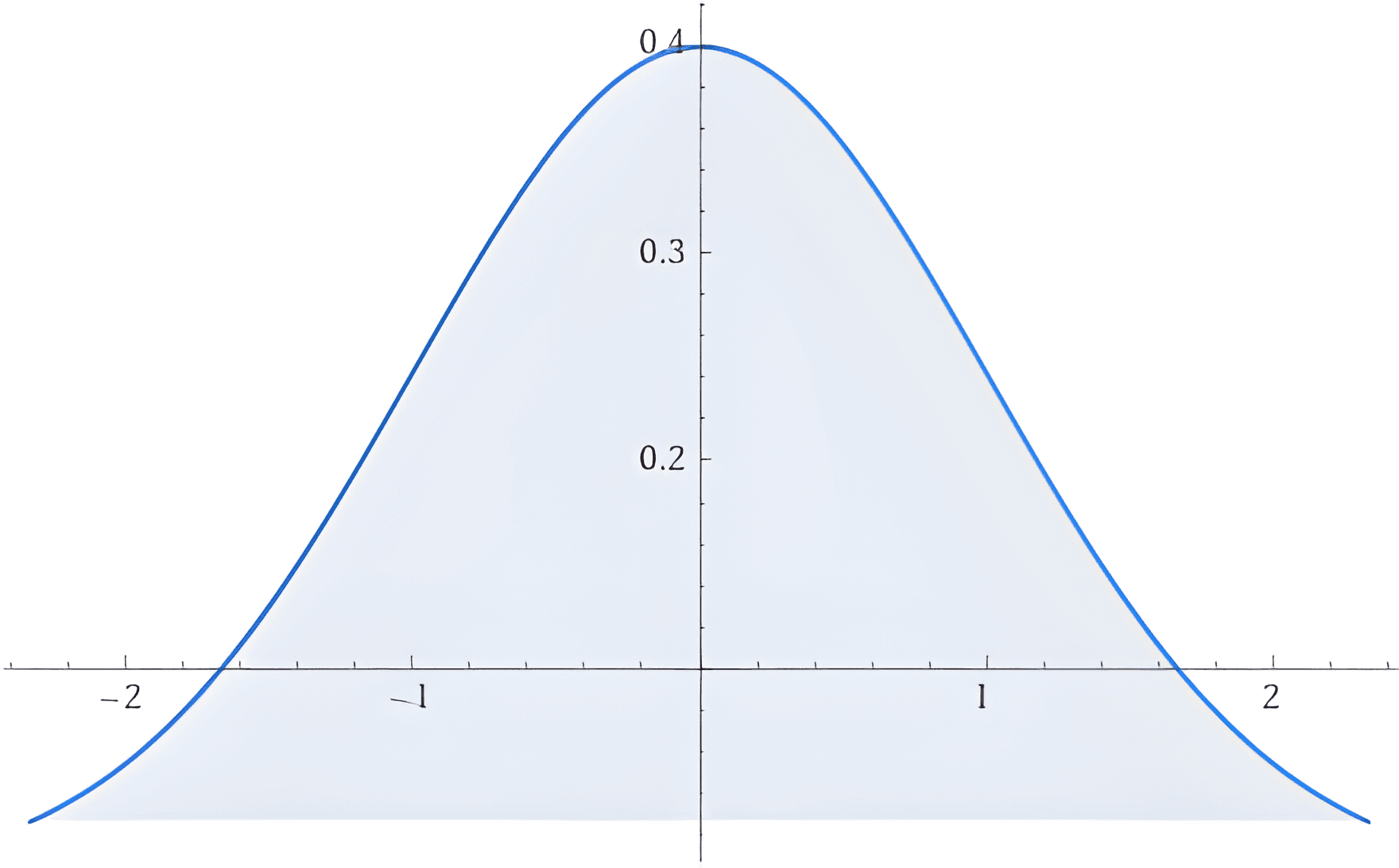
Solution by Steps
step 1
Given the standard normal distribution, we have \operatorname{Pr}(Z<a)=A and \operatorname{Pr}(Z>b)=B, where b>a. We need to find \operatorname{Pr}(a<Z<b \mid Z<b)
step 2
Using the conditional probability formula, \operatorname{Pr}(a<Z<b \mid Z<b) = \frac{\operatorname{Pr}(a<Z<b \cap Z<b)}{\operatorname{Pr}(Z<b)}
step 3
Since a<Z<b is a subset of Z<b, \operatorname{Pr}(a<Z<b \cap Z<b) = \operatorname{Pr}(a<Z<b)
step 4
Therefore, \operatorname{Pr}(a<Z<b \mid Z<b) = \frac{\operatorname{Pr}(a<Z<b)}{\operatorname{Pr}(Z<b)}
step 5
We know \operatorname{Pr}(a<Z<b) = \operatorname{Pr}(Z<b) - \operatorname{Pr}(Z<a) = B - A
step 6
Thus, \operatorname{Pr}(a<Z<b \mid Z<b) = \frac{B - A}{B}
[Question 1] Answer
B
Key Concept
Conditional Probability
Explanation
Conditional probability is the probability of an event occurring given that another event has already occurred. In this case, we used the formula Pr(A∣B)=Pr(B)Pr(A∩B).
Solution by Steps
step 1
Given a normal distribution X with mean μ=60 and standard deviation σ=7, we need to find the probability that X is less than 46
step 2
Convert X to the standard normal variable Z using Z=σX−μ
step 3
For X=46, Z=746−60=7−14=−2
step 4
We need to find \operatorname{Pr}(Z < -2)
step 5
Using standard normal distribution tables or a calculator, \operatorname{Pr}(Z < -2) \approx 0.0228
[Question 2] Answer
A
Key Concept
Standard Normal Distribution
Explanation
The standard normal distribution is a normal distribution with a mean of 0 and a standard deviation of 1. Converting a normal variable to a standard normal variable allows us to use standard normal distribution tables to find probabilities.
© 2023 AskSia.AI all rights reserved