
AskSia
Plus

2. (a) For integer n≥1, use upper and lower Riemann sums with n equal ...
May 5, 2024



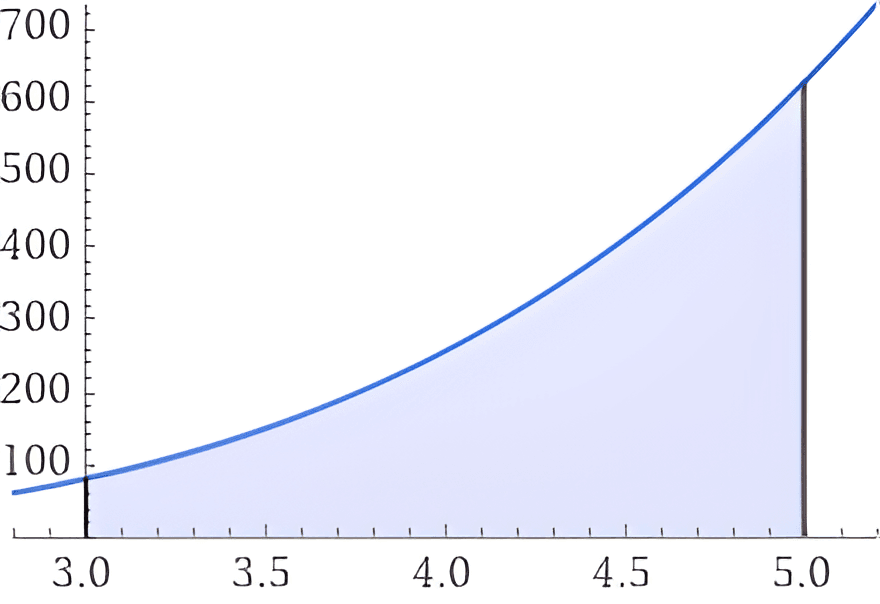
Generated Graph
Solution by Steps
step 1
To find the upper and lower Riemann sums for the integral ∫01(1−x2)dx, we divide the interval [0,1] into n equal subintervals of width Δx=n1
step 2
The upper sum Un is found by evaluating (1−x2) at the right endpoint of each subinterval, which gives us Un=∑k=1n(1−(nk)2)n1
step 3
Using the formula for the sum of squares, we have Un=∑k=1nn1−∑k=1nn3k2=1−6n3(n)(n+1)(2n+1)
step 4
Simplifying Un, we get Un=1−6n2(n+1)(2n+1)
step 5
The lower sum Ln is found by evaluating (1−x2) at the left endpoint of each subinterval, which gives us Ln=∑k=0n−1(1−(nk)2)n1
step 6
Using the formula for the sum of squares with a shift in index, we have Ln=∑k=0n−1n1−∑k=0n−1n3k2=1−6n3(n−1)(n)(2n−1)
step 7
Simplifying Ln, we get Ln=1−6n2(n)(2n−1)
step 8
To evaluate the integral using the definition of the Riemann integral, we take the limit of the Riemann sums as n approaches infinity
step 9
The limit of the upper sum as n approaches infinity is limn→∞Un=limn→∞(1−6n2(n+1)(2n+1))=31
step 10
The limit of the lower sum as n approaches infinity is limn→∞Ln=limn→∞(1−6n2(n)(2n−1))=31
step 11
Since the upper and lower sums converge to the same value, the value of the integral is 31
[1] Answer
The upper and lower bounds for the integral are both 31, hence the value of the integral is 31.
Key Concept
Riemann sums and definite integrals
Explanation
The upper and lower Riemann sums provide bounds for the value of a definite integral. As the number of subdivisions increases, both sums converge to the actual value of the integral if the function is integrable on the interval.
© 2023 AskSia.AI all rights reserved