
AskSia
Plus

2. The springhaas spiral. A springhaas travels along a trajectory, where its po...
Sep 25, 2024



Generated Graph
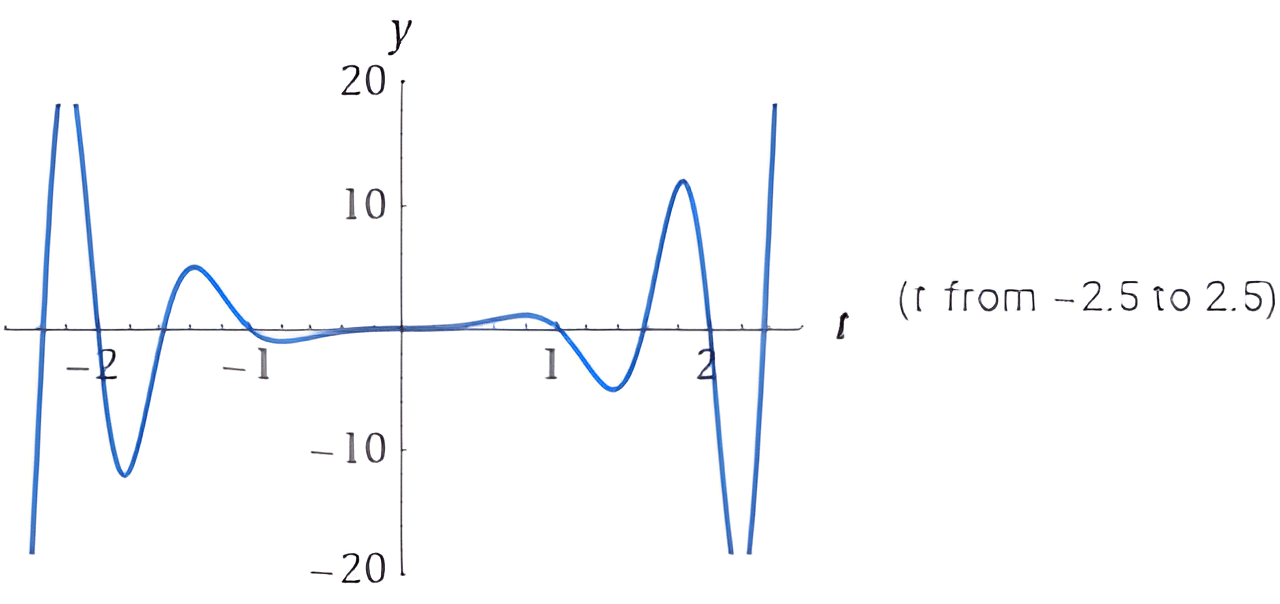
Solution by Steps
step 1
To find the velocity vector v(t), we differentiate the position vector r(t)=t2i+cos(t2)j+sin(t2)k:
\mathbf{v}(t) = \frac{d}{dt}(t^{2} \mathbf{i} + \cos(t^{2}) \mathbf{j} + \sin(t^{2}) \mathbf{k}) = 2t \mathbf{i} - 2t \sin(t^{2}) \mathbf{j} + 2t \cos(t^{2}) \mathbf{k}
step 2
The speed v(t) is the magnitude of the velocity vector:
v(t) = \|\mathbf{v}(t)\| = \sqrt{(2t)^{2} + (-2t \sin(t^{2}))^{2} + (2t \cos(t^{2}))^{2}} = 2t \sqrt{1 + \sin^{2}(t^{2}) + \cos^{2}(t^{2})} = 2t \sqrt{1} = 2t
step 3
The unit tangent vector T(t) is given by:
\mathbf{T}(t) = \frac{\mathbf{v}(t)}{v(t)} = \frac{2t \mathbf{i} - 2t \sin(t^{2}) \mathbf{j} + 2t \cos(t^{2}) \mathbf{k}}{2t} = \mathbf{i} - \sin(t^{2}) \mathbf{j} + \cos(t^{2}) \mathbf{k}
step 4
To determine if the springhaas is speeding up or slowing down, we check the sign of dtdv(t):
\frac{d}{dt} v(t) = \frac{d}{dt}(2t) = 2 > 0 \text{, hence the springhaas is speeding up.}
step 5
To find the unit normal vector N(t), we differentiate T(t) and normalize it:
\mathbf{N}(t) = \frac{\frac{d}{dt} \mathbf{T}(t)}{\|\frac{d}{dt} \mathbf{T}(t)\|}
step 6
The acceleration vector a(t) is given by:
\mathbf{a}(t) = \frac{d}{dt} \mathbf{v}(t) = 2 \mathbf{i} - 2 \sin(t^{2}) \mathbf{j} + 2 \cos(t^{2}) \mathbf{k} + 2t(-2t \cos(t^{2})) \mathbf{j} + 2t(-2t \sin(t^{2})) \mathbf{k}
step 7
The decomposition of the acceleration into tangential and normal components is given by:
\mathbf{a}(t) = a_{\mathbf{T}} \mathbf{T}(t) + a_{\mathbf{N}} \mathbf{N}(t)
step 8
The curvature κ of the trajectory can be found using the formula:
\kappa = \frac{\|\mathbf{T}'(t)\|}{\|\mathbf{v}(t)\|}
Answer
The springhaas's velocity vector is v(t)=2tT(t), it is speeding up, and the curvature can be calculated using the provided formulas.
Key Concept
The velocity vector and its components are crucial in understanding motion along a trajectory.
Explanation
The velocity vector v(t) is derived from the position function, and its magnitude gives the speed, which helps determine if the object is speeding up or slowing down. The unit normal vector and acceleration components further describe the motion's characteristics.
© 2023 AskSia.AI all rights reserved