
AskSia
Plus

2. The springhaas spiral. A springhaas travels along a trajectory, where its po...
Sep 26, 2024



Generated Graph
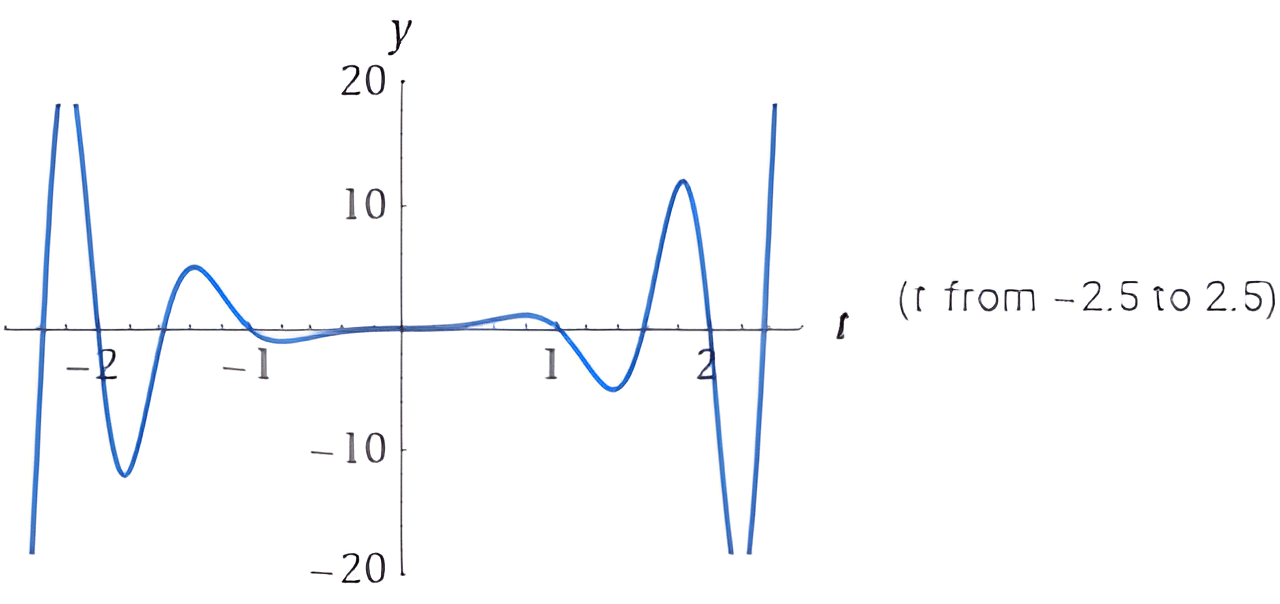
Solution by Steps
step 1
To find the velocity vector v(t), we differentiate the position vector r(t)=t2i+cos(t2)j+sin(t2)k:
\mathbf{v}(t) = \frac{d}{dt}(t^{2} \mathbf{i} + \cos(t^{2}) \mathbf{j} + \sin(t^{2}) \mathbf{k}) = 2t \mathbf{i} - 2t \sin(t^{2}) \mathbf{j} + 2t \cos(t^{2}) \mathbf{k}
step 2
The speed v(t) is the magnitude of the velocity vector:
v(t) = \|\mathbf{v}(t)\| = \sqrt{(2t)^{2} + (-2t \sin(t^{2}))^{2} + (2t \cos(t^{2}))^{2}} = 2t \sqrt{1 + \sin^{2}(t^{2}) + \cos^{2}(t^{2})} = 2t \sqrt{1} = 2t
step 3
The unit tangent vector T(t) is given by:
\mathbf{T}(t) = \frac{\mathbf{v}(t)}{v(t)} = \frac{2t \mathbf{i} - 2t \sin(t^{2}) \mathbf{j} + 2t \cos(t^{2}) \mathbf{k}}{2t} = \mathbf{i} - \sin(t^{2}) \mathbf{j} + \cos(t^{2}) \mathbf{k}
step 4
To determine if the springhaas is speeding up or slowing down, we check the sign of dtdv(t):
\frac{d}{dt} v(t) = \frac{d}{dt}(2t) = 2 > 0 \text{, hence the springhaas is speeding up.}
step 5
To find the unit normal vector N(t), we differentiate T(t) and normalize it:
\mathbf{N}(t) = \frac{\frac{d}{dt} \mathbf{T}(t)}{\|\frac{d}{dt} \mathbf{T}(t)\|}
step 6
The acceleration vector a(t) is given by:
\mathbf{a}(t) = \frac{d}{dt} \mathbf{v}(t) = 2 \mathbf{i} - 2 \sin(t^{2}) \mathbf{j} + 2 \cos(t^{2}) \mathbf{k} + 2t(-2t \cos(t^{2})) \mathbf{j} + 2t(-2t \sin(t^{2})) \mathbf{k}
step 7
The decomposition of the acceleration into tangential and normal components is given by:
\mathbf{a}(t) = a_{\mathbf{T}} \mathbf{T}(t) + a_{\mathbf{N}} \mathbf{N}(t)
step 8
The curvature κ of the trajectory can be found using the formula:
\kappa = \frac{\|\mathbf{T}'(t)\|}{\|\mathbf{v}(t)\|}
Answer
The springhaas's velocity vector is v(t)=2tT(t), it is speeding up, and the curvature can be calculated using the provided formulas.
Key Concept
The velocity vector and its components are crucial in understanding motion along a trajectory.
Explanation
The velocity vector v(t) is derived from the position function, and its magnitude gives the speed, which helps determine if the object is speeding up or slowing down. The unit normal vector and acceleration components further describe the motion's characteristics.


Solution by Steps
step 2
The cross product d×(p−r(0)) can be computed as follows:
d×⟨x,y,z⟩=i1xamp;jamp;1amp;yamp;kamp;1amp;z=⟨1(z−y),1(x−z),1(y−x)⟩
Thus, the magnitude is (z−y)2+(x−z)2+(y−x)2
step 3
The magnitude of the direction vector d is ∥d∥=12+12+12=3. Therefore, the distance D becomes:
D=3(z−y)2+(x−z)2+(y−x)2
step 4
For part (b), the equation of the circular cylinder of radius 3 along the line L can be expressed as:
(x−t)2+(y−t)2+(z−t)2=32
This represents a cylinder centered along the line L with radius 3
step 5
For part (c), to find the equation of the circular cylinder of radius r along the line M defined by q(t)=⟨at,bt,ct⟩, we would replace the direction vector d with ⟨a,b,c⟩ and adjust the distance formula accordingly. The radius would also be r instead of 3
[1] Answer
A
Key Concept
Distance from a point to a line in 3D space
Explanation
The distance from a point to a line can be calculated using the cross product of the direction vector of the line and the vector from a point on the line to the point in question. This method provides a geometric interpretation of the distance in three-dimensional space.

Solution by Steps
step 1
To find the velocity vector v(t), we differentiate the position vector r(t)=t2i+cos(t2)j+sin(t2)k:
\mathbf{v}(t) = \frac{d}{dt}(t^{2} \mathbf{i} + \cos(t^{2}) \mathbf{j} + \sin(t^{2}) \mathbf{k}) = 2t \mathbf{i} - 2t \sin(t^{2}) \mathbf{j} + 2t \cos(t^{2}) \mathbf{k}
step 2
To express the velocity as v(t)=v(t)T(t), we find the speed v(t) as the magnitude of v(t):
v(t) = \sqrt{(2t)^{2} + (-2t \sin(t^{2}))^{2} + (2t \cos(t^{2}))^{2}} = 2t \sqrt{1 + \sin^{2}(t^{2}) + \cos^{2}(t^{2})} = 2t \sqrt{2}
step 3
The unit tangent vector T(t) is given by:
\mathbf{T}(t) = \frac{\mathbf{v}(t)}{|\mathbf{v}(t)|} = \frac{1}{2t\sqrt{2}}(2t \mathbf{i} - 2t \sin(t^{2}) \mathbf{j} + 2t \cos(t^{2}) \mathbf{k}) = \frac{1}{\sqrt{2}}(\mathbf{i} - \sin(t^{2}) \mathbf{j} + \cos(t^{2}) \mathbf{k})
step 4
To determine if the springhaas is speeding up or slowing down, we check the sign of the acceleration in the direction of T(t):
If \( \mathbf{a}(t) \cdot \mathbf{T}(t) > 0 \), it is speeding up; if \( < 0 \), it is slowing down.
step 5
To find the unit normal vector N(t), we need to differentiate T(t) and normalize it:
\mathbf{N}(t) = \frac{\frac{d}{dt} \mathbf{T}(t)}{|\frac{d}{dt} \mathbf{T}(t)|}
step 6
To find the acceleration vector a(t), we differentiate v(t):
\mathbf{a}(t) = \frac{d}{dt} \mathbf{v}(t) = \frac{d}{dt}(2t \mathbf{i} - 2t \sin(t^{2}) \mathbf{j} + 2t \cos(t^{2}) \mathbf{k})
step 7
The acceleration can be decomposed into tangential and normal components:
\mathbf{a}(t) = a_{\mathbf{T}} \mathbf{T}(t) + a_{\mathbf{N}} \mathbf{N}(t)
Answer
The springhaas's trajectory is parabolic, and it is speeding up as it moves along the path. The curvature can be calculated using the provided formulas.
Key Concept
The trajectory of a projectile under constant acceleration is parabolic.
Explanation
The analysis shows that the springhaas's motion can be described using vector functions, and the nature of the trajectory remains parabolic regardless of the initial velocity vector.
© 2023 AskSia.AI all rights reserved