
AskSia
Plus

2. A frequency distribution of weekly wages for 56 skilled workers is as follow...
Aug 1, 2024



Solution by Steps
step 1
To find the sample mean, we first need to calculate the midpoint of each income range. The midpoints are:
Midpoint of [0,5)Midpoint of [5,15)Midpoint of [15,30)Midpoint of [30,45)Midpoint of [45,65)Midpoint of [65,75)Midpoint of [75,95)amp;=20+5=2.5amp;=25+15=10amp;=215+30=22.5amp;=230+45=37.5amp;=245+65=55amp;=265+75=70amp;=275+95=85
step 2
Next, we multiply each midpoint by the corresponding frequency and sum these products:
2.5×410×922.5×1237.5×1055×1370×585×3amp;=10amp;=90amp;=270amp;=375amp;=715amp;=350amp;=255
Sum of products = 10 + 90 + 270 + 375 + 715 + 350 + 255 = 2065
step 3
The sample mean is then calculated by dividing the sum of the products by the total number of persons:
Sample mean=562065=36.875
step 4
To find the median, we need to locate the middle value in the cumulative frequency distribution. The cumulative frequencies are:
\begin{align*}
4, & \quad 4 + 9 = 13, \\
13 + 12 = 25, & \quad 25 + 10 = 35, \\
35 + 13 = 48, & \quad 48 + 5 = 53, \\
53 + 3 = 56
\]
The median falls in the 30 and less than 45 range. Using linear interpolation:
Median=30+(1028−25)×15=34.5
step 5
To find the mode, we identify the class with the highest frequency, which is the 45 and less than 65 range. Using the mode formula for grouped data:
Mode=45+((13−10)+(13−5)13−10)×20=50.455
step 6
To find the sample variance, we first calculate the squared deviations from the mean for each midpoint, multiply by the frequency, and sum these products:
(2.5−36.875)2×4(10−36.875)2×9(22.5−36.875)2×12(37.5−36.875)2×10(55−36.875)2×13(70−36.875)2×5(85−36.875)2×3amp;=4710.625amp;=7221.875amp;=2587.5amp;=39.0625amp;=4190.625amp;=5428.125amp;=11892.1875
Sum of squared deviations = 4710.625 + 7221.875 + 2587.5 + 39.0625 + 4190.625 + 5428.125 + 11892.1875 = 36070
step 7
The sample variance is then calculated by dividing the sum of squared deviations by the total number of persons minus one:
Sample variance=5536070=655.818
step 8
The standard deviation is the square root of the variance:
Standard deviation=655.818=25.6
step 9
The coefficient of variation is calculated as:
Coefficient of variation=(36.87525.6)×100=69.4%
step 10
The coefficient of skewness is calculated using the formula:
Coefficient of skewness=Standard deviation3(Mean−Median)=25.63(36.875−34.5)=0.278
Answer
Sample mean: 36.875, Median: 34.5, Mode: 50.455, Sample variance: 655.818, Standard deviation: 25.6, Coefficient of variation: 69.4%, Coefficient of skewness: 0.278
Key Concept
Descriptive statistics for grouped data
Explanation
The sample mean, median, and mode provide measures of central tendency, while the variance, standard deviation, and coefficient of variation measure the spread of the data. The coefficient of skewness indicates the asymmetry of the distribution.

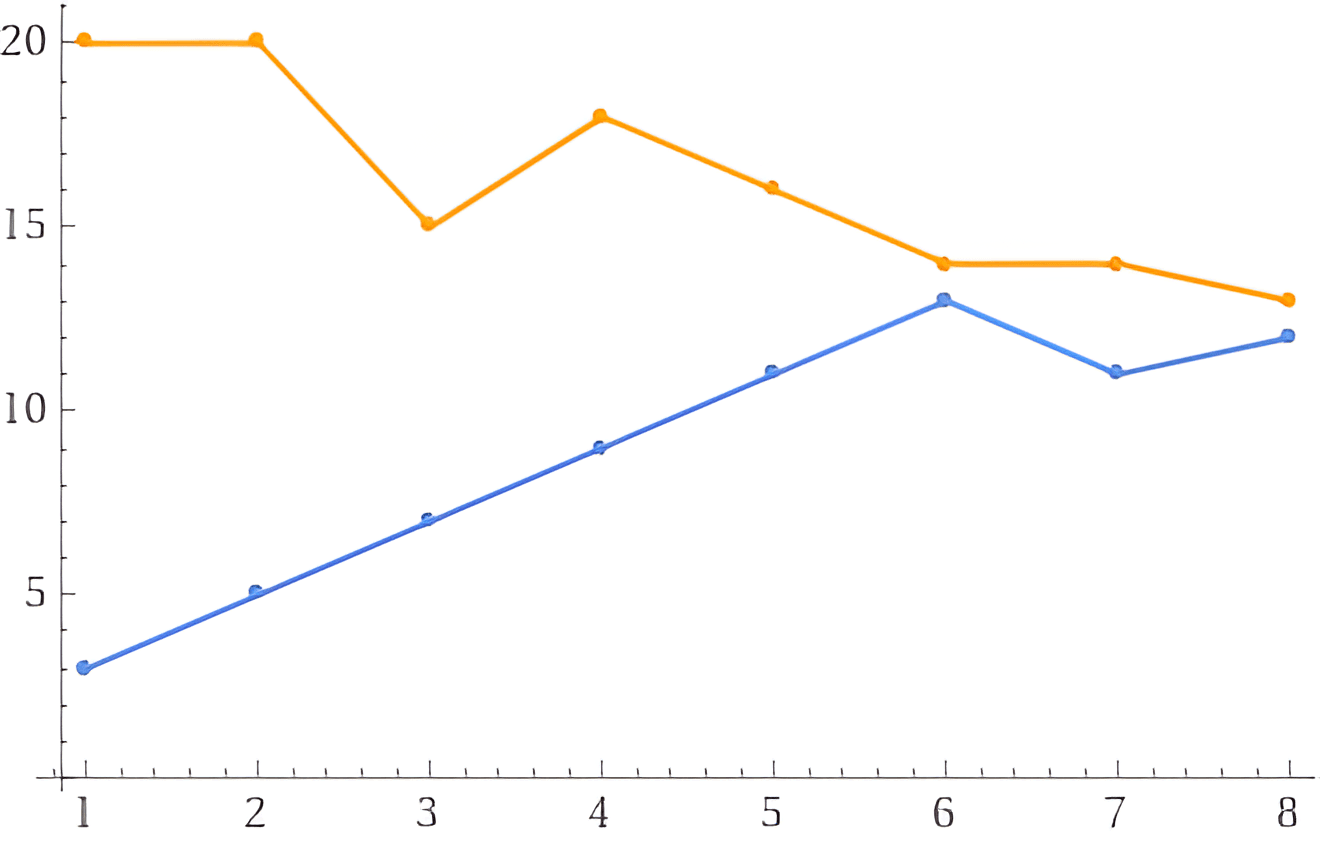
Generated Graph
Solution by Steps
step 1
To calculate the covariance, we use the formula:
Cov(X,Y)=n−1∑(xi−xˉ)(yi−yˉ)
Given:
∑(x−xˉ)(y−yˉ)=−58.75
n=8
So,
Cov(X,Y)=8−1−58.75=7−58.75=−8.39286
step 2
To calculate the correlation coefficient, we use the formula:
r=SxSyCov(X,Y)
Given:
Cov(X,Y)=−8.39286
Sx=3.5632
Sy=2.7646
So,
r=3.5632×2.7646−8.39286=9.849−8.39286=−0.852003
Answer
Covariance: -8.39286, Correlation Coefficient: -0.852003
Key Concept
Covariance and Correlation Coefficient
Explanation
Covariance measures the joint variability of two random variables, while the correlation coefficient measures the strength and direction of the linear relationship between them.
© 2023 AskSia.AI all rights reserved