
AskSia
Plus

1/\sqrt[3]{x+5}-\sqrt[3]{x} can be written as𝐶((𝑥+𝑎)𝑝1+(𝑥2+𝑎𝑥)𝑝2+𝑥𝑝3)
Feb 1, 2024

1/\sqrt[3]{x+5}-\sqrt[3]{x} can be written as𝐶((𝑥+𝑎)𝑝1+(𝑥2+𝑎𝑥)𝑝2+𝑥𝑝3)

1/(\sqrt[3]{x+5}-\sqrt[3]{x}) can be written as𝐶((𝑥+𝑎)𝑝1+(𝑥2+𝑎𝑥)𝑝2+𝑥𝑝3)
Generated Graph
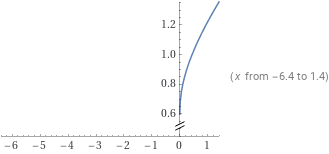
Solution by Steps
step 1
To simplify the expression 3x+5−3x1, we will rationalize the denominator by multiplying the numerator and the denominator by the conjugate of the denominator
step 2
The conjugate of 3x+5−3x is 3x+5+3x
step 3
Multiply the original expression by 3x+5+3x3x+5+3x
step 4
The product in the denominator will be (3x+5)2−(3x)2 due to the difference of squares
step 5
Simplify the denominator to (x+5)32−x32
step 6
The simplified form of the expression is (x+5)32−x323x+5+3x
Answer
(x+5)32−x323x+5+3x
Key Concept
Rationalizing the Denominator
Explanation
To simplify a fraction with a radical in the denominator, we multiply by the conjugate of the denominator to eliminate the radical. This process is known as rationalizing the denominator.
1/(\sqrt[3]{x+5}-\sqrt[3]{x}) can be written as C\left(\left(x+a\right)^{p1}+\left(x^2+ax\right)^{p2}+x^{p3}\right)
Generated Graph
Solution by Steps
step 1
To simplify the expression 3x+5−3x1, we will rationalize the denominator
step 2
Multiply the numerator and the denominator by the conjugate of the denominator: (3x+5+3x)
step 3
The product of the conjugates (3x+5−3x)(3x+5+3x) results in the difference of cubes: (x+5)−x
step 4
Simplify the difference to get 5 in the denominator
step 5
The numerator becomes (3x+5+3x) after multiplying with the conjugate
step 6
The simplified expression is 53x+5+3x
Answer
53x+5+3x
Key Concept
Rationalizing the Denominator
Explanation
To simplify a fraction with a radical in the denominator, we multiply the numerator and denominator by the conjugate of the denominator to eliminate the radical. This process is known as rationalizing the denominator.
1/(\sqrt[3]{x+5}-\sqrt[3]{x}) can be written as C\left(\left(x+a\right)^{p1}+\left(x^2+ax\right)^{p2}+x^{p3}\right) where C=?P1=? P2=?p3=?
Generated Graph
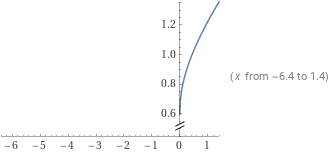
Solution by Steps
step 1
To rationalize the denominator, we multiply the numerator and denominator by the conjugate of the denominator
step 2
The conjugate of (x+5)31−x31 is (x+5)31+x31
step 3
Multiplying the numerator and denominator by the conjugate, we get ((x+5)31−x31)1⋅(x+5)31+x31(x+5)31+x31
step 4
Simplifying the denominator using the difference of cubes formula, we get (x+5)−x
step 5
The denominator simplifies to 5, and the numerator is the conjugate (x+5)31+x31
step 6
The simplified expression is 5(x+5)31+x31
Answer
5(x+5)31+x31
Key Concept
Rationalizing the Denominator
Explanation
To simplify a fraction with a radical in the denominator, we multiply by the conjugate to rationalize it. This process removes the radical from the denominator.
What is the value of C in the expression 1/(\sqrt[3]{x+5}-\sqrt[3]{x}) when it is written as C\left((x+a)^{p1}+(x^2+ax)^{p2}+x^{p3}\right)?
Generated Graph
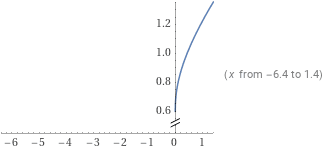
Solution by Steps
step 1
To find the value of C in the expression 3x+5−3x1, we need to rationalize the denominator
step 2
Multiply the numerator and denominator by the conjugate of the denominator: (3x+5)2−(3x+5)(3x)+(3x)23x+5+3x
step 3
Simplify the denominator using the identity a3−b3=(a−b)(a2+ab+b2) to get (x+5)−x3x+5+3x
step 4
Simplify further to obtain 53x+5+3x
step 5
The expression can now be written as C((x+a)p1+(x2+ax)p2+xp3) where C=51, p1=31, p2=0, and p3=31
Answer
C=51, p1=31, p2=0, p3=31
Key Concept
Rationalizing the denominator of a fraction involving cube roots
Explanation
To simplify the given expression, we multiplied by the conjugate of the denominator to eliminate the cube roots, which allowed us to express the result in the desired form with constants C, p1, p2, and p3.
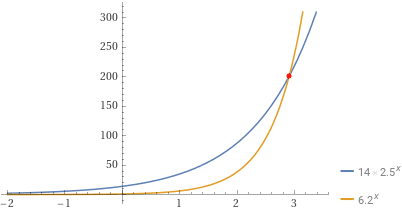
14\left(2.5^x\right)=6.2^x ,what is the value of x
Generated Graph
Solution by Steps
step 1
Set the two expressions equal to each other to solve for x: 14⋅2.5x=6.2x
step 2
Take the natural logarithm of both sides to bring down the exponents: ln(14)+xln(2.5)=xln(6.2)
step 3
Isolate the variable x by moving terms involving x to one side and constant terms to the other: x(ln(2.5)−ln(6.2))=−ln(14)
step 4
Solve for x by dividing both sides by ln(2.5)−ln(6.2): x=ln(2.5)−ln(6.2)−ln(14)
step 5
Simplify the expression for x using properties of logarithms: x=ln(2)−2ln(5)+ln(31)ln(2)+ln(7)
Answer
x=ln(2)−2ln(5)+ln(31)ln(2)+ln(7)
Key Concept
Solving exponential equations with different bases
Explanation
To solve an exponential equation where the bases are different, we can take the natural logarithm of both sides to utilize the property ln(ab)=bln(a), which allows us to bring down the exponents and solve for the variable.
© 2023 AskSia.AI all rights reserved