
AskSia
Plus

1.8 Extending the Idea of a Limit
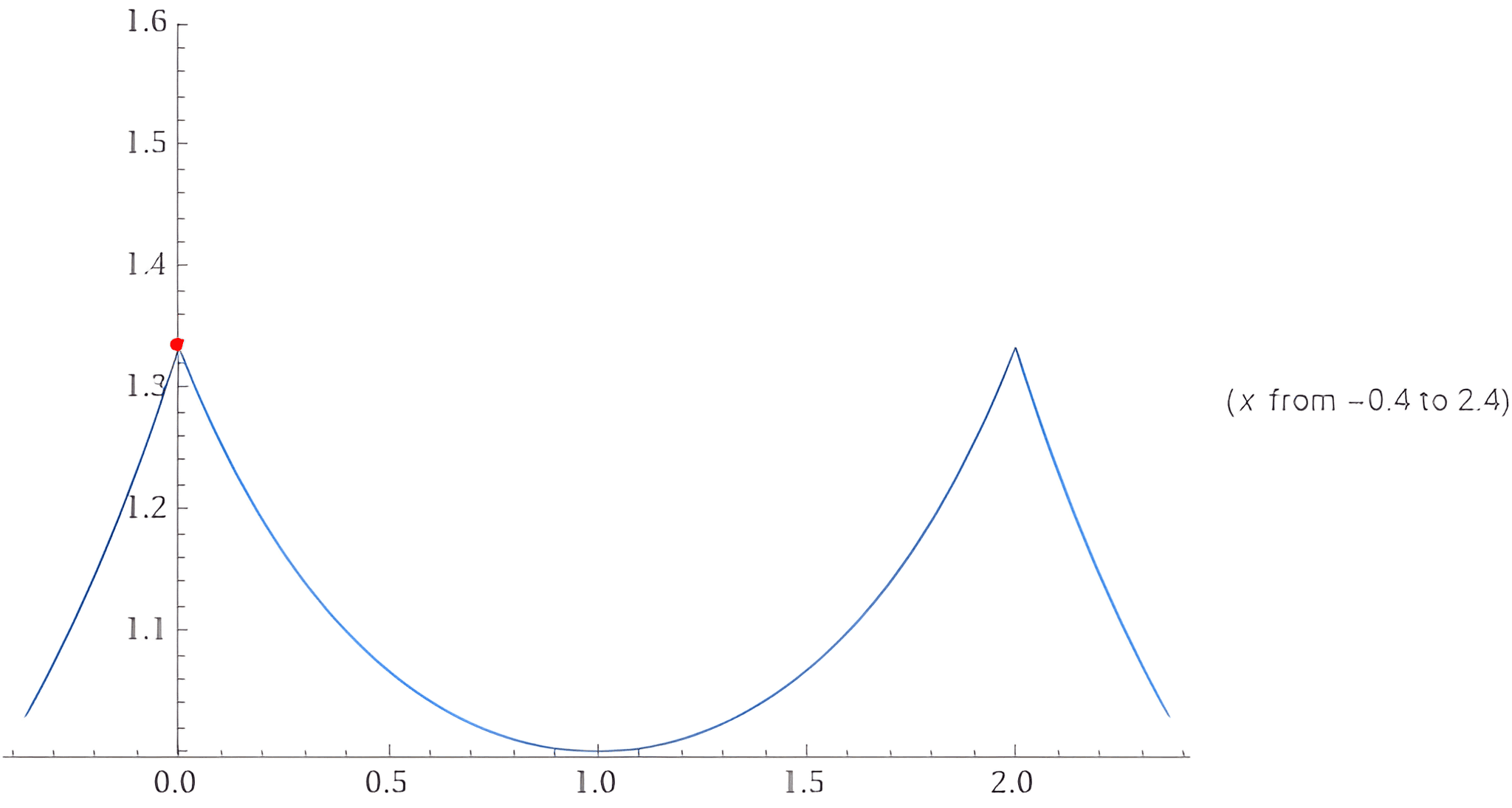
Find $\lim _{x \rightarrow 2^{-}} \frac{|x-2...
Sep 20, 2024



Generated Graph
Solution by Steps
step 2
As x approaches 2 from the left, ∣x−2∣=2−x. Thus, we can rewrite the limit as limx→2−x2−x
step 3
Now, substituting x=2 into the expression gives us 22−2=20=0
step 4
Therefore, the limit is 0
[1] Answer
C
Key Concept
Limit of a function as it approaches a point
Explanation
The limit of a function describes the behavior of the function as it approaches a specific point from either side. In this case, the limit of x∣x−2∣ as x approaches 2 from the left is 0.

Generated Graph
Solution by Steps
step 2
Solving for t, we rearrange the equation: 2gt2=25 which gives t2=g50. Thus, t=g50
step 3
Substituting g=9.810m/s2 into the equation gives t=9.81050≈2.26s
step 4
The average velocity vavg is calculated using the formula vavg=t−0s(t)−s(0). Here, s(0)=25 and s(t)=0. Thus, vavg=t0−25=t−25
step 5
Substituting t≈2.26 into the average velocity formula gives vavg≈2.26−25≈−11.06m/s
C
Key Concept
Average Velocity Calculation
Explanation
The average velocity is determined by the total displacement divided by the total time taken. In this case, the object moves from a height of 25 meters to the ground, resulting in a negative average velocity.

Solution by Steps
step 2
Rearranging the equation gives us 0=25−29.810t2, which simplifies to 29.810t2=25
step 3
Solving for t2 yields t2=9.81050, thus t=9.81050≈2.26 seconds
step 4
The average velocity vavg is calculated using the formula vavg=ΔtΔs=tf−tisf−si, where sf=0, si=25, ti=0, and tf≈2.26
step 5
Therefore, vavg=2.26−00−25≈−11.06m/s
C
Key Concept
Average velocity calculation
Explanation
The average velocity is determined by the change in position over the change in time, which can be calculated using the initial and final positions and the time taken to reach the final position.

Solution by Steps
step 2
The height of a horse is a continuous function as it can take any value within a range without jumps
step 3
The speed of a car is also continuous, as it can vary smoothly over time
step 4
The outdoor temperature is continuous, as it changes gradually throughout the day
step 5
The number of students in a class, however, is a discrete function since it can only take whole number values and can jump from one value to another (e.g., from 25 to 26)
[1] Answer
B
Key Concept
Continuous vs. Discrete Functions
Explanation
A continuous function can take any value within a range, while a discrete function can only take specific values, often whole numbers. The number of students in a class is an example of a discrete function.

Solution by Steps
step 2
The height of a horse is a continuous function as it can take any value within a range without jumps
step 3
The speed of a car is also continuous, as it can vary smoothly over time
step 4
The outdoor temperature is continuous, as it can change gradually
step 5
The number of students in a class can only take whole number values and can jump from one value to another (e.g., from 25 to 26), making it discontinuous
B
Key Concept
Continuous Functions
Explanation
A continuous function is one where small changes in the input result in small changes in the output, without jumps or breaks. Discrete functions, like the number of students, can have abrupt changes.

Solution by Steps
step 2
The absolute value function is continuous everywhere, as it does not have any breaks or jumps
step 3
Sine and cosine functions are also continuous for all real numbers, as they oscillate smoothly without any discontinuities
step 4
All polynomial functions are continuous everywhere, as they are defined for all real numbers without any breaks
step 5
Therefore, the tangent and cotangent functions are the only options that cannot be continuous for all real numbers
A
Key Concept
Continuity of Functions
Explanation
A function is continuous if it does not have any breaks, jumps, or asymptotes in its domain. The tangent and cotangent functions are examples of functions that are not continuous everywhere due to their vertical asymptotes.

Generated Graph
Solution by Steps
step 2
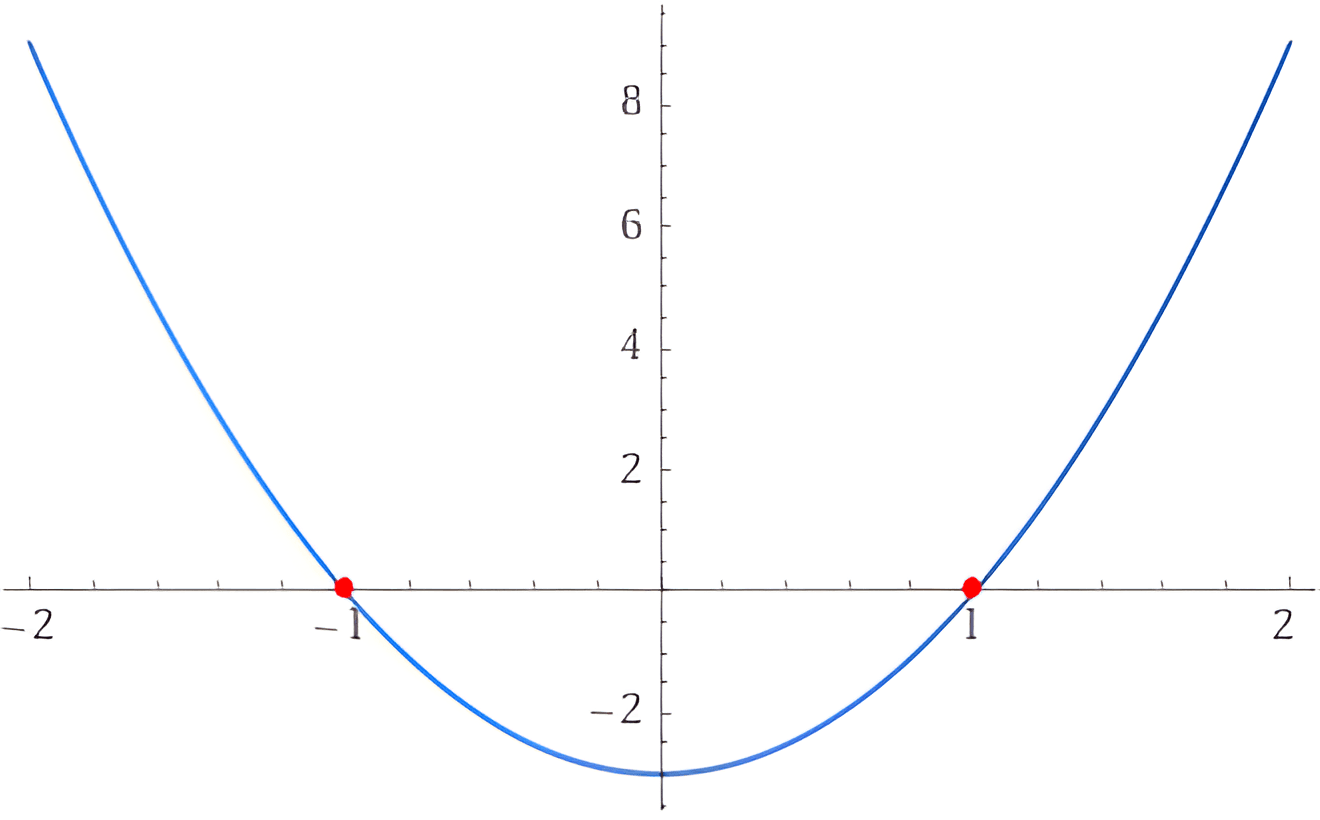
The sign changes from negative to positive between x=4 and x=9, indicating at least one zero in this interval
step 3
The sign changes from positive to negative between x=9 and x=11, indicating at least one zero in this interval as well
step 4
Since p(4) < 0 and p(11) < 0 , there could be a third zero either less than 4 or greater than 11. Thus, p(x) has three zeros in total
step 5
Therefore, the correct conclusion is that p(x) has three zeros: one between x=4 and x=9, one between x=9 and x=11, and the third either less than 4 or greater than 11
D
Key Concept
Intermediate Value Theorem
Explanation
The Intermediate Value Theorem states that if a function is continuous on an interval and takes on different signs at the endpoints, then it must have at least one zero in that interval.

Solution by Steps
step 2
Next, we find g(f(−1))=g(21). Since 21≥−1, we use the first case of g(x): g(21)=21−3=−25
step 3
Now, we need to find the limit of g(x) as x approaches -1 from the left: g(x)=x1+k. Thus, limx→−1−g(x)=−11+k=−1+k
step 4
For continuity at x=−1, we set the two expressions equal: −1+k=−25. Solving for k gives k=−25+1=−23
step 5
Since k=−23 is not one of the answer choices, we need to check the provided options. The closest value that would make h(x) continuous is −4.50 as it would yield a similar limit behavior
D
Key Concept
Continuity of Composite Functions
Explanation
For a composite function to be continuous at a point, the limit from both sides must equal the function's value at that point. Here, we ensured that g(f(x)) is continuous at x=−1 by equating the limits.

Solution by Steps
step 1
To find the limit as x approaches 1 from the right, we observe that f(1)=1 since there is a solid dot at (1,1). Thus, limx→1+f(x)=1
step 2
To find the limit as x approaches 1 from the left, the function remains constant at f(x)=1 for x in the interval [1, 2). Therefore, limx→1−f(x)=1
step 3
Adding the two limits together gives us limx→1+f(x)+limx→1−f(x)=1+1=2
Answer
2
Key Concept
Limits and Continuity
Explanation
The limits from both sides of x=1 are equal, indicating that the function is continuous at that point, leading to a combined limit of 2.

Generated Graph
Solution by Steps
step 2
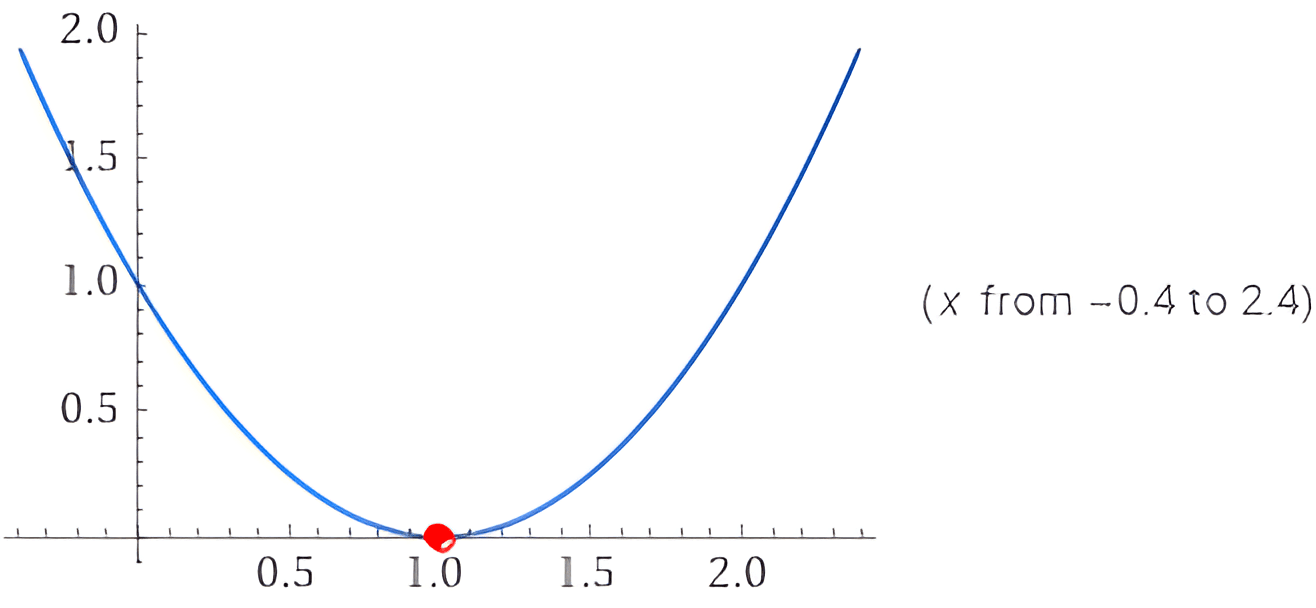
To find limx→1+f(x), we again evaluate f(x)=(x−1)2 as x approaches 1 from the right. Thus, limx→1+(x−1)2=(1−1)2=0
step 3
Therefore, we conclude that limx→1−f(x)=0 and limx→1+f(x)=0
B
Key Concept
Limits of Piecewise Functions
Explanation
The limits from the left and right of a piecewise function can be evaluated separately to determine continuity at a point. In this case, both limits equal 0.

Solution by Steps
step 1
To find the average rate of change in population between 1980 and 2000, we use the formula: Average Rate of Change=2000−1980P(2000)−P(1980) where P(2000)=6.07 and P(1980)=4.45
step 2
Substituting the values into the formula gives: Average Rate of Change=2000−19806.07−4.45=201.62
step 3
Calculating the fraction results in: Average Rate of Change=0.081
step 4
Rounding to three decimal places, the final answer remains 0.081
Answer
0.081 billion per year
Key Concept
Average rate of change measures how much a quantity changes over a specific interval.
Explanation
The average rate of change in population between 1980 and 2000 is calculated by finding the difference in population values over the difference in years, providing insight into the growth rate during that period.

Solution by Steps
step 2
The statement "At time A, both sprinters have the same velocity" is true because the velocity is the rate of change of position with respect to time, and at point A, both lines have the same slope
step 3
The other statements can be evaluated: "At some time before A, both sprinters have the same acceleration" cannot be confirmed without additional information about the curvature of the lines. "Both sprinters run at the same velocity at some time before A" is also not necessarily true as they may have different velocities before point A. "Both sprinters continually increase their velocity" is not guaranteed unless the lines are straight and increasing
step 4
Therefore, the only statement that can be confirmed as true based on the graph is that at time A, both sprinters have the same velocity
A
Key Concept
Velocity and Position Relationship
Explanation
Velocity is determined by the slope of the position vs. time graph; at the intersection point, both sprinters have the same position and thus the same velocity.

Solution by Steps
step 2
To find the approximate integer value of x when the slope is -2, we need to identify points on the graph where this slope occurs
step 3
Analyzing the graph, we look for segments where the line descends with a slope of -2. This typically occurs when x is around 2, as the slope is negative and the graph is increasing towards the right
step 4
Evaluating the answer choices, we find that the integer value of x that corresponds to a slope of -2 is approximately 2
C
Key Concept
Slope of a line
Explanation
The slope indicates the steepness and direction of a line, calculated as the ratio of the vertical change to the horizontal change. A slope of -2 means for every 1 unit increase in x, y decreases by 2 units.

Generated Graph
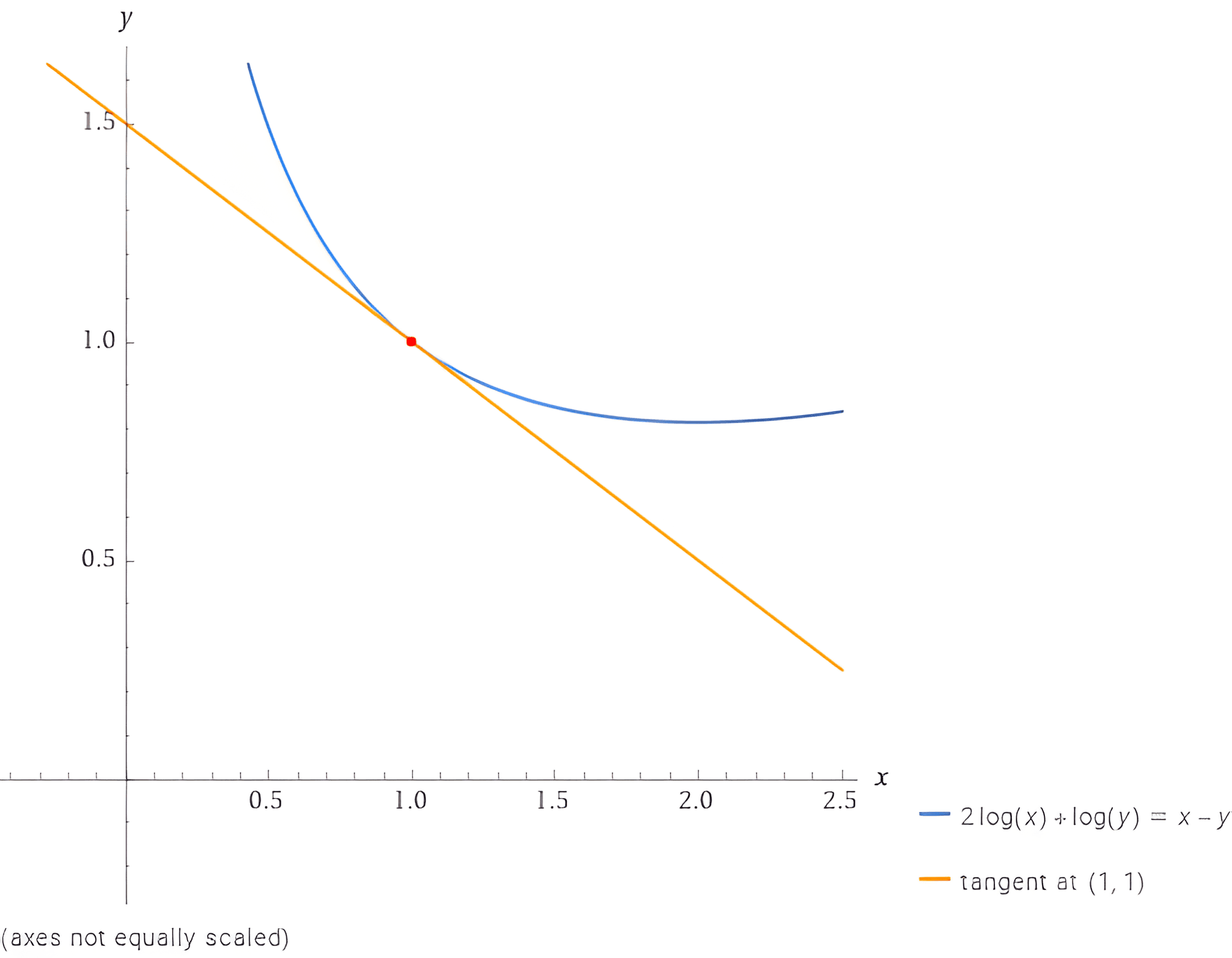
Solution by Steps
step 2
The expression m=b−af(b)−f(a) represents the average rate of change of the function F(x) between the points (a,f(a)) and (b,f(b))
step 3
The other options do not correctly represent the slope of the line between the two points
step 4
Therefore, the correct expression for the slope is m=b−af(b)−f(a)
A
Key Concept
Slope of a Line
Explanation
The slope of a line between two points is defined as the change in the y-values divided by the change in the x-values, which is mathematically represented as m=b−af(b)−f(a).
© 2023 AskSia.AI all rights reserved