
AskSia
Plus

14:02
9月12日周四
85%
IDE 515 Lecture 3_Review of Sta...
IDE 515 Lecture 2_Revi...
Sep 13, 2024



Solution by Steps
step 1
To determine the expected payout for the insurance company, we calculate the expected value E(X) using the formula: E(X)=∑(xi⋅pi), where xi is the payout amount and pi is the probability
step 2
Substituting the values from the table: E(X)=0⋅0.9+400⋅0.04+1000⋅0.03+2000⋅0.01+4000⋅0.01+6000⋅0.01
step 3
Calculating each term: E(X)=0+16+30+20+40+60=166
step 4
Therefore, the expected payout is 166 USD. The insurance company should charge at least this amount to cover the expected payouts
step 5
To find the expected profit for the policyholder, we calculate the expected profit as E(Profit)=Premium−E(X), where the premium is 260 USD
step 6
Substituting the values: E(Profit)=260−166=94
step 7
Thus, the expected profit for the policyholder is 94 USD
Answer
1) The insurance company should charge at least 166 USD. 2) The expected profit for the policyholder is 94 USD.
Key Concept
Expected Value and Profit Calculation
Explanation
The expected value helps determine the fair price for insurance, while the profit calculation shows the potential gain for the policyholder.
Solution by Steps
step 1
To evaluate which upgrade plan maximizes expected profit, we calculate the expected profit for both partial and full upgrades using the formula: E(X)=∑(xi⋅pi)
step 2
For partial upgrade: E(X)=50⋅0.2+150⋅0.5+200⋅0.3
step 3
Calculating: E(X)=10+75+60=145
step 4
For full upgrade: E(X)=0⋅0.2+100⋅0.5+300⋅0.3
step 5
Calculating: E(X)=0+50+90=140
step 6
Comparing the expected profits: Partial upgrade 145 vs Full upgrade 140. The partial upgrade has a higher expected profit
step 7
To evaluate which plan minimizes risk, we can look at the variance or standard deviation of the profits for both plans
step 8
For partial upgrade, calculate variance: Var(X)=∑(pi⋅(xi−E(X))2)
step 9
For partial upgrade: Var(X)=0.2(50−145)2+0.5(150−145)2+0.3(200−145)2
step 10
Calculating: Var(X)=0.2(9025)+0.5(25)+0.3(3025)=1805+12.5+907.5=2725
step 11
For full upgrade: Var(X)=0.2(0−140)2+0.5(100−140)2+0.3(300−140)2
step 12
Calculating: Var(X)=0.2(19600)+0.5(1600)+0.3(25600)=3920+800+7680=12400
step 13
Comparing variances: Partial upgrade 2725 vs Full upgrade 12400. The partial upgrade has lower risk
Answer
1) The partial upgrade maximizes expected profit. 2) The partial upgrade also minimizes risk.
Key Concept
Expected Profit and Risk Assessment
Explanation
Calculating expected profit and variance helps in making informed decisions about which upgrade plan to choose based on profitability and risk.
1.
a) Consider a group of people A, B , C and the relation "at least as tall as," as in "A is at least as tall as B." Is this relation transitive? Is it complete?
b) A college football coach says that given any two linemen A and B, he always prefers the one who is bigger and faster. Is this preference relation transitive? Is it complete?
c) The standard economic theory assumes that a consumer’s preferences must be transitive. Here is an interesting exception. A consumer likes sugar in her coffee, but she simply cannot taste the difference between a cup of coffee with n grams of sugar in it and a cup of coffee with n + 1 grams, for any integer n. Suppose a teaspoon of sugar is 6 grams, and suppose she takes her coffee with one teaspoon of sugar. Why does this violate transitivity?
Solution by Steps
a)step 1
To determine if the relation "at least as tall as" is transitive, we check if for any three people A, B, and C, if A is at least as tall as B and B is at least as tall as C, then A must be at least as tall as C
step 2
Since height is a measurable quantity, if A ≥ B and B ≥ C, it follows that A ≥ C. Thus, the relation is transitive
step 3
To check if the relation is complete, we need to see if for any two people A and B, either A is at least as tall as B or B is at least as tall as A
step 4
Since there can be cases where A and B are of equal height, the relation is complete
step 1
To determine if the preference relation of the coach is transitive, we check if for any two linemen A and B, if A is preferred over B and B is preferred over C, then A must be preferred over C
step 2
If A is bigger and faster than B, and B is bigger and faster than C, then A must be bigger and faster than C. Thus, the preference relation is transitive
step 3
To check if the preference relation is complete, we need to see if for any two linemen A and B, either A is preferred over B or B is preferred over A
step 4
Since the coach always prefers the bigger and faster lineman, the relation is complete
step 1
To analyze the consumer's preferences, we note that she cannot taste the difference between n grams of sugar and n + 1 grams
step 2
If she prefers coffee with 6 grams of sugar (1 teaspoon) over coffee with 0 grams, and she cannot distinguish between 6 grams and 7 grams, she may not prefer 7 grams over 6 grams
step 3
This means that if she prefers 6 grams over 0 grams, and cannot distinguish between 6 and 7 grams, she may not prefer 7 grams over 6 grams, violating transitivity
Answer
a) The relation is transitive and complete. b) The preference relation is transitive and complete. c) The consumer's preferences violate transitivity.
Key Concept
Transitivity and completeness in relations and preferences.
Explanation
Transitivity means if A relates to B and B relates to C, then A relates to C. Completeness means for any A and B, one must relate to the other. The consumer's inability to distinguish between certain amounts of sugar violates transitivity.
2. Suppose you are choosing between hours of work (a bad measured on the horizontal axis) and money (a good measured on the vertical axis). If your marginal cost of working increases in your working hours and marginal utility from money decreases in your income level, what do your indifference curves look like?
Solution by Steps
step 1
To analyze the indifference curves given the conditions, we note that as the marginal cost of working increases with more hours, the consumer will be less willing to give up money for additional hours of work
step 2
Simultaneously, as the marginal utility from money decreases with higher income, the consumer's willingness to trade off hours of work for money also diminishes
step 3
Therefore, the indifference curves will become steeper as the consumer's preference shifts away from working more hours and towards retaining money, indicating a lower marginal rate of substitution
step 4
The resulting indifference curves will be convex to the origin, reflecting the diminishing marginal utility of money and increasing marginal cost of working
Answer
The indifference curves will be steeper and convex to the origin.
Key Concept
Indifference Curves and Marginal Utility
Explanation
Indifference curves represent combinations of goods that provide the same level of utility. Changes in marginal utility and marginal cost affect the shape and steepness of these curves.
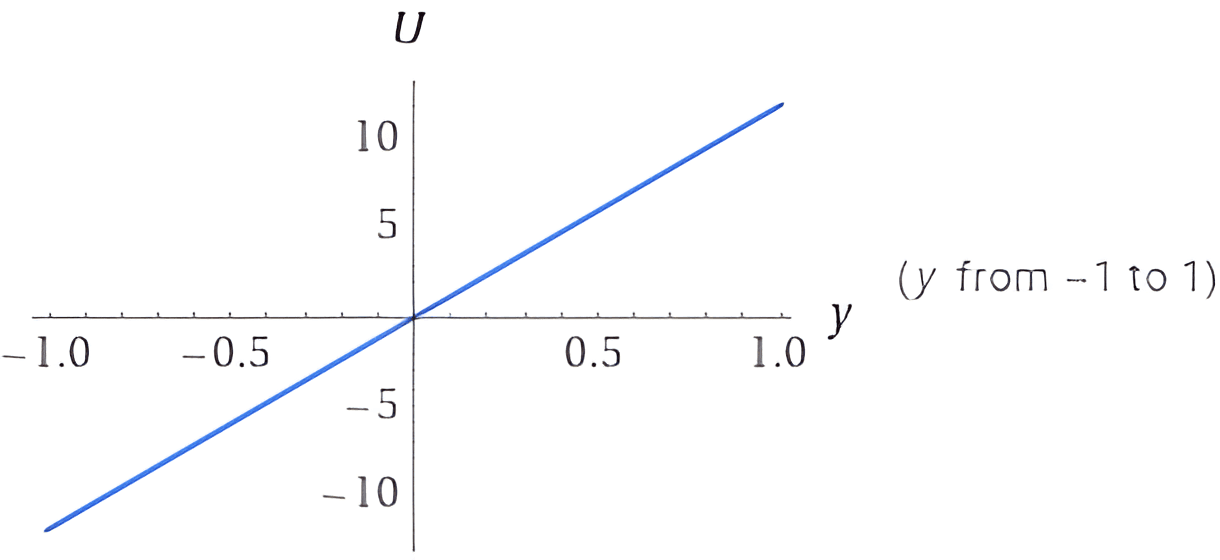
3. If a consumer is always indifferent between three units of x and four units of y, no matter how much x or y she consumes, then which of the following utility function can represent the consumer’s preference for these two goods?
A)U=x+y
B)U=3x+4y
C)U=(4x+3y)2
D)None of the above
Generated Graph
Solution by Steps
step 2
The utility function U=x+y implies a linear relationship, suggesting that the consumer is indifferent between any combination of x and y
step 3
The utility function U=3x+4y also suggests a linear relationship but with different weights, indicating a preference for y over x
step 4
The utility function U=(4x+3y)2 represents a quadratic relationship, which does not maintain the same level of indifference across different combinations of x and y
step 5
Therefore, the only function that maintains indifference between the specified quantities is U=x+y
A
Key Concept
Utility Functions
Explanation
Utility functions represent consumer preferences, and a linear function indicates constant marginal rates of substitution, which aligns with the consumer's indifference between the specified quantities.
4. Suppose a person allocates a given budget between two goods, food and clothing. If food is an inferior good, can you tell whether clothing is inferior or normal?
在这种情况下,如果食物是劣质商品,那么我们可以推断出关于服装的性质,但不能确定它是劣质商品还是正常商品。
劣质商品的定义是,当消费者的收入增加时,需求量减少。相反,正常商品是当消费者的收入增加时,需求量增加。
如果一个人将预算分配在食物和服装之间,并且食物是劣质商品,这意味着当他们的收入增加时,他们会购买更少的食物,可能会将更多的预算用于购买服装。在这种情况下,服装可能是正常商品,因为消费者在收入增加时可能会购买更多的服装。
然而,服装也可能是劣质商品,特别是在某些情况下,例如消费者可能会选择更便宜的服装而不是高档服装。因此,不能仅凭食物是劣质商品这一点来确定服装的性质。
总结来说,食物是劣质商品并不直接决定服装是劣质商品还是正常商品。我们需要更多的信息来做出明确的判断。
5. Jezz has a quasi-linear utility function, U(q1,q2) = q1 + 2ln(q2), and an income of 100andfacespricesp1=p2=20.a.SolveforJezz′soptimalbundle.b.SupposeJezz′sincomefallsto20. What is the optimal consumption bundle?
(Mathematical assistance: )

Solution by Steps
step 1
To find Jezz's optimal bundle, we set up the utility maximization problem subject to the budget constraint. The utility function is given by U(q1,q2)=q1+2ln(q2) and the budget constraint is 20q1+20q2=100
step 2
We can simplify the budget constraint to q1+q2=5. To maximize utility, we can express q1 in terms of q2: q1=5−q2
step 3
Substituting q1 into the utility function gives us U(q2)=(5−q2)+2ln(q2). To find the maximum, we take the derivative with respect to q2 and set it to zero: dq2dU=−1+q22=0
step 4
Solving for q2 gives q2=2. Substituting back to find q1: q1=5−2=3. Thus, the optimal bundle is (q1,q2)=(3,2)
step 5
If Jezz's income falls to $20, we repeat the process with the new budget constraint \( 20q_1 + 20q_2 = 20 \), simplifying to \( q_1 + q_2 = 1 \)
step 6
Again, we express q1 in terms of q2: q1=1−q2. Substituting into the utility function gives U(q2)=(1−q2)+2ln(q2)
step 7
Taking the derivative and setting it to zero: dq2dU=−1+q22=0 leads to q2=2, which is not feasible since q2 must be less than or equal to 1. Thus, we check the endpoints
step 8
At q2=1, q1=0 gives U(0,1)=0+2ln(1)=0. At q2=0, U(1,0) is undefined. Therefore, the optimal consumption bundle when income is $20 is \( (0, 1) \)
Answer
Jezz's optimal bundle is (3,2) when income is 100, and \( (0, 1) \) when income falls to 20.
Key Concept
Utility maximization under budget constraints
Explanation
The solution involves maximizing the utility function subject to the budget constraint, leading to optimal consumption bundles based on income levels.
A consumer is always indifferent between one unit of good A and one unit of good B, no matter how much A or B she consumes. Initially A is cheaper. However, a price increase makes A more expensive than B. Show the substitution, income and total effect of this price change in a diagram.
Solution by Steps
step 1
To illustrate the substitution effect, we start with the initial budget constraint where good A is cheaper than good B. The initial consumption point is determined by the intersection of the budget line and the indifference curve
step 2
After the price increase of good A, the new budget constraint shifts, making good A more expensive. The new consumption point reflects the substitution effect, where the consumer substitutes good B for good A due to the price change
step 3
The income effect is represented by the change in the consumer's purchasing power. As good A becomes more expensive, the consumer can afford less of good A, leading to a new consumption point that reflects the income effect
step 4
The total effect combines both the substitution and income effects, resulting in a new equilibrium point on a lower indifference curve, indicating a decrease in overall utility due to the price increase of good A
Answer
The diagram illustrates the substitution, income, and total effects of the price change on the consumption of goods A and B.
Key Concept
Substitution and income effects in consumer choice theory
Explanation
The substitution effect shows how consumers adjust their consumption in response to price changes, while the income effect reflects changes in purchasing power. Together, they explain the total effect of price changes on consumer behavior.
© 2023 AskSia.AI all rights reserved