
AskSia
Plus

10 In sports like bowling or golf, players often have a 'handicap' (h). A han...
Oct 14, 2024



Solution by Steps
step 1
The domain of the function h(s)=0.9(220−s) is determined by the values of s that make sense in the context of bowling scores. Since s represents a bowler's average score, it must be less than or equal to 220. Therefore, the domain is s≤220. The domain can be expressed as (−∞,220]
step 2
To find the inverse of the function h(s), we start with the equation h(s)=0.9(220−s). We will solve for s in terms of h. First, we set h=0.9(220−s) and rearrange: s=220−0.9h. Thus, the inverse function is h−1(h)=220−0.9h
step 3
To confirm the result graphically, we can plot both h(s) and its inverse h−1(h). The graph of the function and its inverse should be symmetric about the line y=x. This confirms that the inverse is indeed a function
step 4
To find the average score for an opponent whose handicap is 15, we substitute h=15 into the inverse function: s=220−0.915. Calculating this gives s=220−16.67≈203.33. Therefore, the average score for the opponent is approximately 203.33
Answer
The average score for an opponent whose handicap is 15 is approximately 203.33.
Key Concept
The concept of a handicap in sports allows for fair competition between players of different skill levels by adjusting scores.
Explanation
The handicap formula provides a way to calculate the adjusted score, and finding the inverse allows us to determine the original score based on the handicap. The domain restriction ensures that we only consider realistic bowling scores.
What is the range of the function h(s)=0.9(220−s) given its domain restrictions?
Solution by Steps
step 1
The domain of the function h(s)=0.9(220−s) is determined by the values of s that make sense in the context of bowling scores. Since s represents a bowler's average score, it must be less than or equal to 220. Therefore, the domain is s≤220. The domain can be expressed as (−∞,220]
step 2
To find the inverse of the function, we start with h(s)=0.9(220−s). Setting h(s)=y, we have y=0.9(220−s). Rearranging gives s=220−0.9y. Thus, the inverse function is h−1(y)=220−0.9y
step 3
To confirm the result graphically, we can plot both h(s) and h−1(y). The graph of the inverse will reflect over the line y=x, confirming that it is indeed a function
step 4
To find the average score for an opponent whose handicap is 15, we set h(s)=15. Thus, 15=0.9(220−s). Solving for s gives s=220−0.915≈203.33
Answer
The average score for an opponent whose handicap is 15 is approximately 203.33.
Key Concept
The function h(s) represents the calculation of a bowler's handicap based on their average score.
Explanation
The domain is restricted to ensure that the average score is realistic within the context of bowling, and the inverse function allows us to determine the average score based on a given handicap.

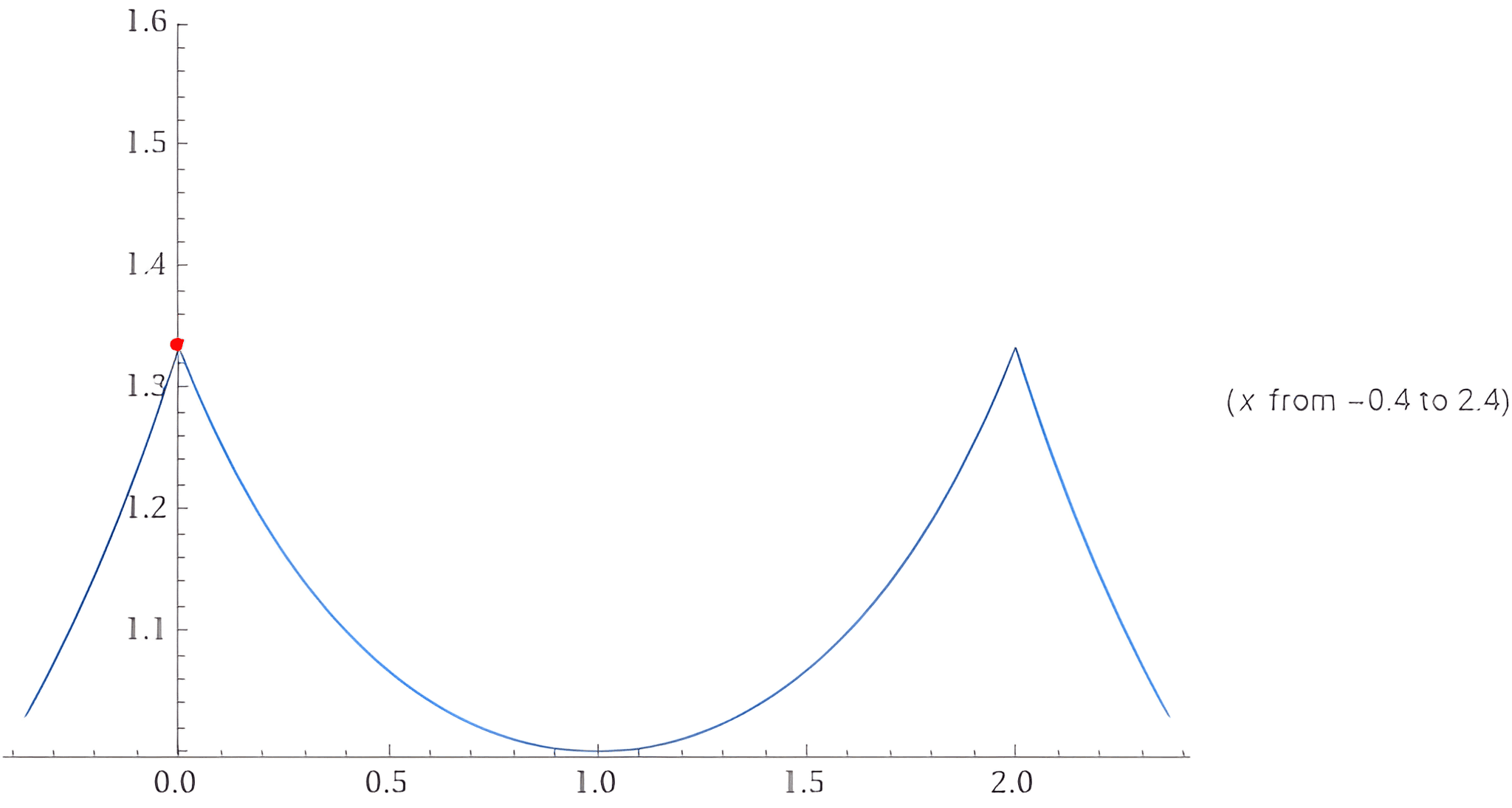
Generated Graph
Solution by Steps
step 1
To find the inverse of the function f(x)=5x−2, we start by replacing f(x) with y: y=5x−2
step 2
Next, we solve for x: y+2=5x⟹x=5y+2
step 3
Thus, the inverse function is f−1(y)=5y+2. The domain of f(x) is all real numbers, so the range of f−1(y) is also all real numbers
step 4
For the function f(x)=7−21x, we set y=7−21x
step 5
Solving for x: y−7=−21x⟹x=−2(y−7)=−2y+14
step 6
The inverse function is f−1(y)=−2y+14. The domain of f(x) is all real numbers, so the range of f−1(y) is also all real numbers
step 7
For the function f(x)=x2−3, we restrict the domain to x≥0 to ensure the inverse is a function
step 8
Setting y=x2−3, we solve for x: y+3=x2⟹x=y+3
step 9
The inverse function is f−1(y)=y+3 with the restricted domain y≥−3
step 10
For the function f(x)=1−x2, we restrict the domain to x≤1 to ensure the inverse is a function
step 11
Setting y=1−x2, we solve for x: x2=1−y⟹x=−1−y
step 12
The inverse function is f−1(y)=−1−y with the restricted domain y≤1
step 13
For the function f(x)=xx+1, we restrict the domain to x > 0 to ensure the inverse is a function
step 14
Setting y=xx+1, we solve for x: yx=x+1⟹x(y−1)=1⟹x=y−11
step 15
The inverse function is f−1(y)=y−11 with the restricted domain y=1
step 16
For the function f(x)=(x−2)2, we restrict the domain to x≥2 to ensure the inverse is a function
step 17
Setting y=(x−2)2, we solve for x: x−2=y⟹x=y+2
step 18
The inverse function is f−1(y)=y+2 with the restricted domain y≥0
Answer
The inverses of the functions are as follows:
1. f−1(y)=5y+2
2. f−1(y)=−2y+14
3. f−1(y)=y+3 (restricted to y≥−3)
4. f−1(y)=−1−y (restricted to y≤1)
5. f−1(y)=y−11 (restricted to y=1)
6. f−1(y)=y+2 (restricted to y≥0)
Key Concept
Finding the inverse of a function involves solving for the variable in terms of the output variable, and sometimes restricting the domain to ensure the inverse is also a function.
Explanation
The inverses were derived by algebraically manipulating the original functions, and domain restrictions were applied where necessary to maintain the function property of the inverses.
© 2023 AskSia.AI all rights reserved