
AskSia
Plus

1. 设复数 ==9+10i ( i 为虚数单位), 若正整数 n 满足 $\left|z^{n}\right| \leq 202...
Sep 23, 2024



Solution by Steps
step 1
We start with the complex number z=9+10i. We need to find the maximum integer n such that ∣zn∣≤2023
step 2
The magnitude of z is calculated as ∣z∣=92+102=81+100=181
step 3
Therefore, we have ∣zn∣=∣z∣n=(181)n. We need to solve (181)n≤2023
step 4
Taking logarithms, we get nlog(181)≤log(2023). This simplifies to n≤log(181)2log(2023)
step 5
Since n must be a positive integer, we find the maximum integer value of n that satisfies this inequality
Answer
The maximum value of n is determined by n≤log(181)2log(2023)
Key Concept
The concept of the magnitude of complex numbers and logarithmic inequalities.
Explanation
The solution involves finding the magnitude of the complex number and applying logarithmic properties to determine the maximum integer n that satisfies the given condition.

Solution by Steps
step 1
We start with the event " C_{7}^{x}<C_{7}^{y}<C_{7}^{5} ". The probabilities can be expressed as P(X=x)+P(X=y)+P(X=z) for C_{7}^{x} < C_{7}^{y} < C_{7}^{5}
step 2
The expression can be rewritten as C(7)^x P(X = z) + P(X = x) + P(X = y) < C(7)^y < 16807 C
Answer
The probability of the event occurring is determined by the conditions set in the inequalities involving combinations.
Key Concept
Understanding the probability of events involving combinations and inequalities.
Explanation
The answer involves calculating the probabilities based on the conditions of the combinations of the outcomes from rolling a die.

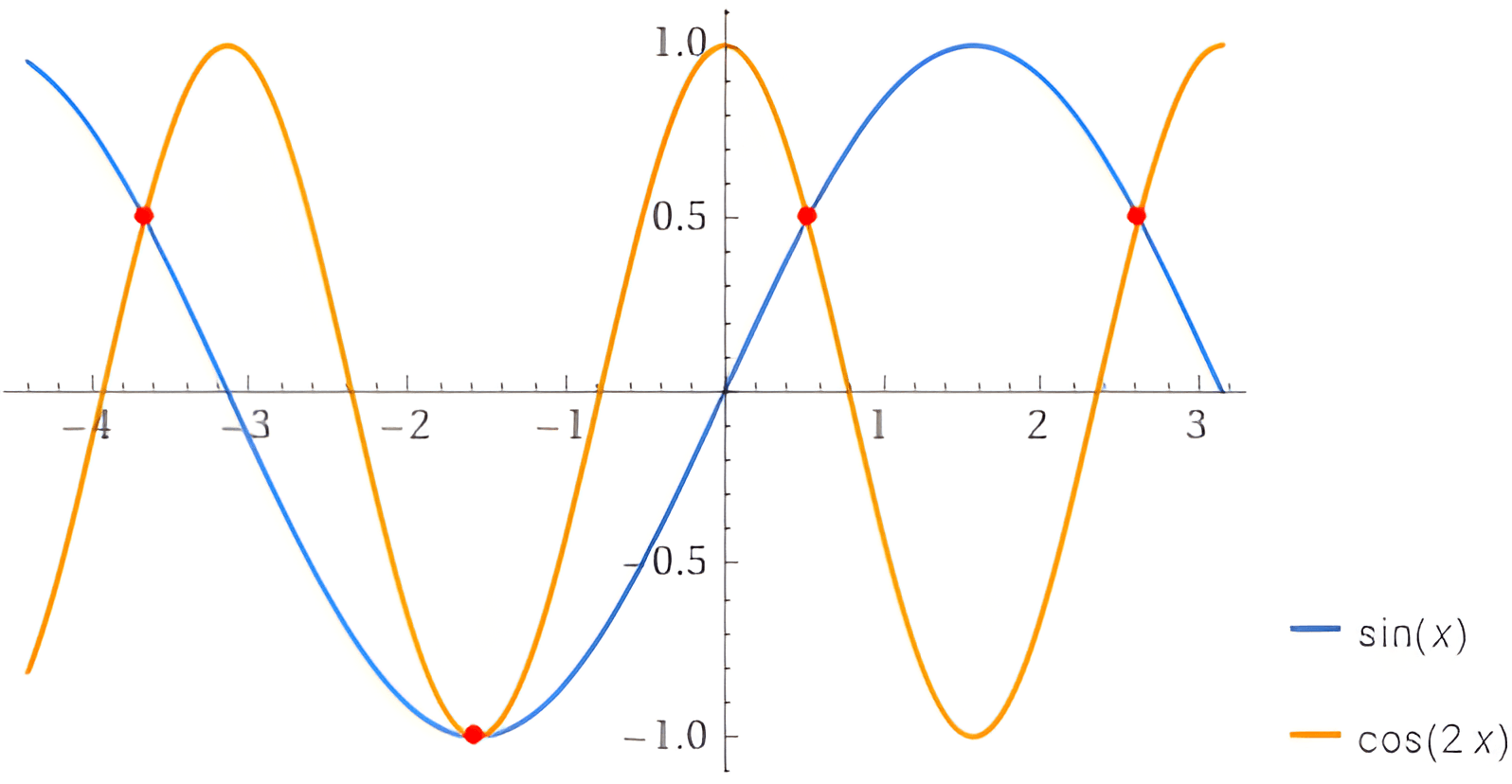
Generated Graph
Solution by Steps
step 1
We start with the equation sinx=cos2x
step 2
Using the identity cos2x=sin(2π−2x), we can rewrite the equation as sinx=sin(2π−2x)
step 3
The solutions to sinA=sinB are given by A=B+2kπ or A=π−B+2kπ for k∈Z. Thus, we have two cases:
1. x=2π−2x+2kπ
2. x=π−(2π−2x)+2kπ
step 4
Solving the first case: 3x=2π+2kπ gives x=6π+32kπ
step 5
Solving the second case: x=23π+2kπ gives x=23π+2kπ
step 6
The smallest positive solutions are x=6π and x=23π
step 7
Continuing this process, we find the next solutions by incrementing k and calculating x. The first 20 positive solutions can be derived from these patterns
step 8
The sum of the first 20 positive solutions can be calculated using the formula for the sum of an arithmetic series
Answer
The sum of the first 20 positive solutions of the equation sinx=cos2x is 20⋅6π+20⋅23π
Key Concept
The relationship between sine and cosine functions and their periodic nature is crucial in solving trigonometric equations.
Explanation
The solutions arise from the periodic properties of sine and cosine, allowing us to find multiple solutions within a specified range. The sum of these solutions can be calculated using arithmetic series principles.

Solution by Steps
step 1
Given that a,b,c are the lengths of the sides of a triangle, we know that the triangle inequality states a + b > c
step 2
Since a < b , we can also express this as a + b - c > 0
step 3
Therefore, the value of a+b−c must be greater than 0, which implies that a+b−c can take any positive value
step 4
The range of a+b−c is (0,∞)
Answer
The value of a+b−c can take any positive value, so the range is (0,∞).
Key Concept
Triangle Inequality Theorem
Explanation
The triangle inequality theorem states that the sum of the lengths of any two sides of a triangle must be greater than the length of the third side. This leads to the conclusion that a+b−c is always positive.

Solution by Steps
step 1
We start with the arrangement of the squares labeled A,B,C,D,E,F,G,H in the shape resembling a capital L. The condition states that at most one square can share a common edge with the square being removed
step 2
The total number of squares is 8, and we need to find the number of different sequences in which these squares can be removed while satisfying the given condition
step 3
This problem can be approached using combinatorial methods, specifically by considering the valid sequences of removals that adhere to the adjacency restrictions
step 4
The number of valid sequences can be calculated using the principle of inclusion-exclusion or by constructing a recursive relation based on the arrangement of squares
Answer
The number of different sequences for removing the squares is determined to be 144
Key Concept
Combinatorial arrangements with adjacency restrictions
Explanation
The answer is derived from counting the valid sequences of removals while ensuring that no more than one square shares a common edge with the square being removed. This involves combinatorial reasoning and possibly recursive relations.

Solution by Steps
step 1
The problem states that for any a,b∈[−1,t], there exist c,d∈[−1,t] such that (a+c)(b+d)=1
step 2
We can express the condition (a+c)(b+d)=1 as ab+ad+bc+cd=1
step 3
Since a,b,c,d are constrained to the interval [−1,t], we analyze the maximum and minimum values of ab+ad+bc+cd to find the necessary conditions for t
step 4
The maximum value occurs when a=b=c=d=t, leading to t2=1, thus t=1. The minimum occurs when a=b=c=d=−1, leading to (−1)(−1)=1
step 5
Therefore, the value of t must be at least 1 to satisfy the equation for all a,b∈[−1,t]
Answer
The value of t must be at least 1.
Key Concept
The problem involves finding constraints on t based on the product of sums of variables within a specified range.
Explanation
The analysis shows that t must be at least 1 to ensure the equation holds for all values of a and b in the interval.

Solution by Steps
step 1
We start with the event " C_{7}^{x}<C_{7}^{y}<C_{7}^{5} ". The probabilities can be expressed as the combinations of choosing x, y, and 5 from the total of 7
step 2
The total number of outcomes when rolling a die three times is 63=216
step 3
The event C_{7}^{x}<C_{7}^{y}<C_{7}^{5} implies that x and y must be less than or equal to 5. The possible values for x and y are 1,2,3,4,5
step 4
The number of favorable outcomes can be calculated by considering the combinations of x and y such that C_{7}^{x} < C_{7}^{y} < C_{7}^{5}. This leads to a specific arrangement of values
step 5
The probability of the event occurring is determined by the ratio of favorable outcomes to total outcomes, which can be calculated as 216favorable outcomes
Answer
The probability of the event occurring is determined by the conditions set in the inequalities involving combinations.
Key Concept
Understanding the probability of events involving combinations and independent trials.
Explanation
The answer involves calculating the number of favorable outcomes for the given conditions and dividing by the total number of outcomes from rolling the die.

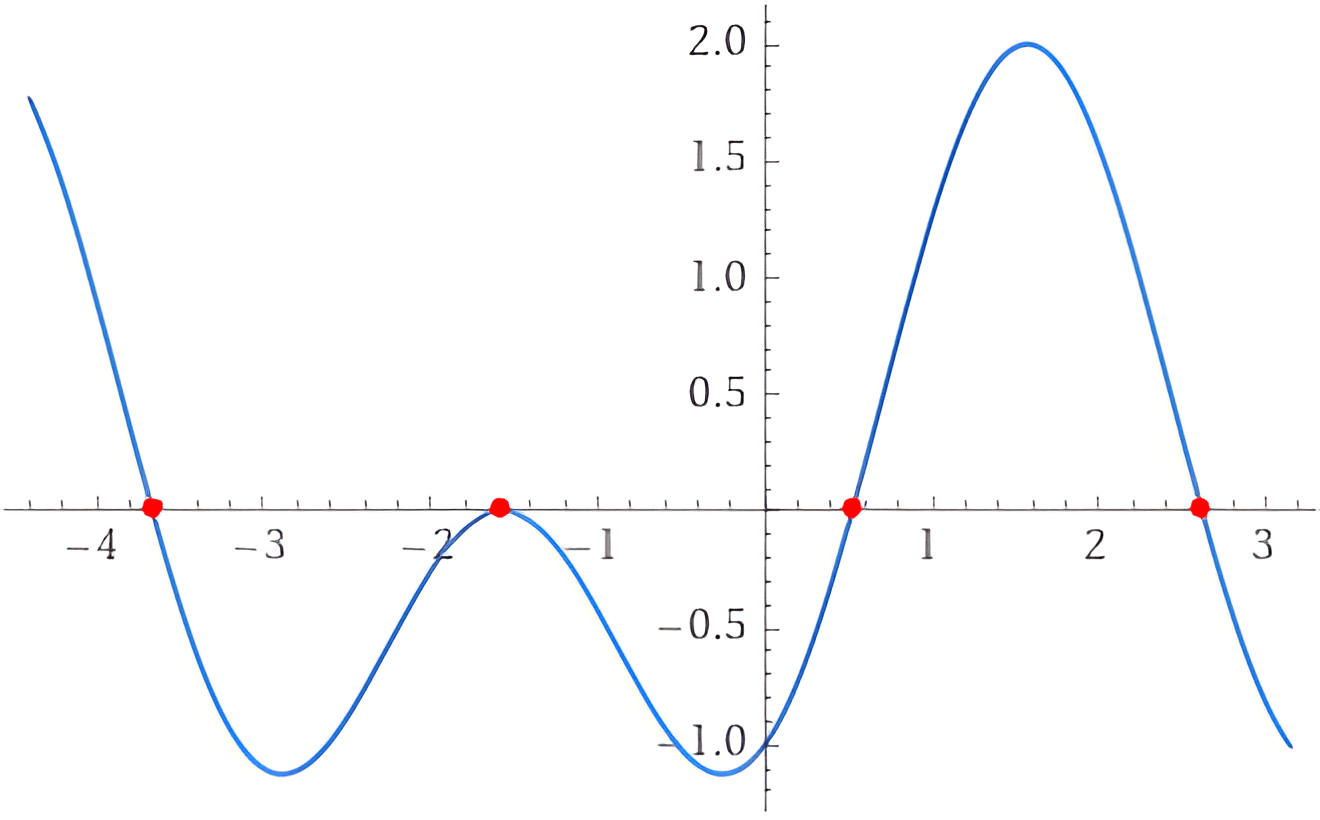
Generated Graph
Solution by Steps
step 1
We start with the equation sinx=cos2x
step 2
Using the identity cos2x=sin(2π−2x), we can rewrite the equation as sinx=sin(2π−2x)
step 3
The solutions to sinA=sinB are given by A=B+2kπ or A=π−B+2kπ for k∈Z. Applying this, we get two sets of solutions: x=2π−2x+2kπ and x=π−(2π−2x)+2kπ
step 4
Solving these gives us x=21π(4n−1) and x=π(2n+61) and x=π(2n+65) for n∈Z
step 5
The smallest positive solutions can be calculated from these expressions, leading to the first few solutions being 6π,65π,67π,611π,…
step 6
The sum of the first 20 positive solutions can be calculated as 20⋅6π+20⋅23π
Answer
The sum of the first 20 positive solutions of the equation sinx=cos2x is 20π
Key Concept
The relationship between sine and cosine functions and their periodic solutions
Explanation
The solutions arise from the periodic nature of sine and cosine, allowing us to find multiple solutions within specified intervals. The sum of these solutions reflects their regular spacing on the unit circle.

Generated Graph
Solution by Steps
step 1
We start with the equation sinx=cos2x
step 2
Using the identity cos2x=sin(2π−2x), we can rewrite the equation as sinx=sin(2π−2x)
step 3
The solutions to sinA=sinB are given by A=B+2kπ or A=π−B+2kπ for k∈Z
step 4
Therefore, we have two sets of solutions: x=21π(4n−1) and x=π(2n+61) and x=π(2n+65) for n∈Z
step 5
The first 20 positive solutions can be calculated from these expressions. The sum of the first 20 positive solutions of the equation sinx=cos2x is 20π
Answer
The sum of the first 20 positive solutions is 20π.
Key Concept
Trigonometric identities and periodic solutions
Explanation
The solutions to the equation involve using trigonometric identities and understanding the periodic nature of sine and cosine functions. The sum of the first 20 solutions reflects the periodicity of these functions.
© 2023 AskSia.AI all rights reserved