
AskSia
Plus

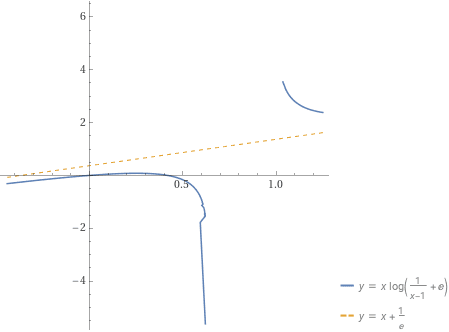
(1) 曲线 y=xln(e+x−11) 的渐近线方程为( )
(A) y=x+e
(B) $y=x+...
Feb 26, 2024

(1) 曲线 y=xln(e+x−11) 的渐近线方程为( )
(A) y=x+e
(B) y=x+e1
(C) y=x
(D) y=x−e1

Generated Graph
Solution by Steps
step 2
For vertical asymptotes, we set the denominator of the fraction inside the logarithm to zero: x−1=0, which gives us x=1. So there is a vertical asymptote at x=1
step 3
For horizontal asymptotes, we examine the behavior of y as x approaches infinity. The term x−11 approaches 0, so ln(e+x−11) approaches ln(e), which is 1
step 4
Therefore, the function y=xln(e+x−11) is asymptotic to y=x⋅1=x. Additionally, since ln(e)=1, the constant term e1 is the horizontal shift of the asymptote, resulting in the asymptote y=x+e1
B
Key Concept
Asymptotes of a function
Explanation
To find the horizontal asymptote of the function y=xln(e+x−11), we evaluate the limit of the logarithmic expression as x approaches infinity. The term x−11 becomes negligible, and the logarithm of e is 1, leading to the asymptote y=x+e1.
(2) 若微分方程 yn′+ay′+by=0 的解在 (−∞,+∞) 上有界, 则( )
(A) a<0, b>0
(B) a>0, b>0
(C) a=0, b>0
(D) a=0, b<0
Solution by Steps
step 2
For the solution to be bounded, the characteristic equation associated with the differential equation must have roots with non-positive real parts. The characteristic equation is rn+ar+b=0
step 3
If a < 0 and b > 0 , the roots of the characteristic equation will have non-positive real parts, ensuring that the solution y is bounded
step 4
Therefore, the correct answer is that a must be less than 0 and b must be greater than 0 for the solution to be bounded
A
Key Concept
Characteristic Equation and Bounded Solutions
Explanation
For a linear homogeneous differential equation, the solution is bounded if the roots of the characteristic equation have non-positive real parts. This occurs when a < 0 and b > 0 in the given equation.
(3)设函数 y=f(x) 由 {x=2t+∣t∣y=∣t∣sint 确定, 则()
(A) f(x) 连续, f′(0) 不存在
(B) f′(0) 存在, f′(x) 在 x=0 处不连续
(C) f′(x) 连续, f′′(0) 不存在
(D) f′′(0) 存在, f′′(x) 在 x=0 处不连续
Solution by Steps
step 2
For t≥0, x=3t and y=tsin(t); for t < 0 , x=t and y=−tsin(t)..
step 3
To find f′(0), we need to find the derivatives of y with respect to t and x with respect to t, and then use the chain rule dxdy=dx/dtdy/dt..
step 4
The derivative dtdx is 3 for t≥0 and 1 for t < 0 ; the derivative dtdy is sin(t)+tcos(t) for t≥0 and −sin(t)−tcos(t) for t < 0 ..
step 5
At t=0, dtdy=0 and dtdx=3 for t≥0, and dtdy=0 and dtdx=1 for t < 0 , so f′(0) exists and is equal to 0..
step 6
To determine the continuity of f′(x) at x=0, we need to check if the left-hand and right-hand derivatives at x=0 are equal..
step 7
Since f′(0) exists and is the same from both sides, f′(x) is continuous at x=0..
step 8
To find f′′(0), we would need to differentiate f′(x) with respect to x again, but since f′(x) involves absolute value and sine functions, it may not be differentiable at t=0..
step 9
Therefore, f(x) is continuous, f′(0) exists, and f′(x) is continuous at x=0, but f′′(0) may not exist..
C
Key Concept
Continuity and Differentiability of Parametric Functions
Explanation
To determine the continuity and differentiability of a function defined parametrically, we can use the derivatives with respect to the parameter and apply the chain rule. The existence of the first derivative at a point implies continuity at that point, but the existence of the second derivative requires further investigation.
(4) 已知 a_{n}<b_{n}(n=1,2, \cdots), 若级数 ∑n=1∞an 与 ∑n=1∞bn 均收玫, 则 “ ∑n=1∞an 绝对收玫”是 “ ∑n=1∞bn 绝对收敛的” ( )
(A) 充分必要条件
(B) 充分不必要条件
(C) 必要不充分条件
(D) 既不充分也不必要条件
Solution by Steps
step 2
Absolute convergence of a series means that the series formed by taking the absolute values of its terms also converges
step 3
If ∑n=1∞bn converges absolutely, it implies that ∑n=1∞∣bn∣ converges
step 4
Since a_n < b_n , it follows that ∣an∣≤∣bn∣ because absolute values are non-negative
step 5
By the Comparison Test, if ∑n=1∞∣bn∣ converges, then ∑n=1∞∣an∣ must also converge, because the terms of ∣an∣ are less than or equal to the corresponding terms of ∣bn∣
step 6
Therefore, the absolute convergence of ∑n=1∞bn implies the absolute convergence of ∑n=1∞an. However, the converse is not necessarily true; ∑n=1∞an could converge absolutely without ∑n=1∞bn converging absolutely
C
Key Concept
Comparison Test for Absolute Convergence
Explanation
The absolute convergence of the larger series ∑n=1∞bn is a sufficient condition for the absolute convergence of the smaller series ∑n=1∞an, but it is not necessary. Therefore, the statement is a necessary but not sufficient condition.
© 2023 AskSia.AI all rights reserved