
AskSia
Plus

1. Suppose U.S. market demand for Chinese produced automobiles is Q=120,000−P...
Jun 10, 2024



Generated Graph
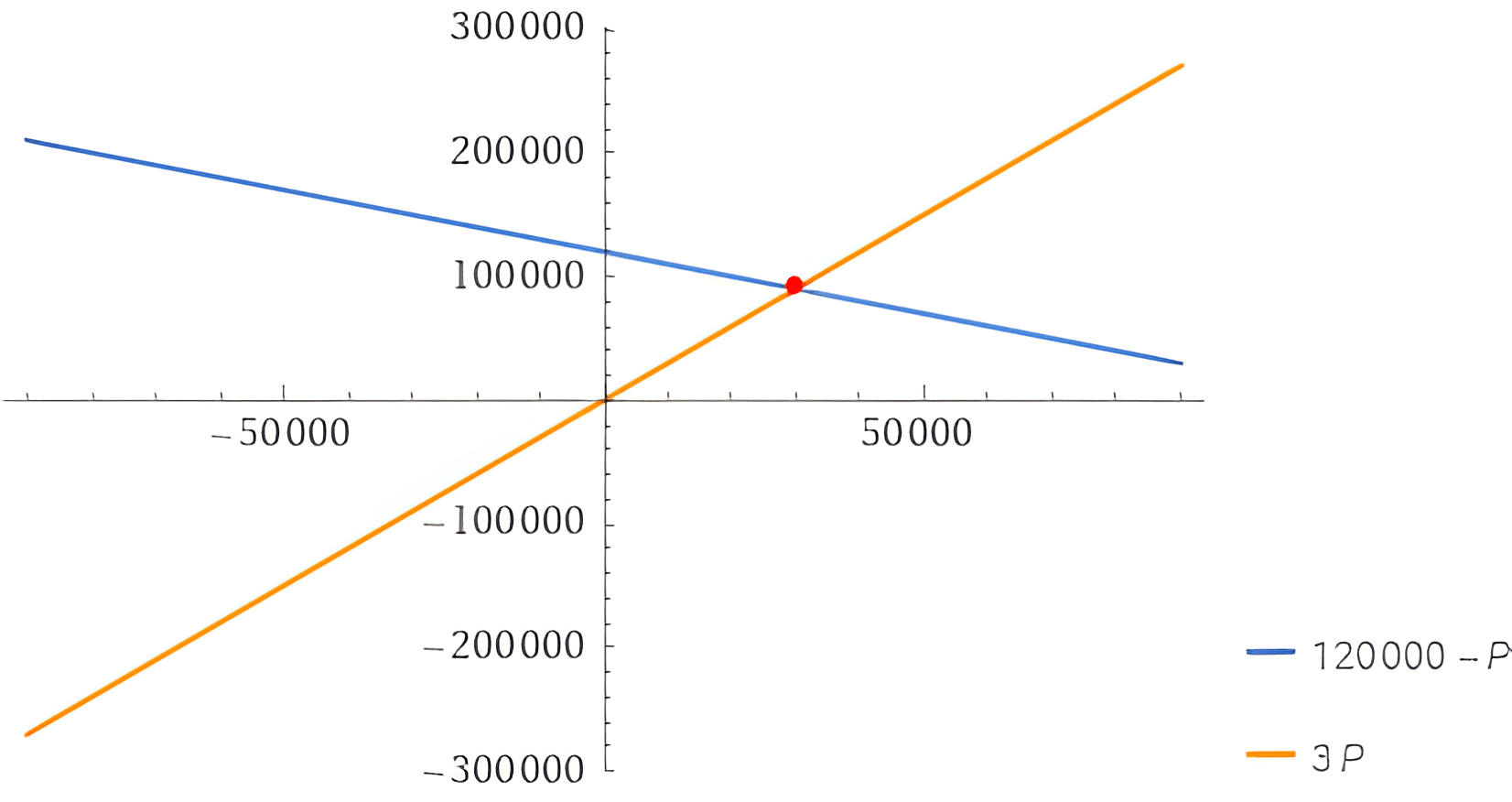
Solution by Steps
step 1
To determine who bears the most burden of the tariff, we need to find the equilibrium price and quantity without the tariff
step 2
Set the demand equal to the supply: 120,000−P=3P
step 3
Solve for P: 120,000=4P⟹P=4120,000=30,000
step 4
Substitute P=30,000 back into either the demand or supply equation to find Q: Q=3×30,000=90,000
step 5
With the tariff, the new price is P+t. Let t be the tariff amount
step 6
The new demand equation is Q=120,000−(P+t)
step 7
The new supply equation is Q=3(P−t)
step 8
Set the new demand equal to the new supply: 120,000−(P+t)=3(P−t)
step 9
Solve for P: 120,000−P−t=3P−3t⟹120,000−t=4P−3t⟹120,000+2t=4P⟹P=4120,000+2t
step 10
The burden on consumers is the increase in price, and the burden on producers is the decrease in price they receive
step 1
To find the impact of the tariff on welfare, we need to calculate the changes in consumer surplus, producer surplus, and government revenue
step 2
Consumer surplus without tariff: 21×(120,000−30,000)×90,000=21×90,000×90,000=4,050,000,000
step 3
Producer surplus without tariff: 21×30,000×90,000=1,350,000,000
step 4
Government revenue with tariff: t×Q
step 5
Deadweight loss: 21×t×(Qwithout tariff−Qwith tariff)
step 6
Calculate the new equilibrium quantity with the tariff: Q=3(P−t)
step 7
Substitute P=4120,000+2t into the supply equation: Q=3(4120,000+2t−t)
step 8
Simplify to find Q: Q=3(4120,000+2t−4t)=3(4120,000−2t)=43×(120,000−2t)=90,000−23t
step 9
Calculate the changes in consumer and producer surplus with the new quantity and price
step 10
Sum the changes to find the overall impact on welfare
Answer
The U.S. consumers bear the most burden of the tariff.
The impact of the tariff on the welfare of the U.S. overall is a decrease in consumer and producer surplus, partially offset by government revenue, resulting in a net welfare loss. The world overall experiences a net welfare loss due to the deadweight loss.
Key Concept
Tariff Burden and Welfare Analysis
Explanation
The burden of a tariff is shared between consumers and producers, but the exact distribution depends on the relative elasticities of demand and supply. The welfare analysis involves calculating changes in consumer surplus, producer surplus, and government revenue to determine the overall impact.
© 2023 AskSia.AI all rights reserved