
AskSia
Plus

1. Parts (a) and (b) of this question are unrelated and can be done independent...
Jun 19, 2024



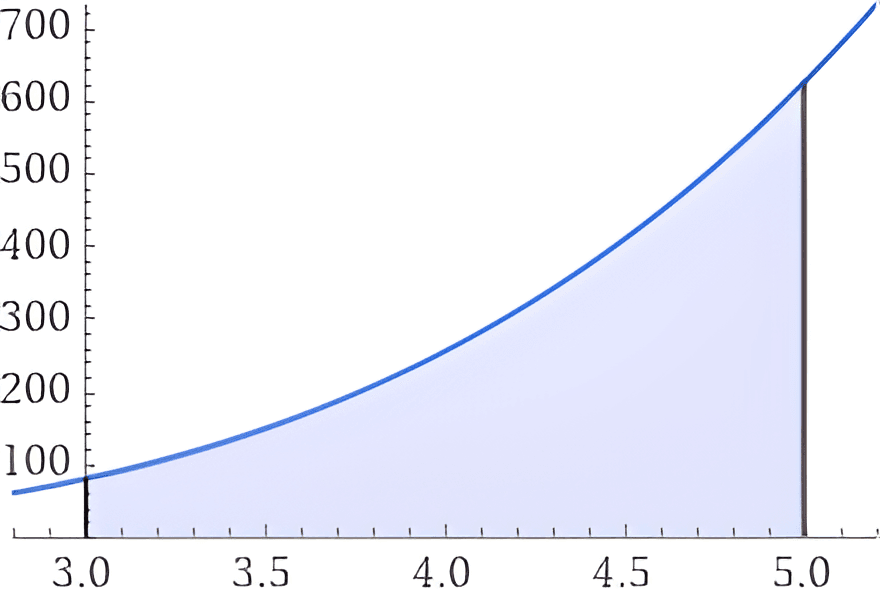
Generated Graph
Solution by Steps
step 1
We need to prove that A∩B∩C⊂A⊂A∪B∪C
step 2
By definition, A∩B∩C is the set of all elements that are in A, B, and C. Therefore, A∩B∩C⊂A
step 3
Since A is a subset of A∪B∪C (because A∪B∪C contains all elements of A, B, and C), we have A⊂A∪B∪C
step 4
Combining these, we get A∩B∩C⊂A⊂A∪B∪C
step 5
Similarly, A∩B∩C⊂B⊂A∪B∪C and A∩B∩C⊂C⊂A∪B∪C can be shown using the same logic
step 1
We need to show that ∣A1∪A2∣≤∣A1∣+∣A2∣
step 2
By the principle of inclusion-exclusion, ∣A1∪A2∣=∣A1∣+∣A2∣−∣A1∩A2∣
step 3
Since ∣A1∩A2∣≥0, it follows that ∣A1∪A2∣≤∣A1∣+∣A2∣
step 1
We need to show by induction that ∣A1∪A2∪⋯∪Ak∣≤∑i=1k∣Ai∣
step 2
Base Case: For k=1, ∣A1∣=∣A1∣, which is true
step 3
Inductive Step: Assume the statement is true for k=n, i.e., ∣A1∪A2∪⋯∪An∣≤∑i=1n∣Ai∣
step 4
We need to show it is true for k=n+1. Consider ∣A1∪A2∪⋯∪An∪An+1∣
step 5
By the principle of inclusion-exclusion, ∣A1∪A2∪⋯∪An∪An+1∣=∣(A1∪A2∪⋯∪An)∪An+1∣
step 6
Using part (i), ∣(A1∪A2∪⋯∪An)∪An+1∣≤∣A1∪A2∪⋯∪An∣+∣An+1∣
step 7
By the inductive hypothesis, ∣A1∪A2∪⋯∪An∣≤∑i=1n∣Ai∣
step 8
Therefore, ∣A1∪A2∪⋯∪An∪An+1∣≤∑i=1n∣Ai∣+∣An+1∣=∑i=1n+1∣Ai∣
step 9
By induction, the statement is true for all positive integers k
Answer
The required proofs are provided for both parts (a) and (b).
Key Concept
Set Theory and Inclusion-Exclusion Principle
Explanation
The problem involves proving subset relations and using the principle of inclusion-exclusion to show inequalities involving the cardinalities of unions of sets.

Solution by Steps
step 1
Let's denote the statements as follows:
- p: I play footy.
- q: I study.
- r: I pass discrete mathematics.
The given statements can be translated into logical expressions:
1. If I play footy, I cannot study: p→¬q
2. Either I play footy, or I pass discrete mathematics: p∨r
3. I passed discrete mathematics: r
4. Therefore, I studied: q
step 2
We need to construct a truth table to determine the validity of the argument. The truth table will include all possible truth values for p, q, and r, and we will evaluate the expressions p→¬q, p∨r, and q.
pTTTTFFFFamp;qamp;Tamp;Tamp;Famp;Famp;Tamp;Tamp;Famp;Famp;ramp;Tamp;Famp;Tamp;Famp;Tamp;Famp;Tamp;Famp;p→¬qamp;Famp;Famp;Tamp;Tamp;Tamp;Tamp;Tamp;Tamp;p∨ramp;Tamp;Tamp;Tamp;Tamp;Tamp;Famp;Tamp;Famp;qamp;Tamp;Tamp;Famp;Famp;Tamp;Tamp;Famp;F
step 3
Now, we need to check if the premises lead to the conclusion. We combine the premises using logical AND and check if they imply the conclusion q.
(p→¬q)∧(p∨r)∧r→q
Evaluating this for each row in the truth table:
pTTTTFFFFamp;qamp;Tamp;Tamp;Famp;Famp;Tamp;Tamp;Famp;Famp;ramp;Tamp;Famp;Tamp;Famp;Tamp;Famp;Tamp;Famp;(p→¬q)amp;Famp;Famp;Tamp;Tamp;Tamp;Tamp;Tamp;Tamp;(p∨r)amp;Tamp;Tamp;Tamp;Tamp;Tamp;Famp;Tamp;Famp;ramp;Tamp;Famp;Tamp;Famp;Tamp;Famp;Tamp;Famp;(p→¬q)∧(p∨r)∧r→qamp;Tamp;Tamp;Famp;Tamp;Tamp;Tamp;Famp;T
step 4
From the truth table, we see that the expression (p→¬q)∧(p∨r)∧r→q is not always true. Specifically, it is false when p=T, q=F, and r=T. Therefore, the argument is not valid
Answer
The argument is not valid.
Key Concept
Truth Table Analysis
Explanation
By constructing a truth table and evaluating the logical expressions, we determined that the given argument does not hold true in all cases, thus it is not valid.

Solution by Steps
step 1
We start by proving that 100≡0(mod4)
step 2
Since 100=4×25, it is clear that 100 is divisible by 4. Therefore, 100≡0(mod4)
step 3
Next, we need to show that 10k×100≡0(mod4) for any positive integer k
step 4
Since 100≡0(mod4), multiplying both sides by 10k gives 10k×100≡10k×0≡0(mod4)
step 5
Now, we explain why if the number formed by the last 2 digits of N is divisible by 4, then a1×10+a0≡0(mod4)
step 6
The number formed by the last 2 digits of N is a1×10+a0. If this number is divisible by 4, then a1×10+a0≡0(mod4)
step 7
Finally, we prove that N is divisible by 4 if and only if the number formed by the last 2 digits of N is divisible by 4
step 8
We express N as N=ak×10k+ak−1×10k−1+⋯+a2×102+a1×10+a0
step 9
Since 10k×100≡0(mod4) for any k≥2, all terms except a1×10+a0 are congruent to 0(mod4)
step 10
Therefore, N≡a1×10+a0(mod4). If a1×10+a0≡0(mod4), then N≡0(mod4), proving that N is divisible by 4
Answer
N is divisible by 4 if and only if the number formed by the last 2 digits of N is divisible by 4.
Key Concept
Divisibility by 4
Explanation
A number is divisible by 4 if and only if the number formed by its last two digits is divisible by 4. This is because the higher powers of 10 are all divisible by 4, leaving only the last two digits to determine divisibility.

Solution by Steps
step 1
To find the Theta notation for the function f(n)=n100+5nen+3en+log(n), we need to identify the term that grows the fastest as n approaches infinity
step 2
Among the terms n100, 5nen, 3en, and log(n), the term 5nen grows the fastest because the exponential function en dominates polynomial and logarithmic growth
step 3
Therefore, f(n)=Θ(nen)
step 4
For the function g(n)=(4n−1)2(n−3), we first expand the expression
step 5
Expanding (4n−1)2 gives 16n2−8n+1
step 6
Multiplying this by (n−3), we get g(n)=16n3−48n2−8n2+24n+n−3
step 7
Simplifying, we get g(n)=16n3−56n2+25n−3
step 8
The term 16n3 dominates as n approaches infinity
step 9
Therefore, g(n)=Θ(n3)
step 10
For the function h(n)=n2+2n+1n3log(n)+log(n)+100e−n, we first simplify the denominator
step 11
The denominator n2+2n+1 can be approximated as n2 for large n
step 12
The numerator n3log(n)+log(n)+100e−n is dominated by n3log(n) for large n
step 13
Therefore, h(n)≈n2n3log(n)=nlog(n)
step 14
Hence, h(n)=Θ(nlog(n))
Answer
f(n)=Θ(nen), g(n)=Θ(n3), h(n)=Θ(nlog(n))
Key Concept
Theta notation
Explanation
Theta notation describes the asymptotic behavior of functions, focusing on the term that grows the fastest as n approaches infinity.

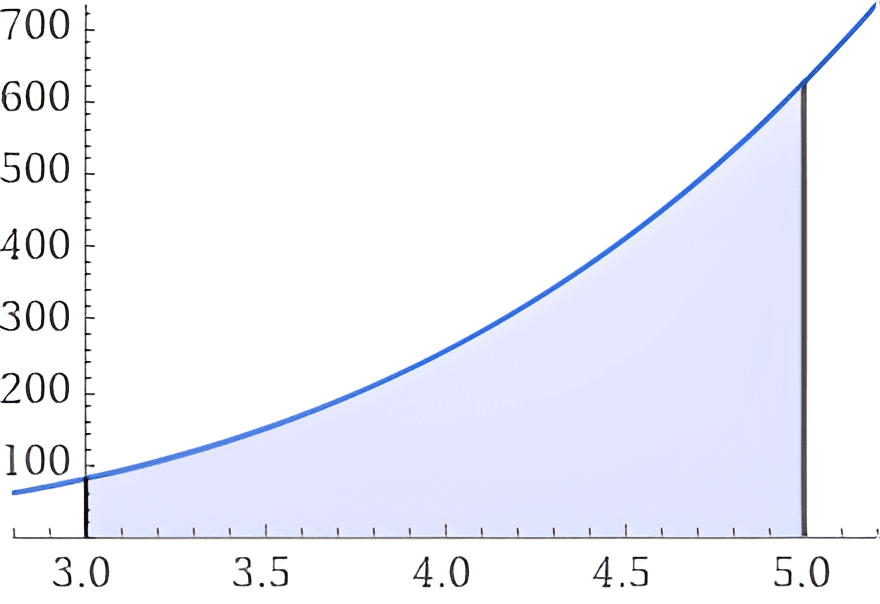
Generated Graph
Solution by Steps
step 1
To show that 2n=∑k=0n(kn) using a counting argument, we start by considering the number of ways to form a sequence of n binary digits (each digit can be either 0 or 1)
step 2
Each of the n positions in the sequence can be either 0 or 1, giving us 2 choices per position. Therefore, the total number of sequences is 2n
step 3
Now, consider the same problem from a different perspective. We can count the number of sequences by considering the number of 1s in the sequence
step 4
For each k from 0 to n, there are (kn) ways to choose k positions out of n to place the 1s, with the remaining positions being 0s
step 5
Summing over all possible values of k (from 0 to n), we get the total number of sequences as ∑k=0n(kn)
step 6
Since both methods count the same set of sequences, we have 2n=∑k=0n(kn)
Answer
2n=∑k=0n(kn)
Key Concept
Counting binary sequences
Explanation
We used two different counting methods to show that the number of binary sequences of length n is equal to both 2n and ∑k=0n(kn).

Solution by Steps
step 1
We need to find the number of integer solutions to the equation x1+x2+x3=30 where xi≥0 for all i. This is a classic "stars and bars" problem
step 2
The formula for the number of non-negative integer solutions to the equation x1+x2+⋯+xk=n is given by (k−1n+k−1)
step 3
Here, n=30 and k=3. So, we need to calculate (3−130+3−1)=(232)
step 4
Calculate (232)=2⋅132⋅31=496
(a) Answer
496
step 1
We need to find the number of integer solutions to the equation x1+x2+x3=30 where x_i > 0 for all i
step 2
We can transform this problem by setting xi′=xi−1 for all i. This ensures xi′≥0
step 3
The transformed equation becomes x1′+x2′+x3′=30−3=27
step 4
Using the "stars and bars" method again, we need to calculate (3−127+3−1)=(229)
step 5
Calculate (229)=2⋅129⋅28=406
(b) Answer
406
step 1
We need to find the number of integer solutions to the equation x1+x2+x3=30 where x1≥0, x2≥1, and x3≥2
step 2
We can transform this problem by setting x2′=x2−1 and x3′=x3−2. This ensures x2′≥0 and x3′≥0
step 3
The transformed equation becomes x1+x2′+x3′=30−1−2=27
step 4
Using the "stars and bars" method again, we need to calculate (3−127+3−1)=(229)
step 5
Calculate (229)=2⋅129⋅28=406
(c) Answer
406
Key Concept
Stars and Bars Method
Explanation
The stars and bars method is a combinatorial technique used to determine the number of ways to distribute indistinguishable objects (stars) into distinguishable bins (bars).

Solution by Steps
step 1
To solve the recurrence relation an+2−6an+1+9an=2 with initial conditions a0=1 and a1=3, we first find a constant solution to the non-homogeneous part
step 2
Assume a constant solution an=C. Substituting into the non-homogeneous equation, we get C−6C+9C=2, which simplifies to 4C=2. Solving for C, we find C=21
step 3
Next, we solve the homogeneous part an+2−6an+1+9an=0. The characteristic equation is r2−6r+9=0, which factors to (r−3)2=0. Thus, r=3 is a repeated root
step 4
The general solution to the homogeneous equation is an=c13n+c2n3n
step 5
Combining the homogeneous and particular solutions, the general solution to the non-homogeneous equation is an=c13n+c2n3n+21
step 6
Using the initial conditions a0=1 and a1=3, we solve for c1 and c2. Substituting n=0 into the general solution, we get 1=c1+21, so c1=21
step 7
Substituting n=1 into the general solution, we get 3=21⋅3+c2⋅1⋅3+21, which simplifies to 3=23+3c2+21. Solving for c2, we find c2=21
step 8
Therefore, the particular solution to the recurrence relation is an=213n+21n3n+21
Answer
an=213n+21n3n+21
Key Concept
Recurrence Relation Solution
Explanation
The solution involves finding a particular solution to the non-homogeneous part, solving the homogeneous part, and then using initial conditions to find the constants.

Solution by Steps
step 1
To determine if K2,1 is planar, we first draw the graph. K2,1 consists of 3 vertices: two vertices in one set {a,b} and one vertex in the other set {1}. The edges are a−1 and b−1
step 2
Euler's formula for planar graphs is V−E+F=2, where V is the number of vertices, E is the number of edges, and F is the number of faces. For K2,1, we have V=3, E=2, and F=1
step 3
Substituting into Euler's formula: 3−2+1=2. Therefore, Euler's formula holds for K2,1
step 4
To determine if K2,2 is planar, we draw the graph. K2,2 consists of 4 vertices: two vertices in one set {a,b} and two vertices in the other set {1,2}. The edges are a−1, a−2, b−1, and b−2
step 5
Euler's formula for planar graphs is V−E+F=2. For K2,2, we have V=4, E=4, and F=2
step 6
Substituting into Euler's formula: 4−4+2=2. Therefore, Euler's formula holds for K2,2
step 7
To prove by induction that K2,m is planar, we start with the base case m=1, which we have already shown to be planar
step 8
Assume K2,k is planar for some k≥1. We need to show that K2,k+1 is also planar
step 9
K2,k+1 can be obtained by adding one more vertex to the set of k vertices and connecting it to both vertices in the set {a,b}. Since K2,k is planar by the induction hypothesis, adding one more vertex and two edges does not violate planarity
step 10
Therefore, by induction, K2,m is planar for all positive integers m
step 11
To draw K2,m in a planar way, place the two vertices {a,b} on opposite sides of a circle and distribute the m vertices evenly around the circle, connecting each to both a and b
step 12
For an Euler tour in K2,m, we need all vertices to have even degrees. If m is odd, each vertex in {1,2,⋯,m} has degree 2 (even), but a and b each have degree m (odd). Therefore, there is no Euler tour if m is odd
step 13
If m is even, each vertex in {1,2,⋯,m} has degree 2 (even), and a and b each have degree m (even). Therefore, there is an Euler tour if m is even
Answer
K2,1 and K2,2 are planar, Euler's formula holds for both. K2,m is planar by induction. No Euler tour if m is odd; Euler tour exists if m is even.
Key Concept
Planarity and Euler's formula for bipartite graphs
Explanation
The key concept is understanding how to apply Euler's formula to determine the planarity of bipartite graphs and using induction to generalize the result. Additionally, the existence of Euler tours depends on the degree of vertices.
© 2023 AskSia.AI all rights reserved