
AskSia
Plus

1. Find the zeros of the polynomial function
\[
f(x)=x^{4}-2 x^{3}+4 x^{2}-8 x
...
May 21, 2024



Generated Graph
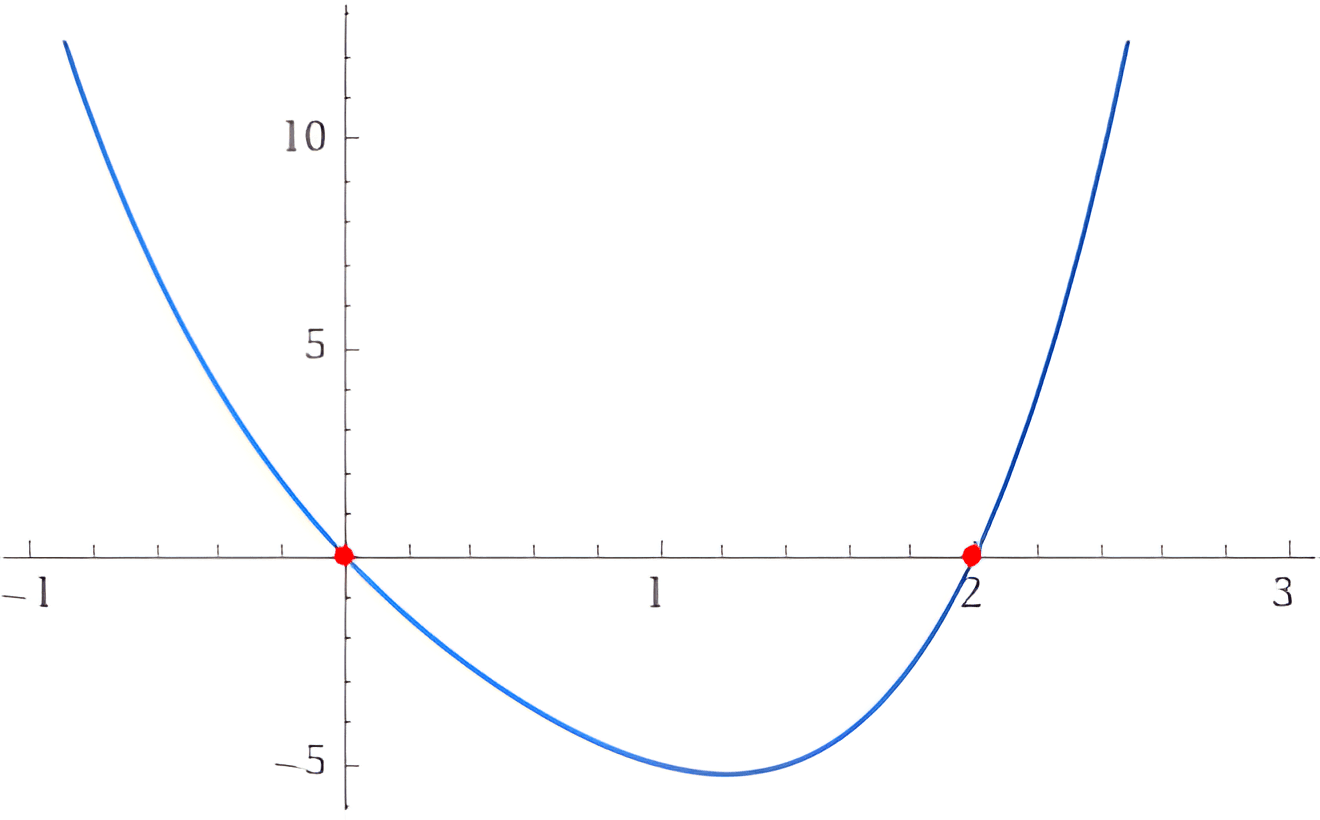
Solution by Steps
step 1
To find the zeros of the polynomial function f(x)=x4−2x3+4x2−8x, we start by factoring out the common term x
step 2
Factor out x from the polynomial: x(x3−2x2+4x−8)=0
step 3
Set each factor equal to zero: x=0 and x3−2x2+4x−8=0
step 4
Solve the cubic equation x3−2x2+4x−8=0. This can be done by finding the roots of the cubic polynomial
step 5
Using the Asksia-LL calculator result, the roots of the cubic polynomial x3−2x2+4x−8=0 are x=2 and x=±2i
step 6
Combine all the roots: x=0, x=2, and x=±2i
Answer
The zeros of the polynomial function f(x)=x4−2x3+4x2−8x are x=0, x=2, and x=±2i.
Key Concept
Finding the zeros of a polynomial function
Explanation
To find the zeros of a polynomial function, factor the polynomial and solve for the values of x that make each factor equal to zero.

Solution by Steps
step 1
To simplify i37, we start by recognizing that i is the imaginary unit, where i=−1
step 2
The powers of i cycle every 4 terms: i,−1,−i,1
step 3
To find i37, we determine the remainder of 37 divided by 4: 37mod4=1
step 4
Therefore, i37=i1=i
step 1
To simplify i77, we use the same approach as before
step 2
The powers of i cycle every 4 terms: i,−1,−i,1
step 3
To find i77, we determine the remainder of 77 divided by 4: 77mod4=1
step 4
Therefore, i77=i1=i
Answer
i37=i and i77=i
Key Concept
Powers of the imaginary unit i
Explanation
The powers of i cycle every 4 terms: i,−1,−i,1. By finding the remainder of the exponent divided by 4, we can determine the simplified form of any power of i.

Generated Graph
Solution by Steps
step 1
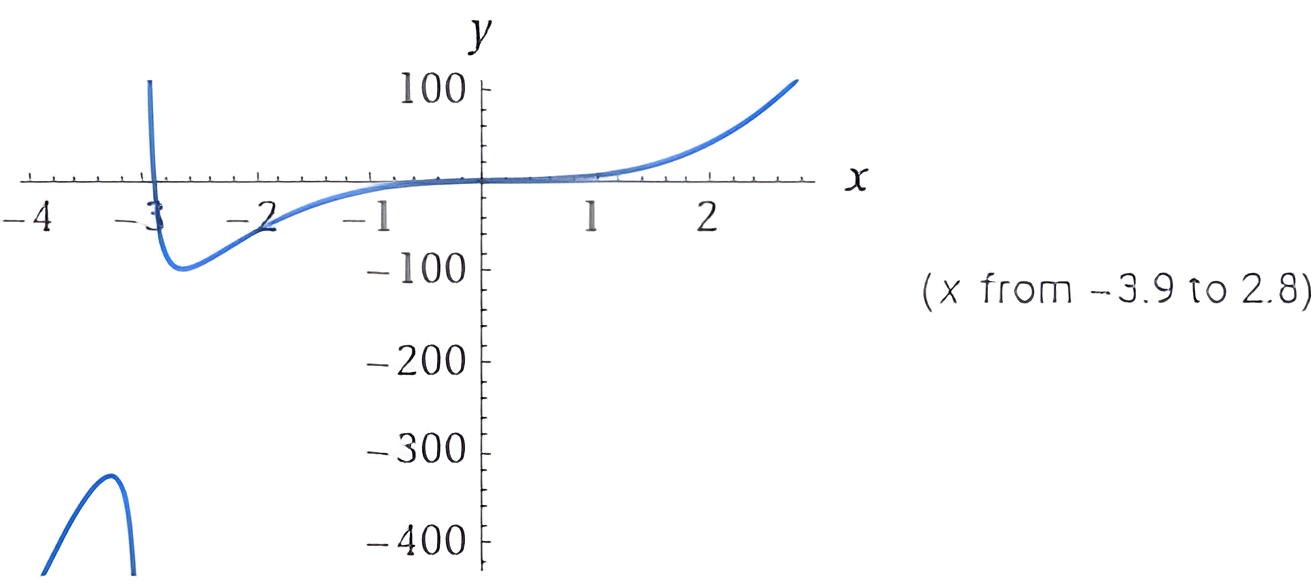
To find the remainder of the polynomial division (6x4+15x3−5x2+7x+3)÷(x+3), we use polynomial long division
step 2
Divide the leading term of the dividend 6x4 by the leading term of the divisor x, which gives 6x3
step 3
Multiply the entire divisor (x+3) by 6x3 to get 6x4+18x3. Subtract this from the original polynomial:
(6x4+15x3−5x2+7x+3)−(6x4+18x3)=−3x3−5x2+7x+3
step 4
Repeat the process with the new polynomial −3x3−5x2+7x+3. Divide −3x3 by x to get −3x2. Multiply the divisor by −3x2 to get −3x3−9x2. Subtract:
(−3x3−5x2+7x+3)−(−3x3−9x2)=4x2+7x+3
step 5
Continue with 4x2+7x+3. Divide 4x2 by x to get 4x. Multiply the divisor by 4x to get 4x2+12x. Subtract:
(4x2+7x+3)−(4x2+12x)=−5x+3
step 6
Finally, divide −5x by x to get −5. Multiply the divisor by −5 to get −5x−15. Subtract:
(−5x+3)−(−5x−15)=18
step 7
The remainder of the division is 18
Answer
The remainder is 18
Key Concept
Polynomial Long Division
Explanation
Polynomial long division is a method used to divide polynomials, similar to the long division of numbers. The remainder is the part of the dividend that is left over after the division process.

Generated Graph
Solution by Steps
step 1
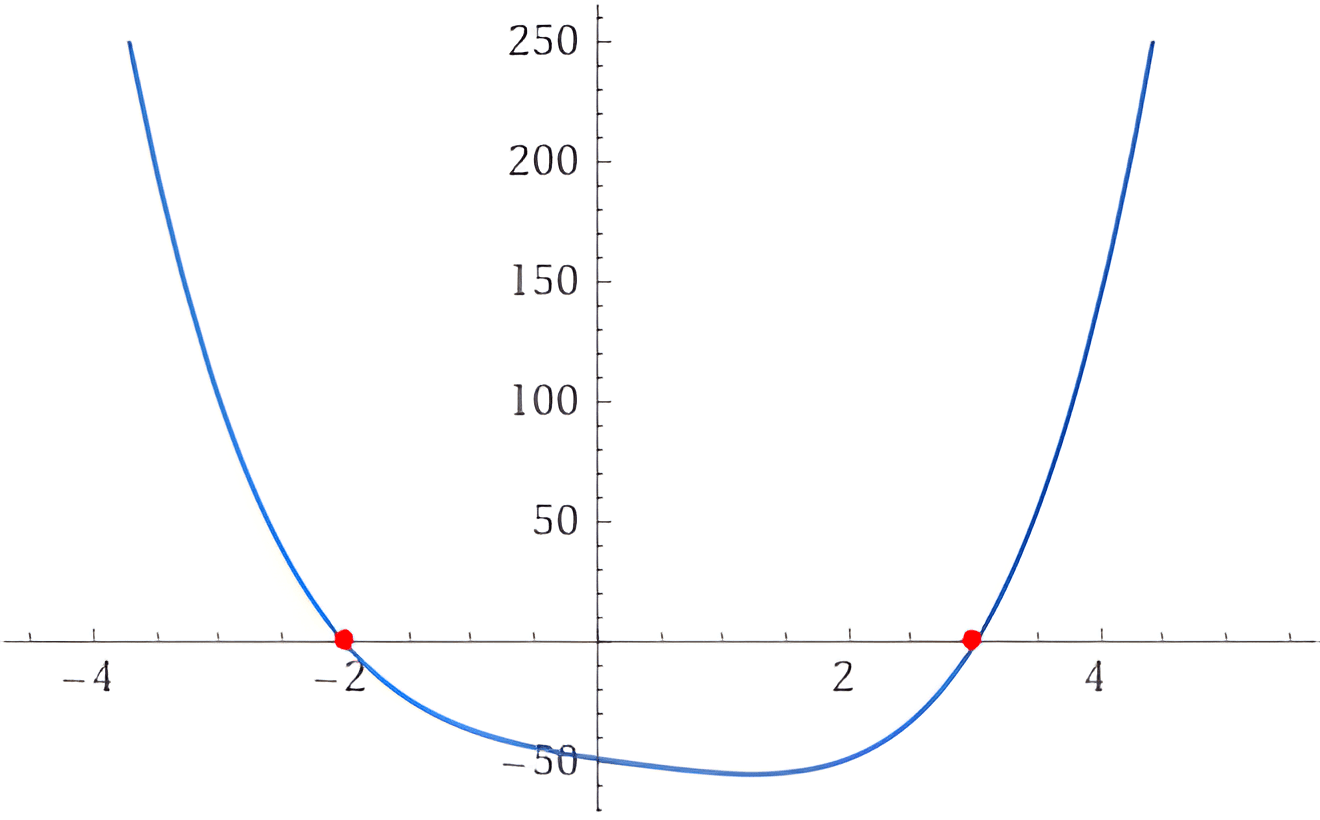
To find the rational zeros of the polynomial x4−x3+2x2−8x−48, we use the Rational Root Theorem. This theorem states that any rational solution, qp, of the polynomial equation must be a factor of the constant term (-48) divided by a factor of the leading coefficient (1)
step 2
The factors of the constant term (-48) are: ±1,±2,±3,±4,±6,±8,±12,±16,±24,±48. The factors of the leading coefficient (1) are: ±1. Therefore, the possible rational zeros are: ±1,±2,±3,±4,±6,±8,±12,±16,±24,±48
step 3
We test these possible rational zeros by substituting them into the polynomial x4−x3+2x2−8x−48 and checking if the result is zero
step 4
Testing x=−2: (−2)4−(−2)3+2(−2)2−8(−2)−48=16+8+8+16−48=0. Therefore, x=−2 is a rational zero
step 5
Testing x=3: (3)4−(3)3+2(3)2−8(3)−48=81−27+18−24−48=0. Therefore, x=3 is a rational zero
step 6
We have found two rational zeros: x=−2 and x=3
Answer
The rational zeros of the polynomial x4−x3+2x2−8x−48 are x=−2 and x=3.
Key Concept
Rational Root Theorem
Explanation
The Rational Root Theorem helps us find possible rational zeros of a polynomial by considering the factors of the constant term and the leading coefficient.

Solution by Steps
step 1
To simplify the fraction 1+6i5+2i, we multiply the numerator and the denominator by the conjugate of the denominator. The conjugate of 1+6i is 1−6i
step 2
Multiply the numerator and the denominator by 1−6i:
(1+6i)(1−6i)(5+2i)(1−6i)
step 3
Expand the numerator:
(5+2i)(1−6i)=5−30i+2i−12i2=5−28i+12=17−28i
(Note: i2=−1)
step 4
Expand the denominator:
(1+6i)(1−6i)=1−36i2=1+36=37
(Note: i2=−1)
step 5
Combine the results:
3717−28i=3717−3728i
step 6
Simplify the fraction:
3717−3728i≈0.459459459459459459459459459459459459459459459459459459459459459−0.756756756756756756756756756756756756756756756756756756756756756i
step 7
Express in polar form:
3729(cos(−tan−1(1728))+isin(−tan−1(1728)))
Answer
3717−3728i or approximately 0.459459459459459459459459459459459459459459459459459459459459459−0.756756756756756756756756756756756756756756756756756756756756756i
Key Concept
Simplifying complex fractions
Explanation
To simplify a complex fraction, multiply the numerator and the denominator by the conjugate of the denominator, then simplify the resulting expression.

Generated Graph
Solution by Steps
step 1
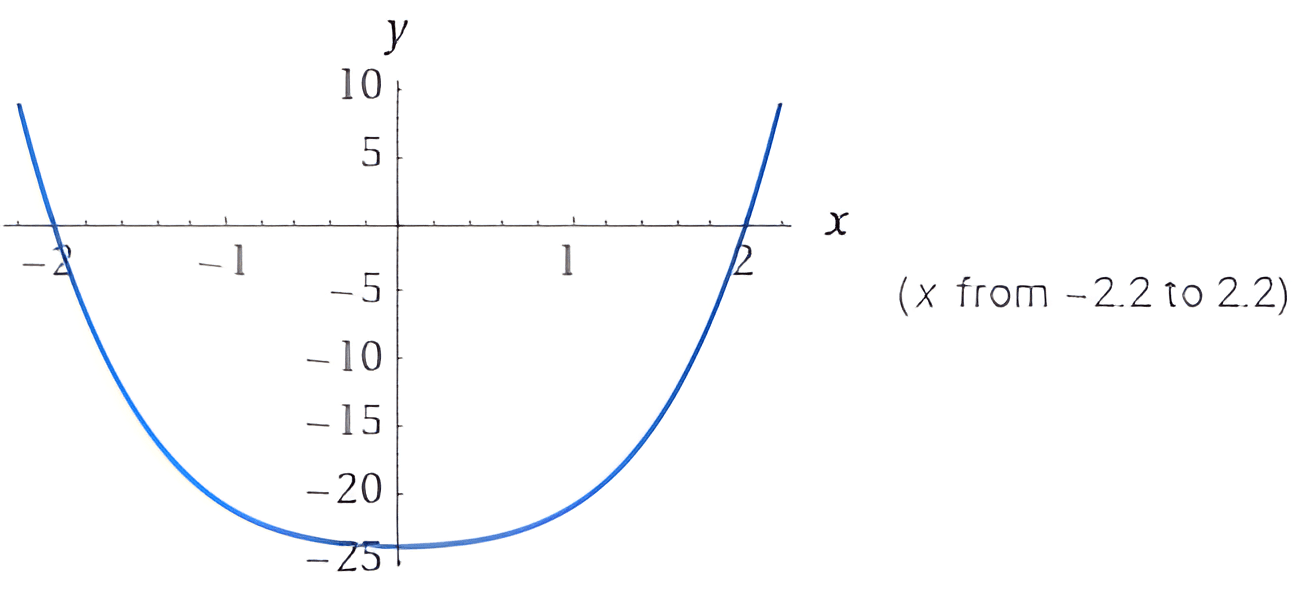
The given polynomial is x4+2x2−24. We need to factorize it
step 2
First, we look for possible factorizations. We can rewrite the polynomial as (x2)2+2(x2)−24
step 3
Let y=x2. Then the polynomial becomes y2+2y−24
step 4
We factorize y2+2y−24 as (y−4)(y+6)
step 5
Substituting back y=x2, we get (x2−4)(x2+6)
step 6
Further factorizing x2−4 as (x−2)(x+2), we get (x−2)(x+2)(x2+6)
step 7
The complete factorization of x4+2x2−24 is (x−2)(x+2)(x2+6)
Answer
The factors of x4+2x2−24 are (x−2)(x+2)(x2+6).
Key Concept
Factorization of polynomials
Explanation
To factorize a polynomial, we can use substitution to simplify the expression and then factorize it step by step. In this case, we substituted y=x2 to factorize the quadratic polynomial and then substituted back to get the factors in terms of x.

Generated Graph
Solution by Steps
step 1
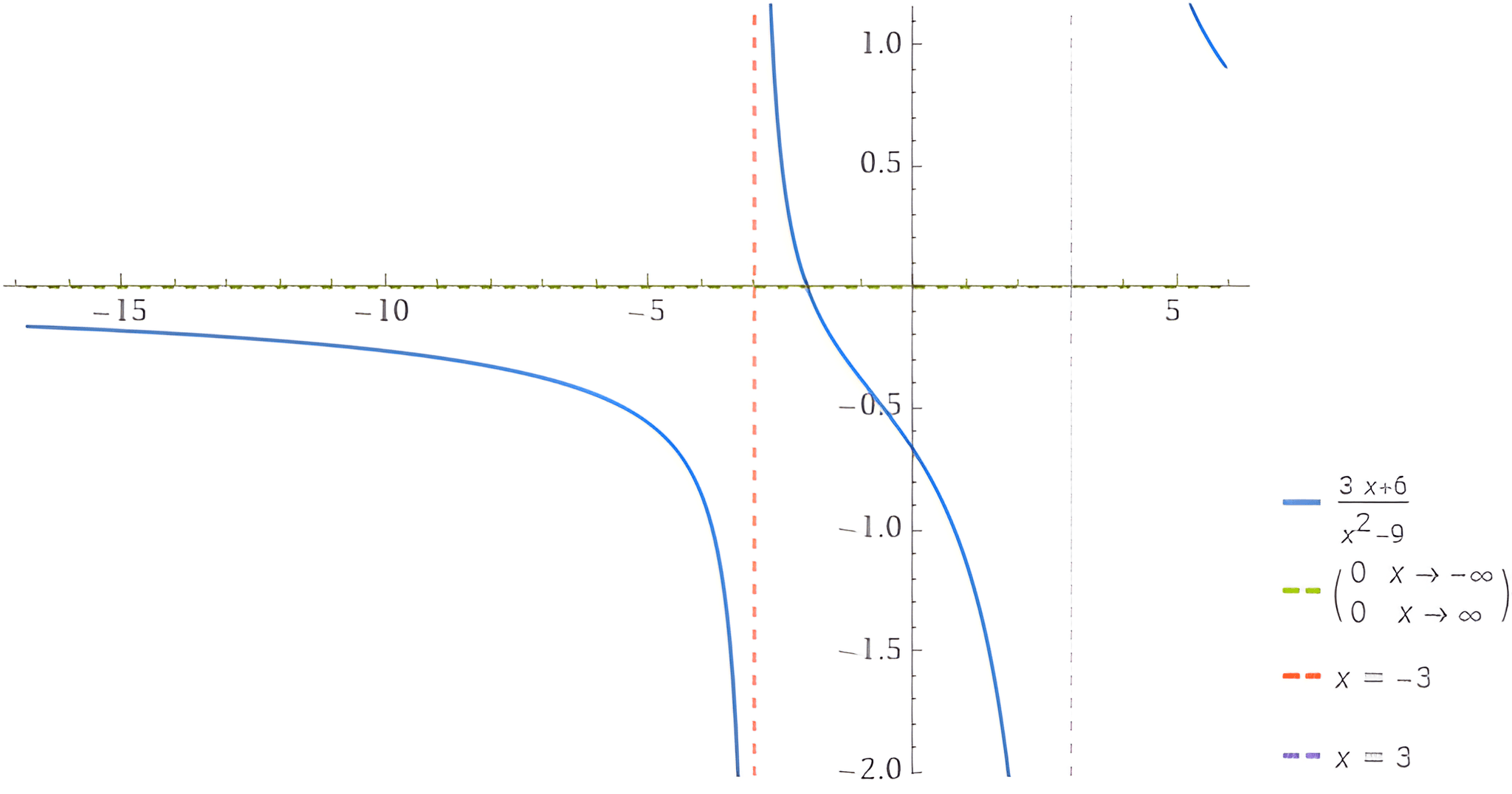
Identify the vertical asymptotes by setting the denominator equal to zero and solving for x
step 2
The denominator of the function f(x)=x2−93x+6 is x2−9. Set x2−9=0
step 3
Solve for x: x2−9=0⟹x2=9⟹x=±3. Therefore, the vertical asymptotes are x=3 and x=−3
step 4
Identify the horizontal asymptote by comparing the degrees of the numerator and the denominator
step 5
The degree of the numerator 3x+6 is 1, and the degree of the denominator x2−9 is 2. Since the degree of the numerator is less than the degree of the denominator, the horizontal asymptote is y=0
Answer
The vertical asymptotes are x=3 and x=−3, and the horizontal asymptote is y=0.
Key Concept
Asymptotes of Rational Functions
Explanation
Vertical asymptotes occur where the denominator is zero and the numerator is non-zero. Horizontal asymptotes are determined by the degrees of the numerator and denominator.

Generated Graph
Solution by Steps
step 1
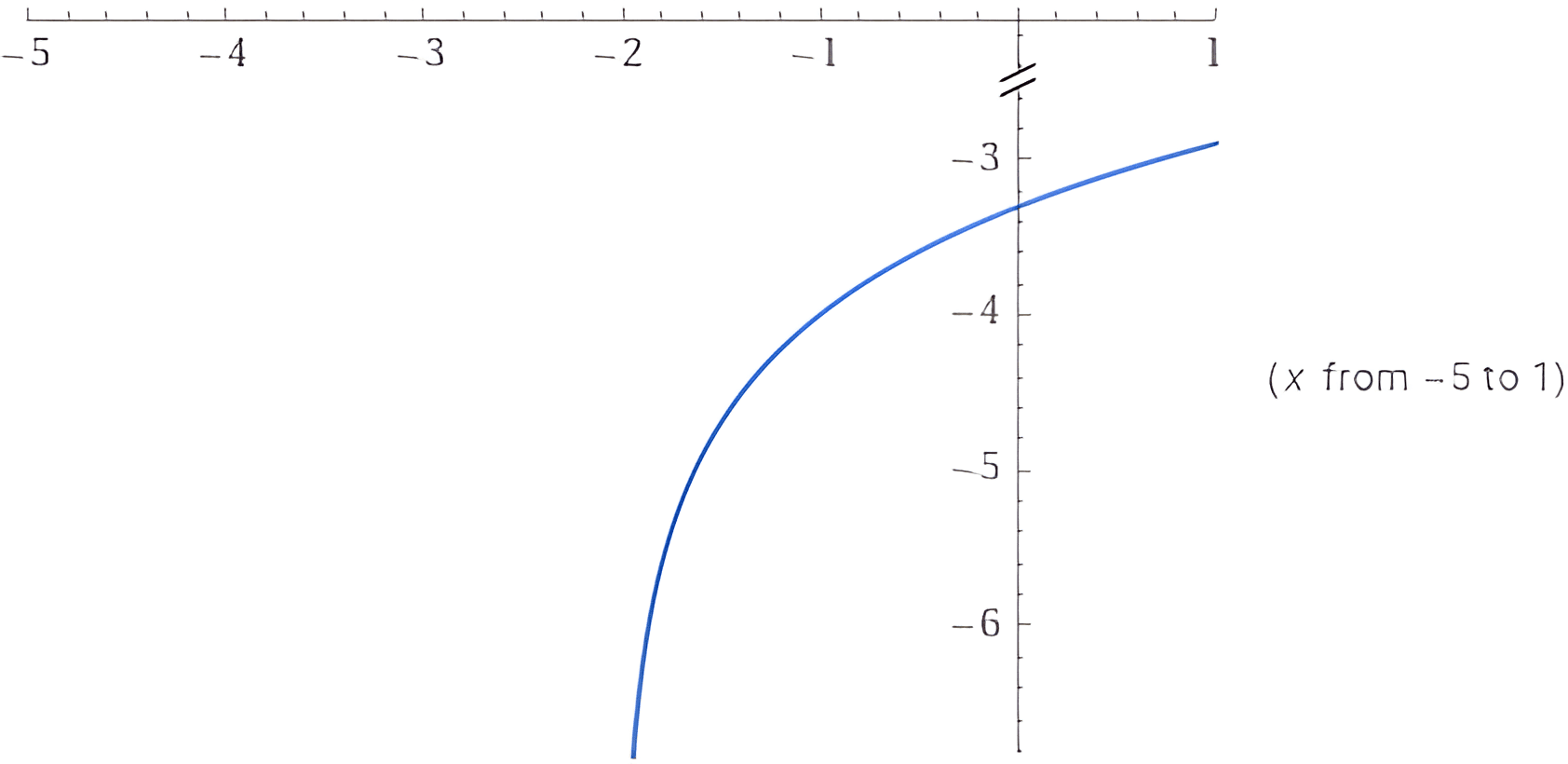
To determine the domain of the function f(x)=log(x+2)−4, we need to find the values of x for which the argument of the logarithm is positive
step 2
The argument of the logarithm is x+2. For log(x+2) to be defined, x + 2 > 0
step 3
Solving the inequality x + 2 > 0 gives x > -2. Therefore, the domain of f(x) is (−2,∞)
step 4
To determine the range of the function f(x)=log(x+2)−4, we note that the logarithmic function log(x+2) can take any real value
step 5
Since log(x+2) can be any real number, subtracting 4 from it will also result in any real number. Therefore, the range of f(x) is (−∞,∞)
Answer
The domain of f(x)=log(x+2)−4 is (−2,∞) and the range is (−∞,∞).
Key Concept
Domain and Range of Logarithmic Functions
Explanation
The domain of a logarithmic function log(x+a) is determined by the condition x + a > 0. The range of a logarithmic function is all real numbers, as the logarithm can take any real value.

Solution by Steps
step 1
Identify the given values: Present Value (PV) = $25000, Interest Rate (i) = 8\%, Compounding Frequency (f) = 52 (weekly), and Number of Years (n) = 20
step 2
Convert the interest rate to a decimal: i=1008=0.08
step 3
Calculate the total number of compounding periods: f⋅n=52⋅20=1040
step 4
Use the future value formula for compound interest: FV=PV(1+fi)f⋅n
step 5
Substitute the values into the formula: FV=25000(1+520.08)1040
step 6
Simplify the expression inside the parentheses: 1+520.08=1+0.00153846≈1.00153846
step 7
Raise the simplified expression to the power of 1040: 1.001538461040≈4.944
step 8
Multiply by the present value to find the future value: FV=25000⋅4.944≈123600
Answer
The amount in the account after 20 years is approximately $123,600.
Key Concept
Compound Interest
Explanation
Compound interest is calculated by applying the interest rate to the initial principal, which then accumulates interest over multiple periods. In this case, the interest is compounded weekly, leading to a significant increase in the future value over 20 years.

Solution by Steps
step 1
The given equation is loghi=j
step 2
To express this in exponential form, we use the definition of logarithms: logba=c is equivalent to bc=a
step 3
Applying this definition, we get hj=i
Answer
hj=i
Key Concept
Exponential Form of a Logarithmic Equation
Explanation
The exponential form of a logarithmic equation logba=c is bc=a. This transformation allows us to switch between logarithmic and exponential representations.

Solution by Steps
step 1
We need to evaluate the logarithm of 1251 with base 5
step 2
Recall that logb(a)=c means bc=a
step 3
We set up the equation: 5c=1251
step 4
Notice that 125=53, so 1251=5−3
step 5
Therefore, 5c=5−3
step 6
Since the bases are the same, we can equate the exponents: c=−3
step 7
Thus, log5(1251)=−3
Answer
−3
Key Concept
Logarithm Evaluation
Explanation
To evaluate log5(1251), we recognize that 1251 is the same as 5−3, leading us to the conclusion that the logarithm is −3.

Solution by Steps
step 1
We start by expanding the logarithmic expression log2(4mn3x2y4)
step 2
Using the properties of logarithms, we can separate the terms: log2(4mn3x2y4)=log2(x2y4)−log2(4mn3)
step 3
Further expanding, we get: log2(x2y4)=log2(x2)+log2(y4) and log2(4mn3)=log2(4)+log2(m)+log2(n3)
step 4
Applying the power rule of logarithms, we have: log2(x2)=2log2(x), log2(y4)=4log2(y), and log2(n3)=3log2(n)
step 5
Substituting these into our expression, we get: 2log2(x)+4log2(y)−(log2(4)+log2(m)+3log2(n))
step 6
Since log2(4)=2, the final expanded form is: 2log2(x)+4log2(y)−2−log2(m)−3log2(n)
Answer
2log2(x)+4log2(y)−2−log2(m)−3log2(n)
Key Concept
Logarithmic Expansion
Explanation
The properties of logarithms allow us to expand a complex logarithmic expression into simpler terms by using the product, quotient, and power rules.

Generated Graph
Solution by Steps
Question 13: Evaluate $\log_{3} 7$step 1
To evaluate log37, we use the change of base formula: logab=logalogb
step 2
Applying the change of base formula: log37=log3log7
step 3
Using a calculator to find the values: log7≈0.8451 and log3≈0.4771
step 4
Dividing the values: 0.47710.8451≈1.7712
Answer
log37≈1.7712
Key Concept
Change of Base Formula
Explanation
The change of base formula allows us to evaluate logarithms with any base by converting them to a ratio of common logarithms (base 10 or base e).
step 1
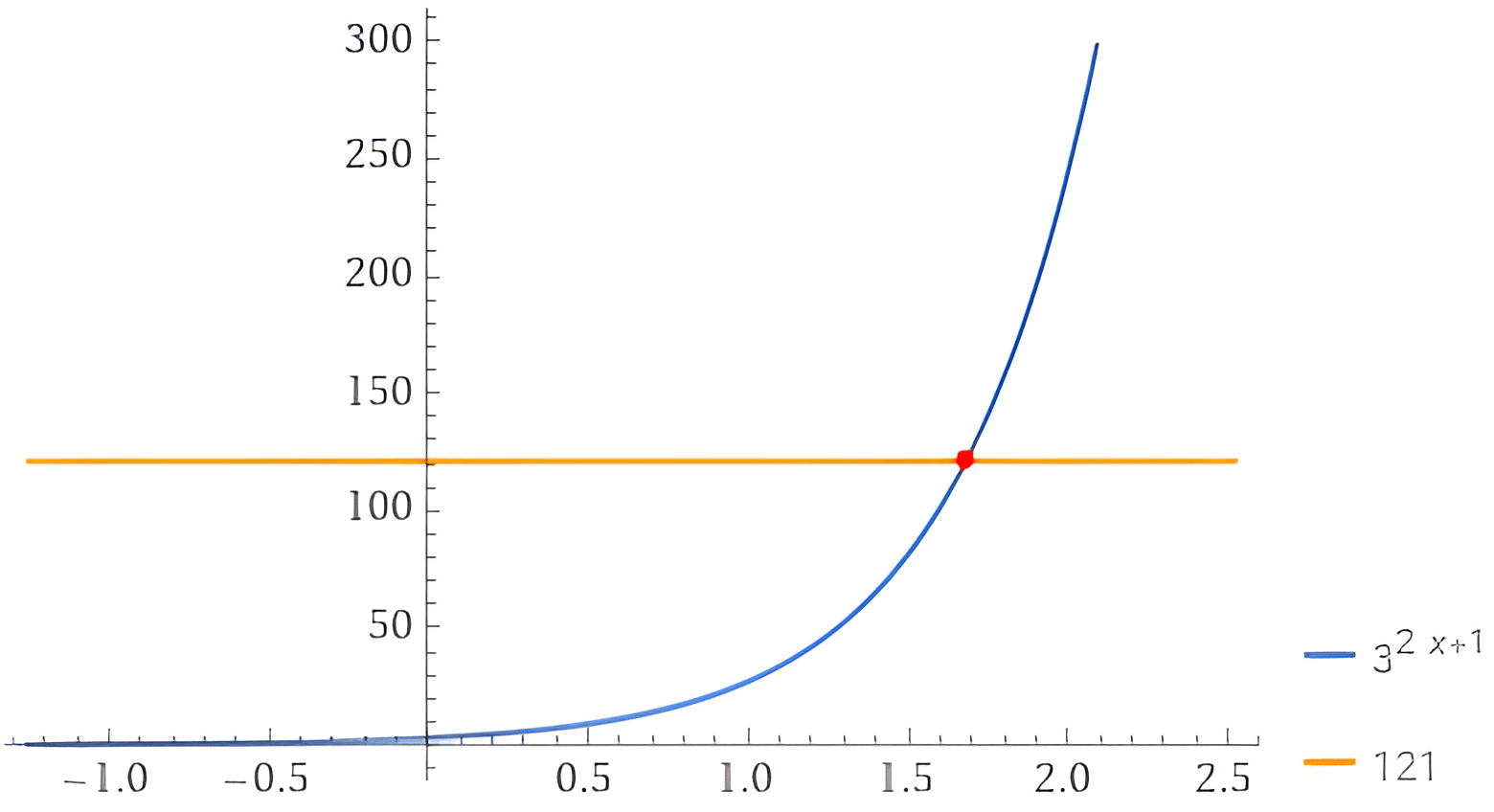
To solve 32x+1=121 for x, we first take the natural logarithm of both sides: ln(32x+1)=ln(121)
step 2
Using the logarithm power rule: (2x+1)ln(3)=ln(121)
step 3
Solving for x: 2x+1=ln(3)ln(121)
step 4
Simplifying ln(121)=2ln(11): 2x+1=ln(3)2ln(11)
step 5
Isolating x: 2x=ln(3)2ln(11)−1
step 6
Dividing by 2: x=ln(3)ln(11)−21
Answer
x=ln(3)ln(11)−21
Key Concept
Logarithmic Equations
Explanation
To solve exponential equations, we can take the logarithm of both sides and use logarithmic properties to isolate the variable.

Generated Graph
Solution by Steps
step 1
We start with the formula for continuous compounding: A=Pert, where A is the amount, P is the principal, r is the rate, and t is the time
step 2
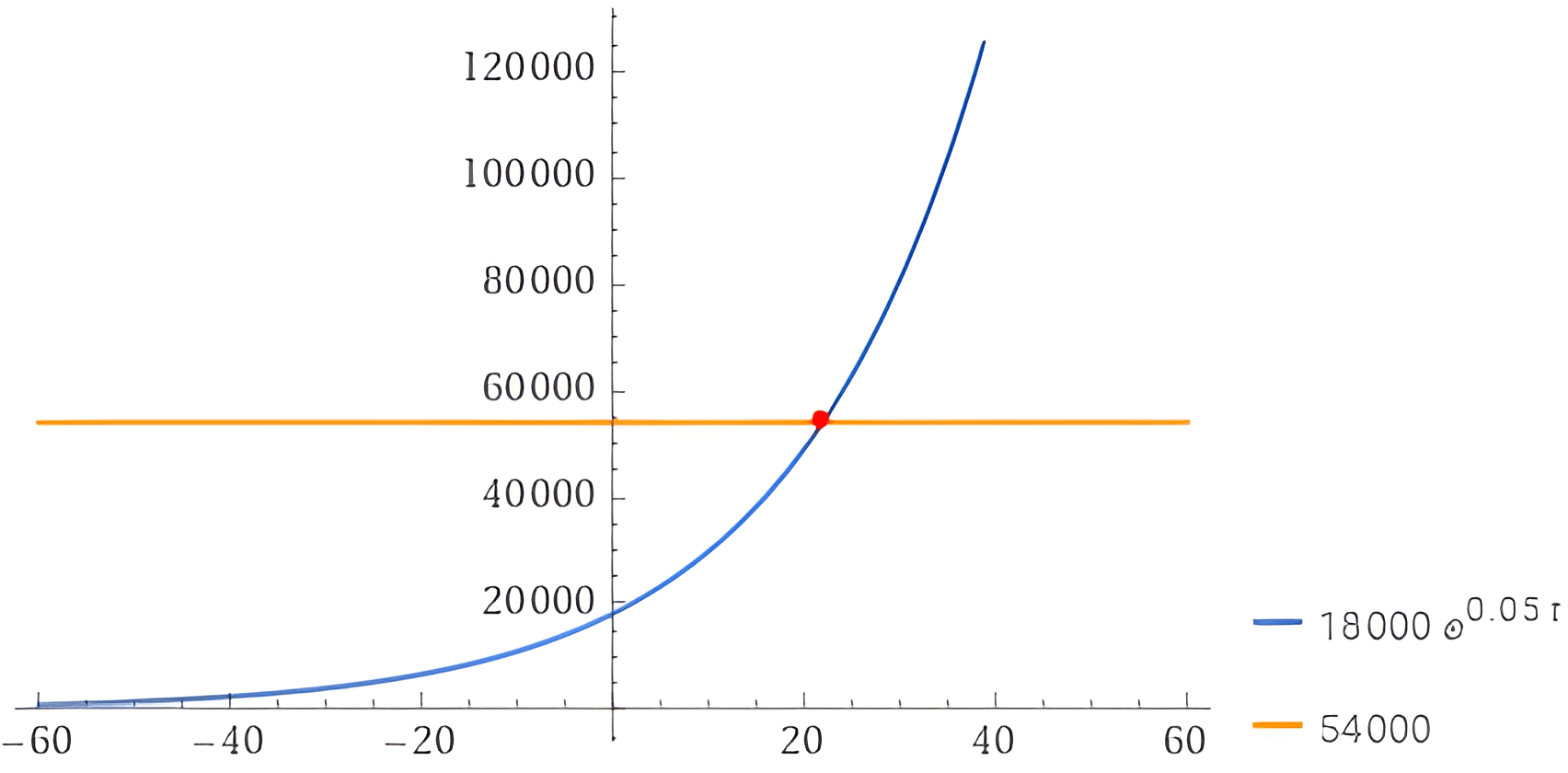
Given P=18000, r=0.05, and A=3P=54000, we set up the equation: 54000=18000e0.05t
step 3
Divide both sides by 18000: 3=e0.05t
step 4
Take the natural logarithm of both sides: ln(3)=0.05t
step 5
Solve for t: t=0.05ln(3)≈21.97
Answer
It takes approximately 21.97 years for the investment to triple.
Key Concept
Continuous compounding formula
Explanation
The continuous compounding formula A=Pert is used to find the time it takes for an investment to grow to a certain amount.
step 1
We use the formula for continuous growth: N=N0ert, where N is the final amount, N0 is the initial amount, r is the growth rate, and t is the time
step 2
Given N0=200, r=0.05, and t=1440 minutes (1 day), we set up the equation: N=200e0.05×1440
step 3
Calculate the exponent: 0.05×1440=72
step 4
Substitute and solve: N=200e72≈3.71734×1033
Answer
There will be approximately 3.71734×1033 bacteria in one day.
Key Concept
Continuous growth formula
Explanation
The continuous growth formula N=N0ert is used to calculate the number of bacteria after a certain period given a constant growth rate.
step 1
We use the formula for exponential decay: N=N0ekt, where N is the final amount, N0 is the initial amount, k is the decay constant, and t is the time
step 2
The decay constant k is related to the half-life T1/2 by k=−T1/2ln(2). Given T1/2=25 minutes, k=−25ln(2)≈−0.0277
step 3
Given N0=200 g and t=120 minutes (2 hours), we set up the equation: N=200e−0.0277×120
step 4
Calculate the exponent: −0.0277×120≈−3.324
step 5
Substitute and solve: N=200e−3.324≈7.17937 g
Answer
Approximately 7.17937 g of Bowmenium will be left after 2 hours.
Key Concept
Exponential decay formula
Explanation
The exponential decay formula N=N0ekt is used to calculate the remaining amount of a substance after a certain period given its half-life.

Solution by Steps
step 1
Solve the system of equations:
{x2+y2=36x2−y2=−14
step 2
Add the two equations to eliminate y2:
x2+y2+x2−y2=36−142x2=22x2=11x=±11
step 3
Substitute x=±11 back into the first equation to solve for y:
(11)2+y2=3611+y2=36y2=25y=±5
step 4
The solutions are:
(x,y)=(11,5),(11,−5),(−11,5),(−11,−5)
Answer
The system has four solutions: (11,5), (11,−5), (−11,5), (−11,−5)
step 1
Solve the system of equations:
{15x+10y=206x+4y=7
step 2
Simplify the second equation by dividing by 2:
3x+2y=3.5
step 3
Multiply the simplified second equation by 5 to align coefficients with the first equation:
15x+10y=17.5
step 4
Compare the two equations:
15x+10y=2015x+10y=17.5
Since 20=17.5, the system has no solutions
Answer
The system has no solutions
Key Concept
Solving systems of equations
Explanation
For the first system, we used substitution and elimination to find the solutions. For the second system, we found that the equations are inconsistent, leading to no solutions.

Solution by Steps
step 1
Let v be the speed of the boat in still water and c be the speed of the current. The effective speed upstream is v−c and downstream is v+c
step 2
The distance each way is 4 miles. The time taken upstream is 3 hours, so we have the equation: 4=3(v−c)
step 3
The time taken downstream is 45 minutes, which is 0.75 hours, so we have the equation: 4=0.75(v+c)
step 4
Solving the first equation for v−c: v−c=34
step 5
Solving the second equation for v+c: v+c=0.754=316
step 6
Adding the two equations: (v−c)+(v+c)=34+316⇒2v=320⇒v=310
step 7
Subtracting the first equation from the second: (v+c)−(v−c)=316−34⇒2c=312⇒c=2
Answer
The speed of the current is 2 miles per hour.
step 1
Let x be the amount invested in the 3% account. The remaining amount, 10000−x, is invested in the 11% account
step 2
The interest earned from the 3% account is 0.03x
step 3
The interest earned from the 11% account is 0.11(10000−x)
step 4
The total interest earned is 500, so we have the equation: 0.03x+0.11(10000−x)=500
step 5
Expanding and simplifying the equation: 0.03x+1100−0.11x=500⇒−0.08x+1100=500⇒−0.08x=−600⇒x=7500
Answer
Emily had 7500 invested in the 3% account.
Key Concept
Solving linear equations
Explanation
To find the speed of the current and the amount invested, we set up and solve linear equations based on the given conditions.

Solution by Steps
step 1
Write the system of equations in augmented matrix form:
21−4amp;−3amp;2amp;2amp;3amp;−1amp;1amp;21amp;8amp;−6
step 2
Perform row operations to get a leading 1 in the first row, first column. Divide the first row by 2:
11−4amp;−1.5amp;2amp;2amp;1.5amp;−1amp;1amp;10.5amp;8amp;−6
step 3
Subtract the first row from the second row to eliminate the first column in the second row:
10−4amp;−1.5amp;3.5amp;2amp;1.5amp;−2.5amp;1amp;10.5amp;−2.5amp;−6
step 4
Add 4 times the first row to the third row to eliminate the first column in the third row:
100amp;−1.5amp;3.5amp;−4amp;1.5amp;−2.5amp;7amp;10.5amp;−2.5amp;36
step 5
Divide the second row by 3.5 to get a leading 1 in the second row, second column:
100amp;−1.5amp;1amp;−4amp;1.5amp;−0.714amp;7amp;10.5amp;−0.714amp;36
step 6
Add 4 times the second row to the third row to eliminate the second column in the third row:
100amp;−1.5amp;1amp;0amp;1.5amp;−0.714amp;4.144amp;10.5amp;−0.714amp;33.144
step 7
Divide the third row by 4.144 to get a leading 1 in the third row, third column:
100amp;−1.5amp;1amp;0amp;1.5amp;−0.714amp;1amp;10.5amp;−0.714amp;8
step 8
Substitute back to find the values of y and x:
zy−0.714zx−1.5y+1.5zamp;=8amp;=−0.714⟹y−5.712=−0.714⟹y=5amp;=10.5⟹x−7.5+12=10.5⟹x=6
Answer
The solution to the system of equations is x=6, y=5, z=8.
step 1
Identify the number of rows and columns in the matrix:
[20amp;9amp;7amp;2amp;1amp;1amp;5]
step 2
Count the rows and columns:
Rows=2,Columns=4
Answer
The dimensions of the matrix are 2×4.
Key Concept
Gaussian Elimination
Explanation
Gaussian elimination is a method used to solve systems of linear equations by transforming the system's augmented matrix into row-echelon form.

Solution by Steps
step 1
Write the system of equations in matrix form
step 2
The system of equations is:
2x−3yx−3z4x+2y+zamp;=10amp;=3amp;=6
step 3
The matrix equation can be written as Ax=b, where A is the coefficient matrix, x is the variable matrix, and b is the constant matrix
step 4
The coefficient matrix A is:
A=214amp;−3amp;0amp;2amp;0amp;−3amp;1
step 5
The variable matrix x is:
x=xyz
step 6
The constant matrix b is:
b=1036
step 7
Therefore, the matrix equation is:
214amp;−3amp;0amp;2amp;0amp;−3amp;1xyz=1036
Answer
The matrix equation is:
\[
\begin{pmatrix}
2 & -3 & 0 \\
1 & 0 & -3 \\
4 & 2 & 1
\end{pmatrix}
\begin{pmatrix}
x \\
y \\
z
\end{pmatrix}
=
\begin{pmatrix}
10 \\
3 \\
6
\end{pmatrix}
Key Concept
Matrix Equation
Explanation
A matrix equation represents a system of linear equations in matrix form, where the coefficient matrix multiplies the variable matrix to yield the constant matrix.
step 1
Write the augmented matrix for the system of equations:
2x+y−3zx+2y+3z−x+3y−2zamp;=5amp;=16amp;=1
step 2
The augmented matrix is:
21−1amp;1amp;2amp;3amp;−3amp;3amp;−2amp;∣amp;∣amp;∣amp;5amp;16amp;1
step 3
Use row operations to convert the augmented matrix to reduced row echelon form (RREF)
step 4
Perform R2−21R1→R2:
20−1amp;1amp;23amp;3amp;−3amp;29amp;−2amp;∣amp;∣amp;∣amp;5amp;227amp;1
step 5
Perform R3+R1→R3:
200amp;1amp;23amp;4amp;−3amp;29amp;−5amp;∣amp;∣amp;∣amp;5amp;227amp;6
step 6
Perform 32R2→R2:
200amp;1amp;1amp;4amp;−3amp;3amp;−5amp;∣amp;∣amp;∣amp;5amp;9amp;6
step 7
Perform R3−4R2→R3:
200amp;1amp;1amp;0amp;−3amp;3amp;−17amp;∣amp;∣amp;∣amp;5amp;9amp;−30
step 8
Perform −171R3→R3:
200amp;1amp;1amp;0amp;−3amp;3amp;1amp;∣amp;∣amp;∣amp;5amp;9amp;1730
step 9
Perform R2−3R3→R2:
200amp;1amp;1amp;0amp;−3amp;0amp;1amp;∣amp;∣amp;∣amp;5amp;173amp;1730
step 10
Perform R1+3R3→R1:
200amp;1amp;1amp;0amp;0amp;0amp;1amp;∣amp;∣amp;∣amp;17155amp;173amp;1730
step 11
Perform 21R1→R1:
100amp;21amp;1amp;0amp;0amp;0amp;1amp;∣amp;∣amp;∣amp;34155amp;173amp;1730
step 12
Perform R1−21R2→R1:
100amp;0amp;1amp;0amp;0amp;0amp;1amp;∣amp;∣amp;∣amp;34149amp;173amp;1730
step 13
The solution to the system is:
xyz=341491731730
Answer
The solution to the system is:
\[
\begin{pmatrix}
x \\
y \\
z
\end{pmatrix}
=
\begin{pmatrix}
\frac{149}{34} \\
\frac{3}{17} \\
\frac{30}{17}
\end{pmatrix}
Key Concept
Gauss-Jordan Elimination
Explanation
Gauss-Jordan elimination is a method for solving linear systems by transforming the augmented matrix to reduced row echelon form.
step 1
Write the matrices to be multiplied:
(14amp;3amp;6) and (−32amp;5amp;−1amp;8amp;3)
step 2
Perform the matrix multiplication:
(14amp;3amp;6)(−32amp;5amp;−1amp;8amp;3)
step 3
Calculate the elements of the resulting matrix:
(1⋅−3+3⋅2)(1⋅5+3⋅−1)(1⋅8+3⋅3)(4⋅−3+6⋅2)(4⋅5+6⋅−1)(4⋅8+6⋅3)amp;=−3+6=3amp;=5−3=2amp;=8+9=17amp;=−12+12=0amp;=20−6=14amp;=32+18=50
step 4
The resulting matrix is:
(30amp;2amp;14amp;17amp;50)
Answer
The product of the matrices is:
\[
\begin{pmatrix}
3 & 2 & 17 \\
0 & 14 & 50
\end{pmatrix}
Key Concept
Matrix Multiplication
Explanation
Matrix multiplication involves taking the dot product of rows and columns to produce a new matrix.

Solution by Steps
step 1
The given matrices are:
[13amp;9amp;0]
and
[32amp;7amp;4]
step 2
Add the corresponding elements of the matrices:
[1+33+2amp;9+7amp;0+4]
step 3
Simplify the result:
[45amp;16amp;4]
Answer
[45amp;16amp;4]
Key Concept
Matrix Addition
Explanation
To add two matrices, add their corresponding elements.
step 1
The given matrix is:
[−12amp;4amp;5]
step 2
Calculate the determinant:
det=(−1)(5)−(4)(2)=−5−8=−13
step 3
Use the formula for the inverse of a 2x2 matrix:
Inverse=det1[d−camp;−bamp;a]
where a=−1, b=4, c=2, d=5
step 4
Substitute the values and simplify:
Inverse=−131[5−2amp;−4amp;−1]=[−5/132/13amp;4/13amp;−1/13]
Answer
[−5/132/13amp;4/13amp;−1/13]
Key Concept
Matrix Inversion
Explanation
To find the inverse of a 2x2 matrix, use the formula involving the determinant and the elements of the matrix.
step 1
The system of equations is:
{2x−3y=2x+2y=20
step 2
Write the system in matrix form AX=B:
A=[21amp;−3amp;2],X=[xy],B=[220]
step 3
Find the inverse of matrix A:
A−1=[21amp;−3amp;2]−1=71[2−1amp;3amp;2]=[2/7−1/7amp;3/7amp;2/7]
step 4
Multiply A−1 by B to find X:
X=A−1B=[2/7−1/7amp;3/7amp;2/7][220]=[(2/7)(2)+(3/7)(20)(−1/7)(2)+(2/7)(20)]=[64/738/7]
step 5
Simplify the result:
x=764,y=738
Answer
x=764,y=738
Key Concept
Solving Systems of Equations Using Inverse Matrices
Explanation
To solve a system of linear equations using an inverse matrix, express the system in matrix form and multiply both sides by the inverse of the coefficient matrix.

Solution by Steps
step 1
To find the determinant of matrix A, we use the formula for a 2×2 matrix: ∣A∣=ad−bc
step 2
Here, a=9, b=6, c=2, and d=3
step 3
Substitute the values into the formula: ∣A∣=(9⋅3)−(6⋅2)
step 4
Calculate the determinant: ∣A∣=27−12=15
Answer
15
Key Concept
Determinant of a 2×2 matrix
Explanation
The determinant of a 2×2 matrix is calculated using the formula ∣A∣=ad−bc.
step 1
Write the system of equations in matrix form AX=B, where A is the coefficient matrix, X is the variable matrix, and B is the constant matrix
step 2
The coefficient matrix A is 12−1amp;−2amp;1amp;−4amp;3amp;−2amp;5
step 3
The variable matrix X is xyz
step 4
The constant matrix B is 852
step 5
To solve for x using Cramer's Rule, we need to find the determinant of A, denoted as ∣A∣
step 6
Replace the first column of A with B to form a new matrix Ax: 852amp;−2amp;1amp;−4amp;3amp;−2amp;5
step 7
Calculate the determinant of Ax, denoted as ∣Ax∣
step 8
The value of x is given by x=∣A∣∣Ax∣
Answer
x=∣A∣∣Ax∣
Key Concept
Cramer's Rule
Explanation
Cramer's Rule is used to solve a system of linear equations with as many equations as unknowns, using determinants.
step 1
Factor the denominator: 2x2−7x+3=(2x−1)(x−3)
step 2
Write the partial fraction decomposition: (2x−1)(x−3)x=2x−1A+x−3B
step 3
Multiply both sides by the denominator (2x−1)(x−3) to clear the fractions: x=A(x−3)+B(2x−1)
step 4
Expand and collect like terms: x=Ax−3A+2Bx−B
step 5
Combine like terms: x=(A+2B)x−(3A+B)
step 6
Equate coefficients of x and the constant terms: A+2B=1 and −3A−B=0
step 7
Solve the system of equations for A and B: A=1 and B=−1
step 8
Substitute A and B back into the partial fractions: (2x−1)(x−3)x=2x−11−x−31
Answer
2x−11−x−31
Key Concept
Partial Fraction Decomposition
Explanation
Partial fraction decomposition is a method used to express a rational function as a sum of simpler fractions.

Generated Graph
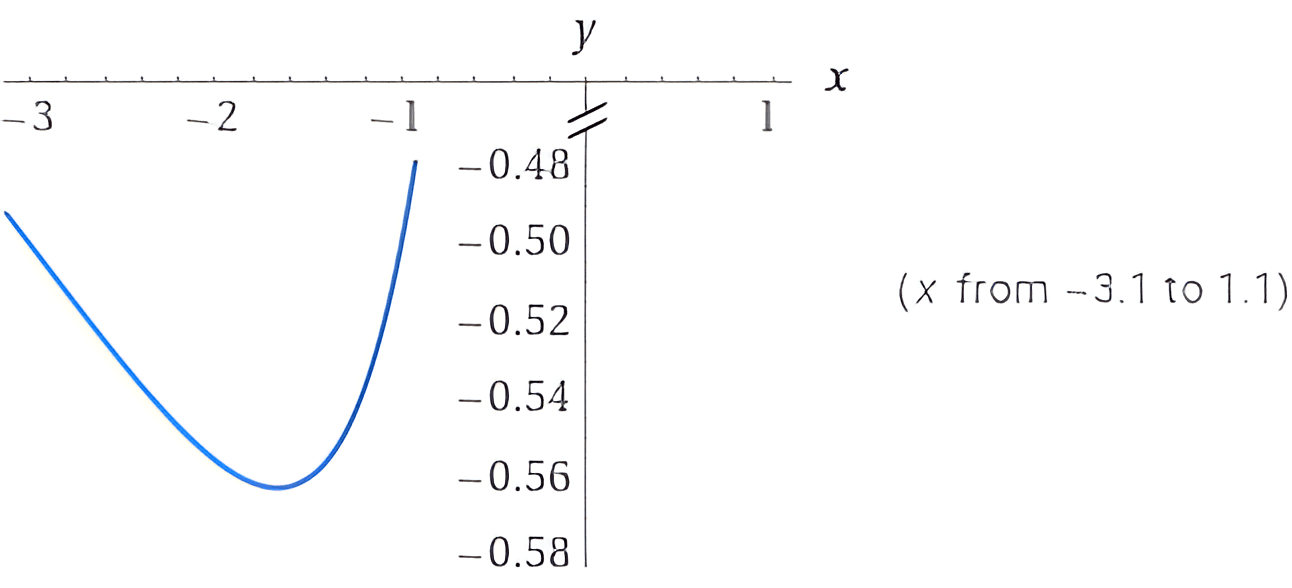
Solution by Steps
step 1
Identify the form of the partial fraction decomposition for the given rational function
step 2
The given function is (x−1)23x+1
step 3
Since the denominator is (x−1)2, we decompose it as x−1A+(x−1)2B
step 4
Set up the equation: (x−1)23x+1=x−1A+(x−1)2B
step 5
Multiply both sides by (x−1)2 to clear the denominators: 3x+1=A(x−1)+B
step 6
Expand and combine like terms: 3x+1=Ax−A+B
step 7
Equate coefficients of like terms: 3x+1=Ax−A+B
step 8
From the equation, we get A=3 and −A+B=1
step 9
Substitute A=3 into −A+B=1: −3+B=1
step 10
Solve for B: B=4
step 11
Therefore, the partial fraction decomposition is x−13+(x−1)24
Answer
x−13+(x−1)24
Key Concept
Partial Fraction Decomposition
Explanation
The given rational function is decomposed into simpler fractions whose denominators are factors of the original denominator.
step 1
Identify the shapes and their equations from the graph
step 2
The first shape is a circle centered at the origin with radius r
step 3
The equation of the circle is x2+y2=r2
step 4
The second shape is an ellipse centered at the origin with horizontal orientation
step 5
The equation of the ellipse is a2x2+b2y2=1
step 6
Write the inequalities for the circle and ellipse
step 7
For the circle, the inequality is x2+y2≤r2
step 8
For the ellipse, the inequality is a2x2+b2y2≤1
Answer
x2+y2≤r2 and a2x2+b2y2≤1
Key Concept
Inequalities for Graphs
Explanation
The inequalities represent the regions inside the circle and ellipse, respectively.
step 1
Identify the vertex and directrix of the parabola
step 2
The vertex is at the origin (0,0) and the directrix is x=−5
step 3
Use the standard form of the equation of a parabola with a vertical axis: (x−h)2=4p(y−k)
step 4
Since the vertex is at (0,0), the equation simplifies to x2=4py
step 5
The distance from the vertex to the directrix is ∣p∣=5
step 6
Since the directrix is to the left of the vertex, p=5
step 7
Substitute p into the equation: x2=4(5)y
step 8
Simplify the equation: x2=20y
Answer
x2=20y
Key Concept
Equation of a Parabola
Explanation
The equation is derived using the vertex and the distance to the directrix.

Solution by Steps
step 1
The equation of a parabola with vertex at the origin and opening upwards is given by y=4fx2, where f is the focal length
step 2
Given the width at the opening is 12 feet, the distance from the vertex to the edge of the parabola is 6 feet (half of 12 feet)
step 3
The depth of the parabola is given as 5 feet
step 4
Substitute x=6 and y=5 into the equation y=4fx2 to find f:
5=4f62
5=4f36
5=f9
f=59=1.8 feet
Answer
The bulb should be placed 1.8 feet above the bottom of the reflector.
step 1
The standard form of the equation of an ellipse with center at the origin is a2x2+b2y2=1, where a is the semi-major axis and b is the semi-minor axis
step 2
Given the vertex at (0,6), the length of the semi-major axis a=6
step 3
The minor axis length is 2, so the semi-minor axis b=1
step 4
Substitute a and b into the standard form:
62x2+12y2=1
36x2+1y2=1
Answer
The equation of the ellipse is 36x2+1y2=1.
step 1
The foci of an ellipse are located at (0,±c), where c=a2−b2
step 2
Given a=6 and b=1, calculate c:
c=62−12
c=36−1
c=35
step 3
The foci are at (0,±35)
Answer
The foci of the ellipse are at (0,±35).
Key Concept
Parabola and Ellipse Properties
Explanation
For a parabola, the focal length can be found using the vertex form equation. For an ellipse, the standard form equation helps determine the semi-major and semi-minor axes, and the foci are calculated using the relationship between these axes.

Solution by Steps
step 1
Identify the standard form of the hyperbola equation. The given equation is in the form a2y2−b2x2=1, where a2=1 and b2=4
step 2
Determine the center of the hyperbola. Since the equation is not shifted, the center is at (0,0)
step 3
Find the vertices. The vertices are at (0,±a). Here, a=1, so the vertices are at (0,±1)
step 4
Calculate the asymptotes. The asymptotes for this hyperbola are given by y=±bax. Substituting a=1 and b=2, the asymptotes are y=±21x
step 5
Determine the foci. The foci are at (0,±c), where c=a2+b2. Here, c=1+4=5, so the foci are at (0,±5)
Answer
Center: (0,0)
Vertices: (0,±1)
Asymptotes: y=±21x
Foci: (0,±5)
Key Concept
Hyperbola properties
Explanation
The center, vertices, asymptotes, and foci of a hyperbola can be determined from its standard form equation.
step 1
Identify the vertices. The vertices are at (±5,0), so a=5
step 2
Write the standard form of the hyperbola equation. Since the vertices are on the x-axis, the equation is a2x2−b2y2=1. Substituting a=5, we get 25x2−b2y2=1
step 3
Use the given point (41,58) to find b2. Substitute x=41 and y=58 into the equation: 25(41)2−b2(58)2=1
step 4
Simplify the equation: 2541−b22564=1
step 5
Solve for b2: 2541−25b264=1. Multiply through by 25: 41−b264=25
step 6
Rearrange and solve: 41−25=b264, so 16=b264. Therefore, b2=4
step 7
Write the final equation of the hyperbola: 25x2−4y2=1
Answer
Equation: 25x2−4y2=1
Key Concept
Hyperbola equation
Explanation
The equation of a hyperbola can be determined using the vertices and a point on the hyperbola.
step 1
Rewrite the equation in standard form by completing the square. Group the x and y terms: 3(x2+2x)−2(y2−4y)=9
step 2
Complete the square for the x-terms: x2+2x becomes (x+1)2−1
step 3
Complete the square for the y-terms: y2−4y becomes (y−2)2−4
step 4
Substitute back into the equation: 3((x+1)2−1)−2((y−2)2−4)=9
step 5
Simplify: 3(x+1)2−3−2(y−2)2+8=9
step 6
Combine constants: 3(x+1)2−2(y−2)2=4
step 7
Identify the center of the conic. The center is at (−1,2)
Answer
Center: (−1,2)
Key Concept
Completing the square
Explanation
Completing the square helps to rewrite the conic equation in standard form to identify the center.

Generated Graph
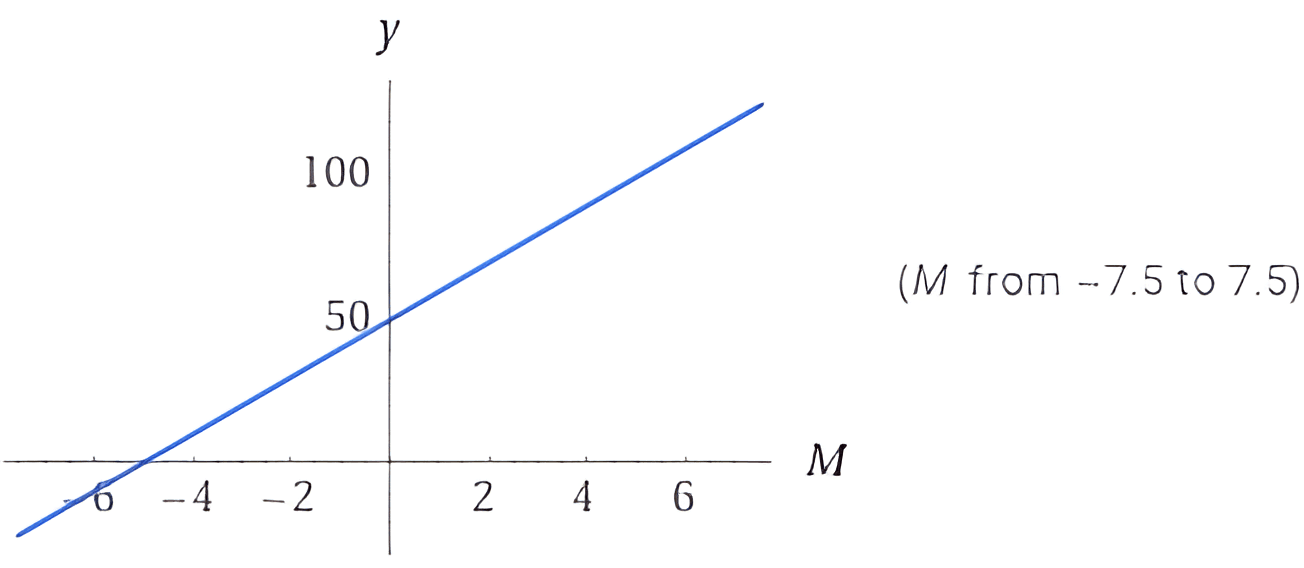
Solution by Steps
step 1
The given equation of the ellipse is 9(x−5)2+144(y+7)2=1
step 2
Identify the center of the ellipse: (h,k)=(5,−7)
step 3
The lengths of the semi-major and semi-minor axes are a=12 and b=3, respectively
step 4
Calculate the distance c from the center to each focus using c=a2−b2=144−9=135=315
step 5
The foci are located at (h,k±c)=(5,−7±315)
step 6
Therefore, the foci are (5,−7−315) and (5,−7+315)
Answer
The foci of the ellipse are (5,−7−315) and (5,−7+315).
Key Concept
Foci of an ellipse
Explanation
The foci of an ellipse are found using the relationship c=a2−b2, where a and b are the lengths of the semi-major and semi-minor axes, respectively.
step 1
The given sum is ∑k=812(2M+k)
step 2
Separate the sum into two parts: ∑k=8122M+∑k=812k
step 3
Evaluate the first part: ∑k=8122M=2M⋅5=10M
step 4
Evaluate the second part: ∑k=812k=8+9+10+11+12=50
step 5
Combine the results: 10M+50
Answer
The sum of 2M+k from k=8 to 12 is 10M+50.
Key Concept
Summation of a series
Explanation
The sum of a series can be separated into simpler parts and evaluated individually before combining the results.
step 1
Identify the pattern in the sequence. The numerators increase by 4: 3,7,11,…
step 2
The general form for the numerator is 3+4(n−1)=4n−1
step 3
The denominators increase by 2: 4,6,8,…
step 4
The general form for the denominator is 4+2(n−1)=2n+2
step 5
For the 7th term, substitute n=7: numerator = 4(7)−1=27, denominator = 2(7)+2=16
step 6
Therefore, the 7th term is 1627
Answer
The 7th term of the sequence is 1627.
Key Concept
Arithmetic sequence
Explanation
The terms of the sequence follow a linear pattern in both the numerator and the denominator, which can be expressed in general forms and used to find any term in the sequence.

Solution by Steps
step 1
Recognize the pattern in the number of oranges per level. The sequence is 1, 5, 9, ..., which is an arithmetic sequence with the first term a1=1 and common difference d=4
step 2
Use the formula for the sum of the first n terms of an arithmetic sequence: Sn=2n(2a1+(n−1)d). Here, n=24, a1=1, and d=4
step 3
Substitute the values into the formula: S24=224(2⋅1+(24−1)⋅4)
step 4
Simplify inside the parentheses: S24=12(2+23⋅4)=12(2+92)=12⋅94
step 5
Calculate the final sum: S24=12⋅94=1128
Answer
1128 oranges are needed for 24 levels.
Key Concept
Arithmetic Sequence Sum
Explanation
The sum of the first n terms of an arithmetic sequence can be found using the formula Sn=2n(2a1+(n−1)d).
step 1
Recognize the pattern in the sequence. The sequence is an arithmetic sequence with the first term a1=5 and common difference d=7
step 2
Use the formula for the n-th term of an arithmetic sequence: an=a1+(n−1)d. Here, n=200, a1=5, and d=7
step 3
Substitute the values into the formula: a200=5+(200−1)⋅7
step 4
Simplify the expression: a200=5+199⋅7=5+1393
step 5
Calculate the final term: a200=1398
Answer
The 200th term is 1398.
Key Concept
Arithmetic Sequence Term
Explanation
The n-th term of an arithmetic sequence can be found using the formula an=a1+(n−1)d.
step 1
Recognize the pattern in the sequence. The sequence is a geometric sequence with the first term a1=200 and common ratio r=75
step 2
Use the formula for the sum of the first n terms of a geometric sequence: Sn=a11−r1−rn. Here, n=10, a1=200, and r=75
step 3
Substitute the values into the formula: S10=2001−751−(75)10
step 4
Simplify the denominator: 1−75=72
step 5
Substitute and simplify: S10=200721−(75)10=200⋅27(1−(75)10)
step 6
Calculate the final sum: S10=700(1−(75)10)
Answer
The sum of the first 10 terms is 700(1−(75)10).
Key Concept
Geometric Sequence Sum
Explanation
The sum of the first n terms of a geometric sequence can be found using the formula Sn=a11−r1−rn.

Solution by Steps
step 1
Identify the first term (a) and the common ratio (r) of the geometric series. The first term is a=38
step 2
To find the common ratio r, divide the second term by the first term: r=381240=1240⋅83=12⋅840⋅3=96120=45
step 3
Verify that the series is geometric by checking the ratio between subsequent terms. For example, 124048200=48⋅40200⋅12=19202400=45, confirming r=45
step 4
Since |r| > 1, the series diverges. Therefore, the sum of the infinite geometric series does not exist
Answer
The series diverges
Key Concept
Divergence of geometric series
Explanation
For a geometric series to converge, the absolute value of the common ratio must be less than 1. In this case, |r| = \frac{5}{4} > 1, so the series diverges.

Solution by Steps
step 1
Identify the given values: Britney saves $100 per week, the interest rate is 8% per year compounded weekly, and the duration is 17 years
step 2
Convert the annual interest rate to a weekly interest rate: r=520.08
step 3
Calculate the total number of weeks: n=17×52
step 4
Use the future value of an annuity formula: FV=P(r(1+r)n−1), where P=100, r=520.08, and n=17×52
step 5
Substitute the values into the formula and calculate: FV=100(520.08(1+520.08)884−1)
step 6
Simplify and compute the final amount
Answer
FV≈193,964.24
Key Concept
Future Value of an Annuity
Explanation
This formula calculates the future value of regular savings with compound interest.
step 1
Identify the given values: Loan amount PV=100,000, annual interest rate r=0.045, and loan term n=15 years with monthly payments
step 2
Convert the annual interest rate to a monthly interest rate: rmonthly=120.045
step 3
Calculate the total number of payments: nmonthly=15×12
step 4
Use the loan payment formula: PMT=PV((1+rmonthly)nmonthly−1rmonthly(1+rmonthly)nmonthly)
step 5
Substitute the values into the formula and calculate: PMT=100,000((1+120.045)180−1120.045(1+120.045)180)
step 6
Simplify and compute the monthly payment
Answer
PMT≈764.99
Key Concept
Loan Payment Calculation
Explanation
This formula calculates the monthly payment required to pay off a loan with compound interest over a specified term.
step 1
State the base case: For n=1, the left-hand side is 4+6+8+2(1)+2=4+6+8+2+2=22, and the right-hand side is 1(1+3)=4
step 2
Clearly, the base case does not hold. Recheck the problem statement or initial conditions
step 3
Assume the statement is true for n=k: 4+6+8+2k+2=k(k+3)
step 4
Prove for n=k+1: 4+6+8+2(k+1)+2=(k+1)((k+1)+3)
step 5
Simplify the left-hand side: 4+6+8+2k+2+2=k(k+3)+2(k+1)+2
step 6
Simplify the right-hand side: (k+1)(k+4)=k2+5k+4
step 7
Verify both sides are equal: k2+3k+2+2k+2=k2+5k+4
Answer
The statement is proven by induction.
Key Concept
Mathematical Induction
Explanation
This method proves a statement is true for all natural numbers by proving it for the base case and then assuming it for n=k to prove it for n=k+1.

Generated Graph
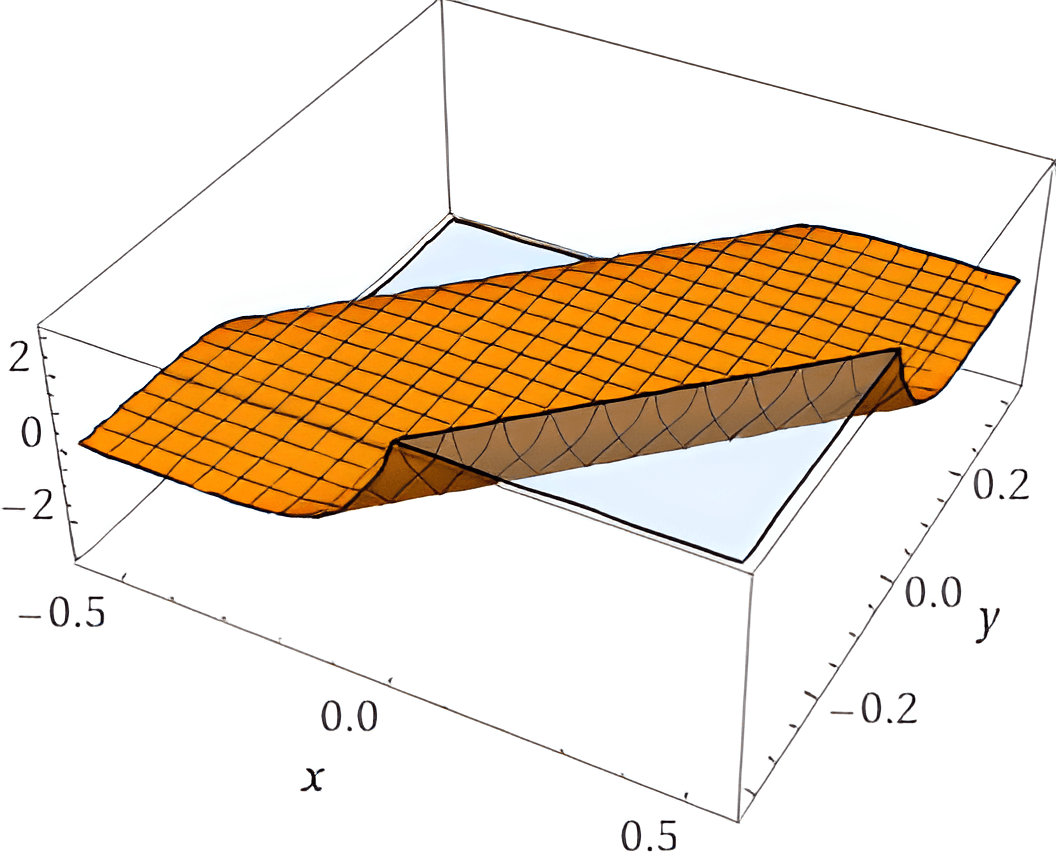
Solution by Steps
step 1
To find the 3rd term in the expansion of (2x−3y)7, we use the binomial theorem: (a+b)n=∑k=0n(kn)an−kbk
step 2
Here, a=2x, b=−3y, and n=7. The 3rd term corresponds to k=2
step 3
The 3rd term is given by (27)(2x)7−2(−3y)2
step 4
Calculate (27)=2!(7−2)!7!=21
step 5
Calculate (2x)5=32x5 and (−3y)2=9y2
step 6
Multiply these together: 21⋅32x5⋅9y2=6048x5y2
Answer
The 3rd term in the expansion of (2x−3y)7 is 6048x5y2.
Key Concept
Binomial Theorem
Explanation
The binomial theorem allows us to expand expressions of the form (a+b)n and find specific terms in the expansion.
step 1
To find the coefficient of the y2 term in the expansion of (2x−3y)7, we use the binomial theorem: (a+b)n=∑k=0n(kn)an−kbk
step 2
Here, a=2x, b=−3y, and n=7. The y2 term corresponds to k=2
step 3
The term is given by (27)(2x)7−2(−3y)2
step 4
Calculate (27)=2!(7−2)!7!=21
step 5
Calculate (2x)5=32x5 and (−3y)2=9y2
step 6
The coefficient is 21⋅32⋅9=6048
Answer
The coefficient of the y2 term in the expansion of (2x−3y)7 is 6048.
Key Concept
Binomial Coefficient
Explanation
The binomial coefficient (kn) determines the coefficients in the expansion of (a+b)n.
step 1
To find the limit limx→0x3−2x−3x3−27, we substitute x=0 directly into the expression
step 2
Substituting x=0 gives 03−2(0)−303−27=−3−27=9
Answer
The limit limx→0x3−2x−3x3−27 is 9.
Key Concept
Direct Substitution
Explanation
When finding limits, direct substitution can be used if the function is continuous at the point of interest.

Generated Graph
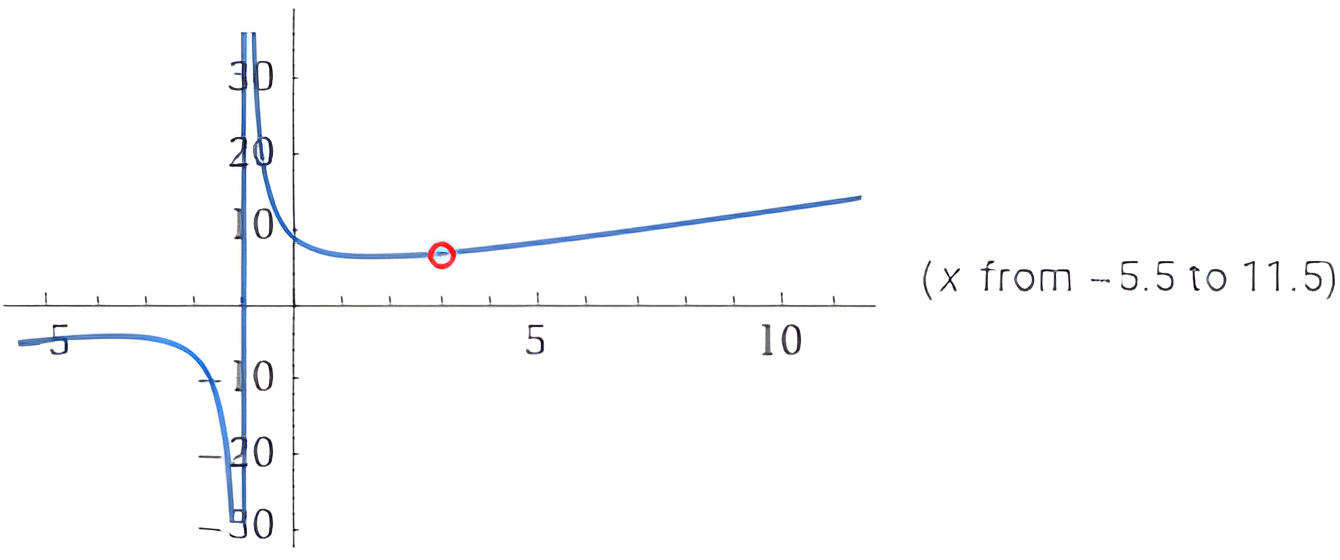
Solution by Steps
step 1
We start by simplifying the given limit expression: limx→3x2−2x−3x3−27
step 2
Notice that x3−27 can be factored as (x−3)(x2+3x+9) and x2−2x−3 can be factored as (x−3)(x+1)
step 3
Substitute these factorizations into the limit expression: limx→3(x−3)(x+1)(x−3)(x2+3x+9)
step 4
Cancel the common factor (x−3) in the numerator and the denominator: limx→3x+1x2+3x+9
step 5
Evaluate the limit by substituting x=3: 3+132+3⋅3+9=49+9+9=427
Answer
427
Key Concept
Limit of a rational function
Explanation
To find the limit of a rational function as x approaches a certain value, factor the numerator and the denominator, cancel common factors, and then substitute the value of x.

Generated Graph
Solution by Steps
step 1
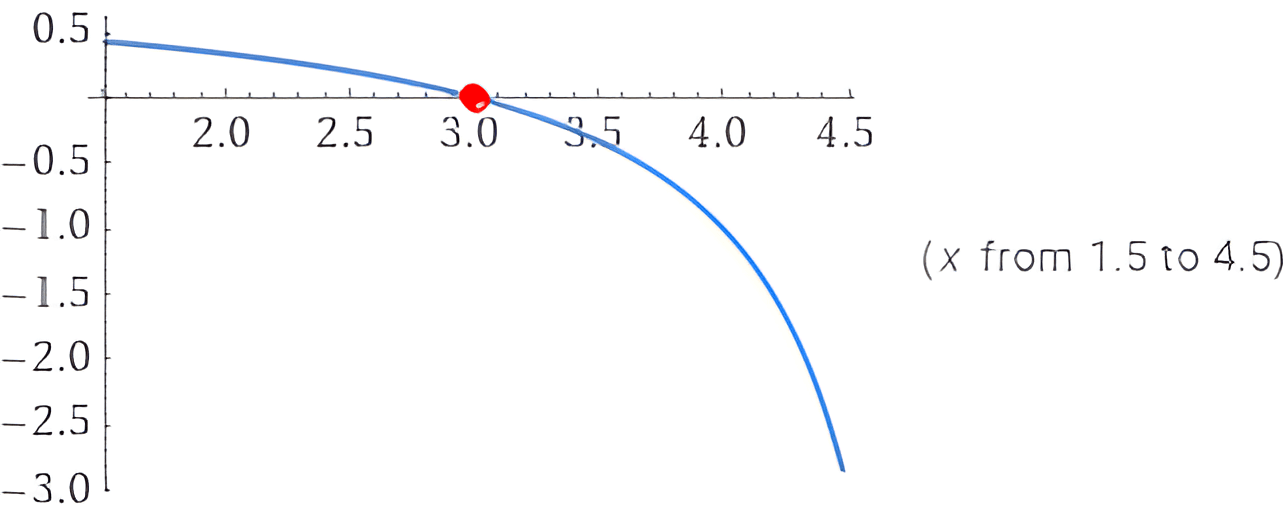
To find the limit limx→3x−5x−3, we first observe that direct substitution of x=3 into the expression x−5x−3 results in −20, which simplifies to 0
step 2
Therefore, limx→3x−5x−3=0
Answer
0
Key Concept
Limit of a function
Explanation
The limit of a function as x approaches a certain value can often be found by direct substitution, provided it does not result in an indeterminate form.
Solution by Steps
step 1
To find the limit limx→2x−2x+2−2, we first observe that direct substitution of x=2 into the expression x−2x+2−2 results in 00, which is an indeterminate form
step 2
To resolve this, we can use the technique of multiplying by the conjugate. Multiply the numerator and the denominator by x+2+2:
step 3
x−2x+2−2⋅x+2+2x+2+2=(x−2)(x+2+2)(x+2)2−22=(x−2)(x+2+2)x+2−4=(x−2)(x+2+2)x−2
step 4
Simplify the expression: (x−2)(x+2+2)x−2=x+2+21
step 5
Now, substitute x=2 into the simplified expression: 2+2+21=2+21=41
Answer
41
Key Concept
Limit involving square roots
Explanation
When dealing with limits that result in an indeterminate form, multiplying by the conjugate can help simplify the expression to find the limit.
Solution by Steps
step 1
To find the derivative of f(x)=2x2+5 at x=3, we first find the general derivative of the function
step 2
The derivative of f(x)=2x2+5 is found using the power rule: dxd(2x2+5)=4x
step 3
Now, substitute x=3 into the derivative: 4(3)=12
Answer
12
Key Concept
Derivative using the power rule
Explanation
The power rule states that the derivative of xn is nxn−1. This rule is applied to each term of the polynomial to find the derivative.

Generated Graph
Solution by Steps
step 1
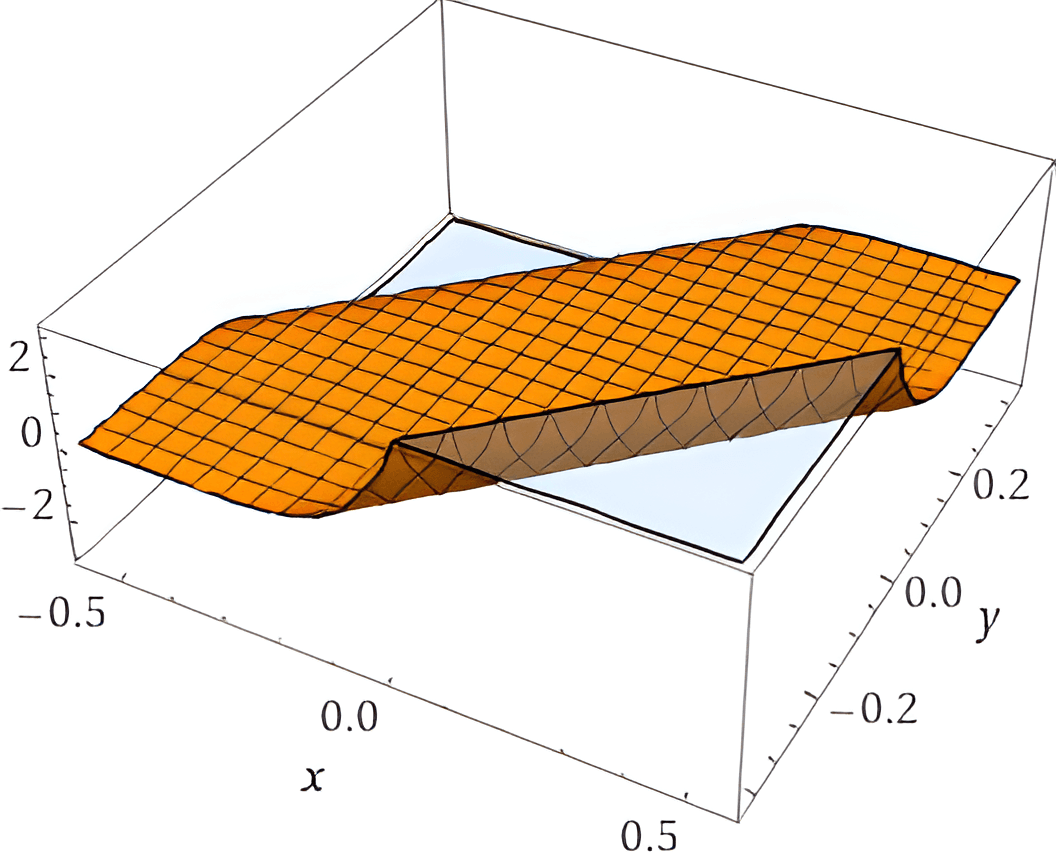
To find the 3rd term in the expansion of (2x−3y)7, we use the binomial theorem: (a+b)n=∑k=0n(kn)an−kbk
step 2
Here, a=2x, b=−3y, and n=7. The 3rd term corresponds to k=2
step 3
The 3rd term is given by (27)(2x)7−2(−3y)2
step 4
Calculate (27)=2!(7−2)!7!=21
step 5
Calculate (2x)5=32x5 and (−3y)2=9y2
step 6
Multiply these together: 21⋅32x5⋅9y2=6048x5y2
Answer
The 3rd term in the expansion of (2x−3y)7 is 6048x5y2.
Key Concept
Binomial Theorem
Explanation
The binomial theorem allows us to expand expressions of the form (a+b)n and find specific terms in the expansion.
step 1
To find the coefficient of the y2 term in the expansion of (2x−3y)7, we use the binomial theorem: (a+b)n=∑k=0n(kn)an−kbk
step 2
Here, a=2x, b=−3y, and n=7. The y2 term corresponds to k=2
step 3
The coefficient of the y2 term is given by (27)(2x)7−2(−3y)2
step 4
Calculate (27)=2!(7−2)!7!=21
step 5
Calculate (2x)5=32x5 and (−3y)2=9y2
step 6
Multiply these together: 21⋅32x5⋅9y2=6048x5y2
step 7
The coefficient of the y2 term is 6048x5
Answer
The coefficient of the y2 term in the expansion of (2x−3y)7 is 6048x5.
Key Concept
Binomial Coefficient
Explanation
The binomial coefficient (kn) determines the coefficient of each term in the binomial expansion.
step 1
To find the limit limx→3x2−2x−3x3−27, we first factorize the numerator and the denominator
step 2
The numerator x3−27 can be factored as (x−3)(x2+3x+9)
step 3
The denominator x2−2x−3 can be factored as (x−3)(x+1)
step 4
The limit becomes limx→3(x−3)(x+1)(x−3)(x2+3x+9)
step 5
Cancel the common factor (x−3): limx→3x+1x2+3x+9
step 6
Substitute x=3: 3+132+3⋅3+9=49+9+9=427
Answer
The limit is 427.
Key Concept
Limit Calculation
Explanation
Factoring the numerator and denominator allows us to simplify the expression and find the limit.
© 2023 AskSia.AI all rights reserved