
AskSia
Plus

1. Find the gradient of the function:
\[
f\left(x_{1}, x_{2}\right)=\frac{c_{1}...
Jun 14, 2024



Solution by Steps
step 1
To find the gradient of the function f(x1,x2)=1+e−x1c1+1+e−x2c2, we need to compute the partial derivatives with respect to x1 and x2
step 2
The partial derivative of f with respect to x1 is given by:
∂x1∂f=∂x1∂(1+e−x1c1)=(1+e−x1)2c1e−x1
Similarly, the partial derivative of f with respect to x2 is:
∂x2∂f=∂x2∂(1+e−x2c2)=(1+e−x2)2c2e−x2
step 3
Therefore, the gradient of the function f is:
∇f=(∂x1∂f,∂x2∂f)=((1+e−x1)2c1e−x1,(1+e−x2)2c2e−x2)
Answer
The gradient of the function f(x1,x2)=1+e−x1c1+1+e−x2c2 is ((1+e−x1)2c1e−x1,(1+e−x2)2c2e−x2).
Key Concept
Gradient of a function
Explanation
The gradient of a function is a vector that contains all of its partial derivatives. It points in the direction of the greatest rate of increase of the function.

Generated Graph
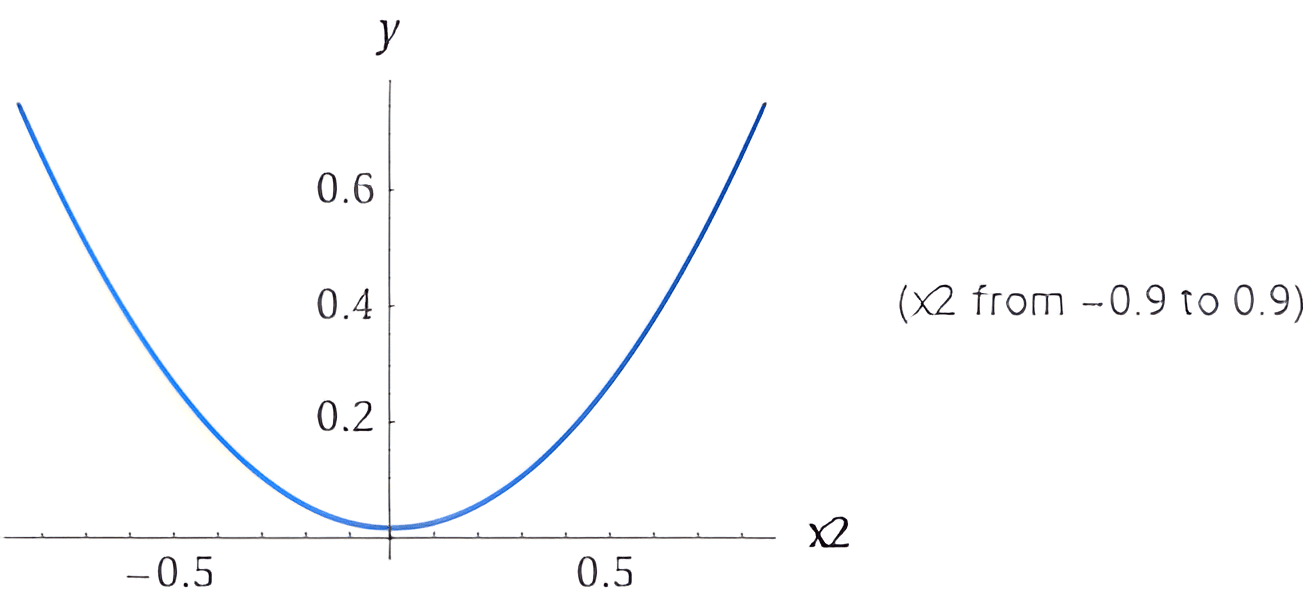
Solution by Steps
step 1
To find the gradient of the function f(x1,x2)=x12+x22 at xˉ=(1,1), we need to compute the partial derivatives with respect to x1 and x2
step 2
The partial derivative of f with respect to x1 is given by:
∂x1∂f=∂x1∂(x12+x22)=2x1
At x1=1, this becomes:
∂x1∂fx1=1=2⋅1=2
step 3
The partial derivative of f with respect to x2 is given by:
∂x2∂f=∂x2∂(x12+x22)=2x2
At x2=1, this becomes:
∂x2∂fx2=1=2⋅1=2
step 4
Therefore, the gradient of f at xˉ=(1,1) is:
∇f(1,1)=(∂x1∂f,∂x2∂f)(1,1)=(2,2)
Answer
The gradient of the function f(x1,x2)=x12+x22 at xˉ=(1,1) is (2,2).
Key Concept
Gradient Calculation
Explanation
The gradient of a function at a given point is found by computing the partial derivatives with respect to each variable and evaluating them at that point.

Solution by Steps
step 1
To find the eigenvalues of matrix A=[30amp;0amp;0], we solve the characteristic equation det(A−λI)=0
step 2
The characteristic equation for matrix A is det([30amp;0amp;0]−λ[10amp;0amp;1])=0
step 3
This simplifies to det([3−λ0amp;0amp;−λ])=(3−λ)(−λ)=0
step 4
Solving (3−λ)(−λ)=0, we get the eigenvalues λ1=3 and λ2=0
step 5
To find the eigenvectors corresponding to λ1=3, we solve (A−3I)v=0. This gives [00amp;0amp;−3][v1v2]=[00], leading to v1=1 and v2=0. Thus, v1=[10]
step 6
For λ2=0, we solve (A−0I)v=0. This gives [30amp;0amp;0][v1v2]=[00], leading to v1=0 and v2=1. Thus, v2=[01]
step 7
To find the eigenvalues of matrix B=[31amp;−1amp;0], we solve the characteristic equation det(B−λI)=0
step 8
The characteristic equation for matrix B is det([31amp;−1amp;0]−λ[10amp;0amp;1])=0
step 9
This simplifies to det([3−λ1amp;−1amp;−λ])=(3−λ)(−λ)−(−1)(1)=λ2−3λ+1=0
step 10
Solving λ2−3λ+1=0, we get the eigenvalues λ1=23+5 and λ2=23−5
step 11
To find the eigenvectors corresponding to λ1=23+5, we solve (B−λ1I)v=0. This gives [3−23+51amp;−1amp;−23+5][v1v2]=[00], leading to v1=[23+51]
step 12
For λ2=23−5, we solve (B−λ2I)v=0. This gives [3−23−51amp;−1amp;−23−5][v1v2]=[00], leading to v2=[23−51]
Answer
The eigenvalues and eigenvectors of matrix A are λ1=3, λ2=0, v1=[10], and v2=[01]. The eigenvalues and eigenvectors of matrix B are λ1=23+5, λ2=23−5, v1=[23+51], and v2=[23−51].
Key Concept
Eigenvalues and Eigenvectors
Explanation
Eigenvalues are the special set of scalars associated with a linear system of equations (i.e., a matrix equation) that provide insights into the system's properties. Eigenvectors are the corresponding vectors that, when multiplied by the matrix, result in a vector that is a scalar multiple of the original vector.

Solution by Steps
step 1
To find the inverse of the matrix A, we start with the given matrix A=[11amp;1amp;2]
step 2
The formula for the inverse of a 2x2 matrix A=[acamp;bamp;d] is A−1=ad−bc1[d−camp;−bamp;a]
step 3
For the given matrix A=[11amp;1amp;2], we have a=1, b=1, c=1, and d=2
step 4
Calculate the determinant of A: ad−bc=(1)(2)−(1)(1)=2−1=1
step 5
Substitute the values into the inverse formula: A−1=11[2−1amp;−1amp;1]=[2−1amp;−1amp;1]
Answer
A−1=[2−1amp;−1amp;1]
Key Concept
Matrix Inversion
Explanation
The inverse of a 2x2 matrix is found using the formula A−1=ad−bc1[d−camp;−bamp;a], where ad−bc is the determinant of the matrix.

Generated Graph
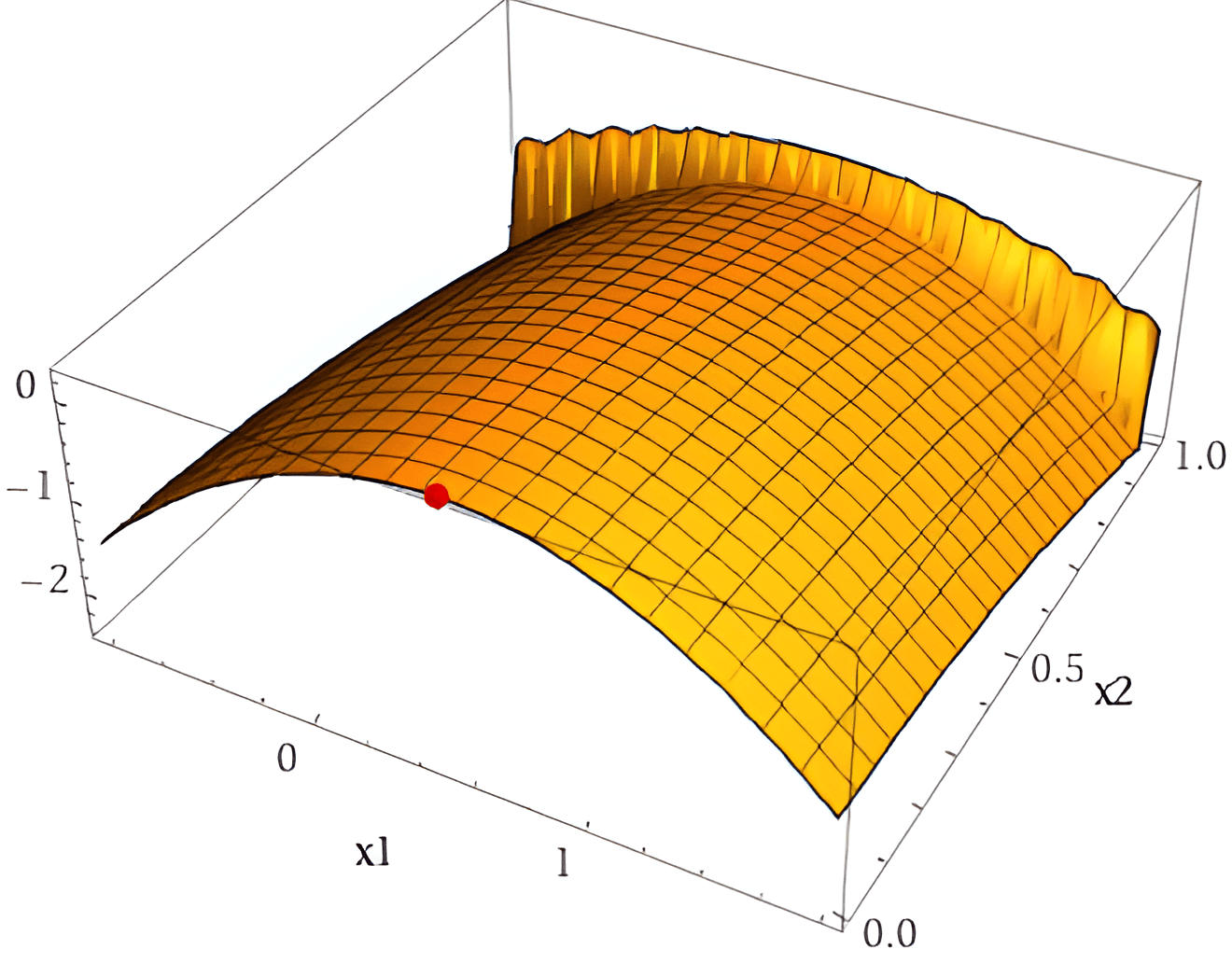
Solution by Steps
step 1
We need to find the global maximum of the function f(x1,x2)=x1−x12−x22 where x2∈[0,1]
step 2
To find the critical points, we first take the partial derivatives of f with respect to x1 and x2 and set them to zero
step 3
The partial derivative with respect to x1 is ∂x1∂f=1−2x1. Setting this to zero gives 1−2x1=0⇒x1=21
step 4
The partial derivative with respect to x2 is ∂x2∂f=−2x2. Setting this to zero gives −2x2=0⇒x2=0
step 5
We now evaluate the function f at the critical point (x1,x2)=(21,0)
step 6
Substituting x1=21 and x2=0 into f, we get f(21,0)=21−(21)2−02=21−41=41
step 7
We also need to check the boundary values of x2. For x2=0, we already have f(21,0)=41. For x2=1, we evaluate f at x1=21 and x2=1
step 8
Substituting x1=21 and x2=1 into f, we get f(21,1)=21−(21)2−12=21−41−1=−43
step 9
Comparing the values, the maximum value of f is 41 at (x1,x2)=(21,0)
Answer
The global maximum of f(x1,x2)=x1−x12−x22 for x2∈[0,1] is 41 at (x1,x2)=(21,0).
Key Concept
Global Maximum
Explanation
The global maximum of a function within a specified domain is found by evaluating the function at critical points and boundary values, then comparing these values to determine the highest one.
© 2023 AskSia.AI all rights reserved