
AskSia
Plus

1. Find Re(z) and Im(z) in simplest terms giv...
Jun 6, 2024



Generated Graph
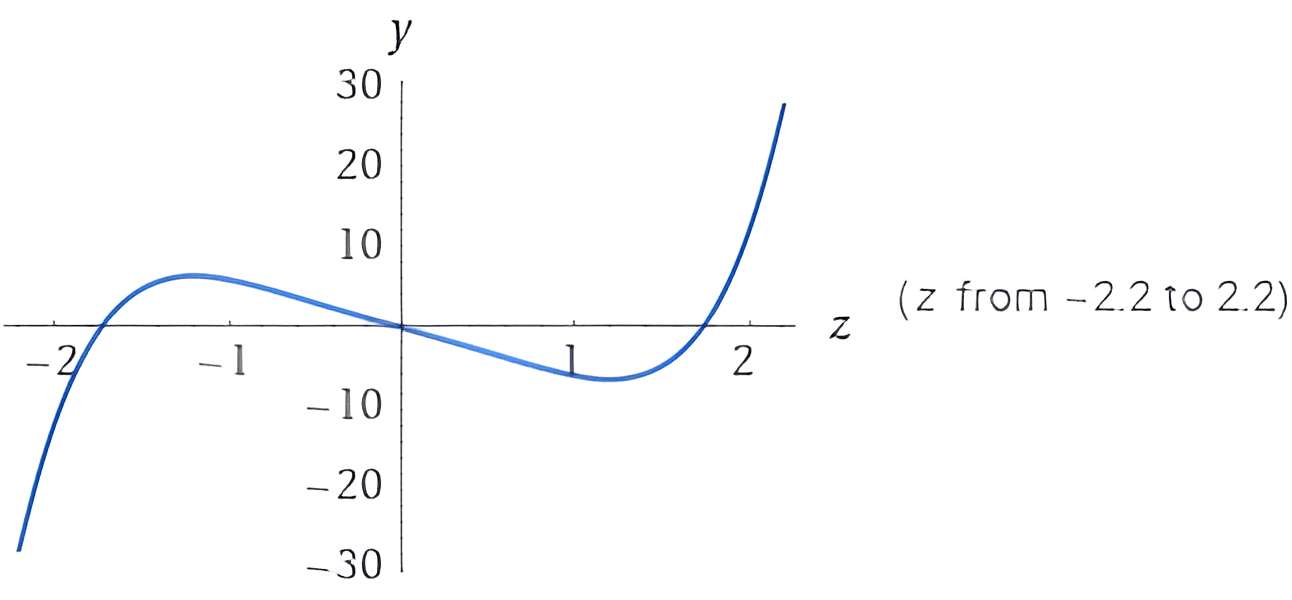
Solution by Steps
step 1
Start by simplifying the denominator (1+i)3
step 2
(1+i)3=(1+i)(1+i)(1+i)=(1+2i+i2)(1+i)=(1+2i−1)(1+i)=2i(1+i)=2i+2i2=2i−2=−2+2i
step 3
Substitute back into the equation: z+i=−2+2i8+4i
step 4
Simplify the fraction: −2+2i8+4i=2i(−1+i)8+4i=2i8+4i⋅−1−i−1−i=−2i(8+4i)(−1−i)=−2i−8−8i−4i−4i2=−2i−8−12i+4=−2i−4−12i=2+6i
step 5
Therefore, z+i=2+6i
step 6
Taking the conjugate, z+i=2−6i
step 7
Solving for z, z=2−6i−i=2−7i
step 8
Thus, Re(z)=2 and Im(z)=−7
Answer
Re(z)=2, Im(z)=−7
Key Concept
Complex number manipulation
Explanation
The problem involves simplifying a complex fraction and solving for the real and imaginary parts of a complex number.
step 1
Factor out the common term z: z(z4−z2−6)=0
step 2
Factor the quadratic z4−z2−6: z(z2+2)(z2−3)=0
step 3
Solve each factor: z=0, z2+2=0, z2−3=0
step 4
For z2+2=0: z2=−2⇒z=±i2
step 5
For z2−3=0: z2=3⇒z=±3
step 6
Combine all solutions: z=0,±i2,±3
Answer
z=0,±i2,±3
Key Concept
Factoring polynomials
Explanation
The problem involves factoring a polynomial and solving the resulting quadratic equations.
step 1
Let ω=[(1−3)+(1+3)i]3
step 2
Simplify the expression inside the cube: (1−3)+(1+3)i=1−3+i+i3
step 3
Cube the simplified expression: (1−3+i+i3)3
step 4
Use binomial expansion to expand the cube: (a+b)3=a3+3a2b+3ab2+b3
step 5
Substitute a=1−3 and b=i+i3 and simplify
step 6
After simplification, the real part of ω is found to be −7−3
Answer
Re(ω)=−7−3
Key Concept
Complex number exponentiation
Explanation
The problem involves expanding and simplifying a complex number raised to a power.
© 2023 AskSia.AI all rights reserved