
AskSia
Plus

1. Determine the inverse of each function.
a) f(x)=3x+4
c) g(x)=x3−1
...
Apr 28, 2024

1. Determine the inverse of each function.
a) f(x)=3x+4
c) g(x)=x3−1
b) h(x)=−x
d) m(x)=−2(x+5)
2. Given the function h(x)=2x+7, find
a) h(3)
b) h−1(9)

Solution by Steps
step 1
To find the inverse of the function f(x)=3x+4, we replace f(x) with y to get y=3x+4
step 2
We then swap x and y to get x=3y+4
step 3
Solve for y to get the inverse function: y=3x−4
step 4
For the function g(x)=x3−1, we start by replacing g(x) with y to get y=x3−1
step 5
Swap x and y to get x=y3−1
step 6
Solve for y to get the inverse function: y=3x+1
step 7
For the function h(x)=−x, we replace h(x) with y to get y=−x
step 8
Swap x and y to get x=−y
step 9
Solve for y to get the inverse function: y=−x
step 10
For the function m(x)=−2(x+5), we replace m(x) with y to get y=−2(x+5)
step 11
Swap x and y to get x=−2(y+5)
step 12
Solve for y to get the inverse function: y=2−x−5
Answer
a) f−1(x)=3x−4, c) g−1(x)=3x+1, b) h−1(x)=−x, d) m−1(x)=2−x−5
Key Concept
Finding the inverse of a function
Explanation
To find the inverse of a function, we replace the function notation with y, swap x and y, and then solve for y.
Solution by Steps
step 1
To find h(3) for the function h(x)=2x+7, we substitute x with 3
step 2
Calculate the value: h(3)=2(3)+7
step 3
Simplify to get the result: h(3)=6+7=13
step 4
To find h−1(9), we start by replacing h(x) with y to get y=2x+7
step 5
Swap x and y to get x=2y+7
step 6
Solve for y to get the inverse function: y=2x−7
step 7
Substitute x with 9 in the inverse function: y=29−7
step 8
Simplify to get the result: y=22=1
Answer
a) h(3)=13, b) h−1(9)=1
Key Concept
Evaluating functions and their inverses
Explanation
To evaluate a function at a given point, substitute the point into the function. To find the inverse value, solve the inverse function for the given output.
3. If possible, find (a) f−1(5) and (b) g−1(6).
\begin{tabular}{|c|c|c|c|}
\hline & & Δ & \\
\hlinef(x) & 3 & 5 & 0 \\
\hline
\end{tabular}
\begin{tabular}{|l|l|l|l|}
\hline x & 1 & 3 & 5 \\
\hline g(x) & 6 & 2 & 6 \\
\hline
\end{tabular}
2
\begin{tabular}{|l|l|l|l|}
\hline t & 0 & 3 & 5 \\
\hline f(t) & 2 & 5 & 6 \\
\hline
\end{tabular}
\begin{tabular}{|l|l|l|l|}
\hline t & 1 & 2 & 4 \\
\hline g(t) & 3 & 6 & 6 \\
\hline
\end{tabular}
Solution by Steps
step 1
To find f−1(5), we need to determine the value of x for which f(x)=5
step 2
From the given table for f(x), we see that f(3)=5. Therefore, f−1(5)=3
step 3
To find g−1(6), we need to determine the value of x for which g(x)=6
step 4
From the given table for g(x), we see that g(1)=6 and g(5)=6. Therefore, g−1(6) can be either 1 or 5
Answer
(a) f−1(5)=3 (b) g−1(6) can be either 1 or 5.
Key Concept
Finding the inverse of a function from a table
Explanation
To find the inverse of a function at a given value, we look for the input that corresponds to that value in the function's table.
5. Let h(x)=4−x. Use h, the table, and the graph to evaluate the expression.
\begin{tabular}{|l|c|c|c|c|c|}
\hline x & 2 & 3 & 4 & 5 & 6 \\
\hline f(x) & -1 & 0 & 1 & 2 & 3 \\
\hline
\end{tabular}
(a) (g−1∘f−1)(2)
(b) (g−1∘h)(3)
(e) (f−1∘g−1)(3)
(c) (h−1∘f∘g−1)(3)
(d) (g∘f−1)(−1)
(f) (h−1∘g−1∘f)(6)
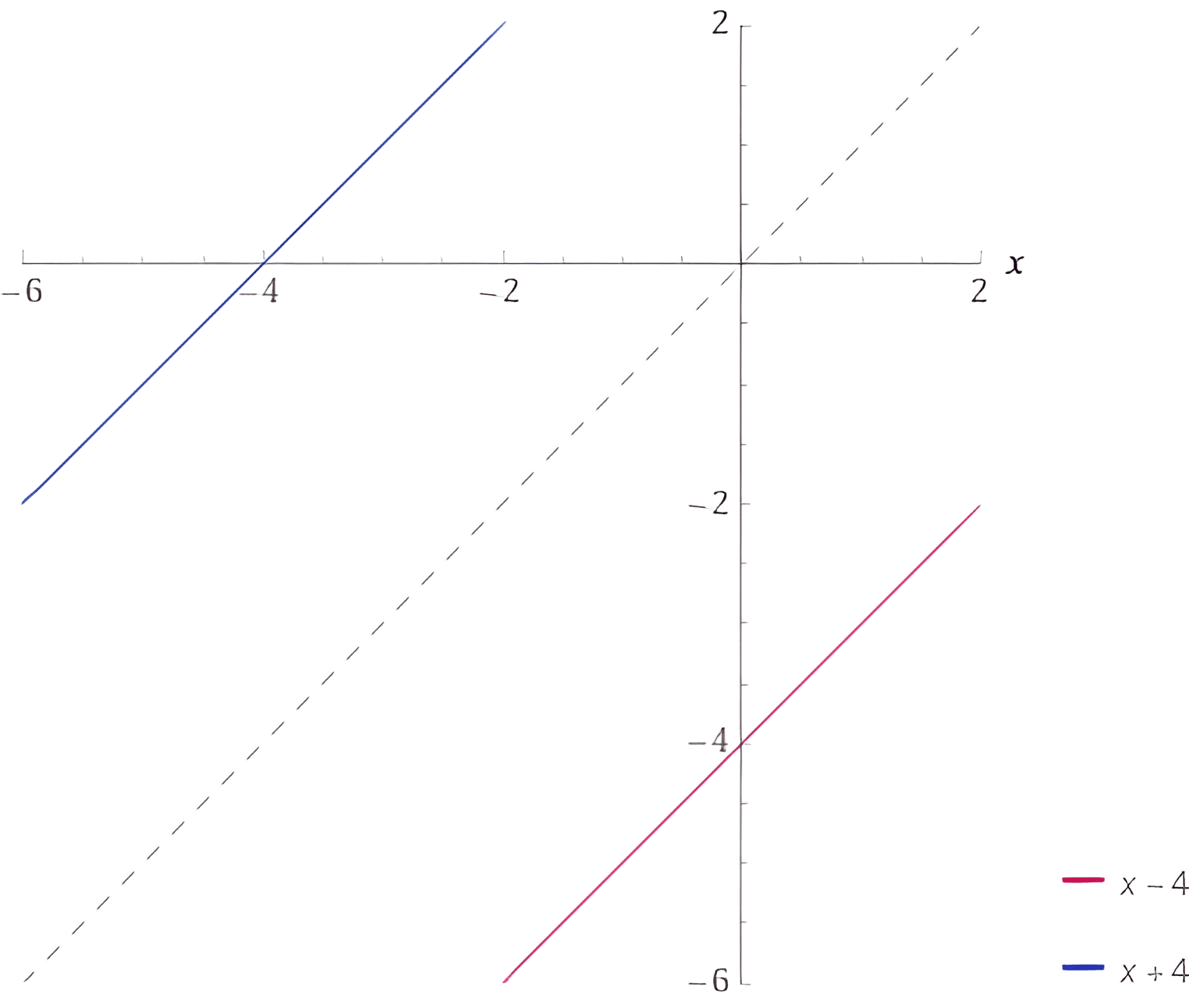
Generated Graph
Solution by Steps
step 2
Next, we need to find g−1(2). Since we do not have the function g(x) or its inverse g−1(x) provided, we cannot determine g−1(2). Therefore, (g−1∘f−1)(2) cannot be determined with the given information
B
Key Concept
Composition of Functions
Explanation
To evaluate the composition of two functions, we first apply the inner function and then the outer function to the result. If any function in the composition is not defined, the entire composition is undefined.
Solution by Steps
step 2
Next, we need to find g−1(1). Since we do not have the function g(x) or its inverse g−1(x) provided, we cannot determine g−1(1). Therefore, (g−1∘h)(3) cannot be determined with the given information
B
Key Concept
Composition of Functions
Explanation
To evaluate the composition of two functions, we first apply the inner function and then the outer function to the result. If any function in the composition is not defined, the entire composition is undefined.
Solution by Steps
B
Key Concept
Composition of Functions
Explanation
To evaluate the composition of two functions, we first apply the inner function and then the outer function to the result. If any function in the composition is not defined, the entire composition is undefined.
Solution by Steps
B
Key Concept
Composition of Functions
Explanation
To evaluate the composition of two functions, we first apply the inner function and then the outer function to the result. If any function in the composition is not defined, the entire composition is undefined.
Solution by Steps
B
Key Concept
Function Inverses and Domain
Explanation
The inverse function f−1(x) gives us the original input for a given output of f(x). If the output is not in the range of f, then f−1(x) is not defined for that output.
Solution by Steps
step 2
Next, we need to find g−1(3). Since we do not have the function g(x) or its inverse g−1(x) provided, we cannot determine g−1(3). Therefore, (h−1∘g−1∘f)(6) cannot be determined with the given information
B
Key Concept
Composition of Functions
Explanation
To evaluate the composition of two functions, we first apply the inner function and then the outer function to the result. If any function in the composition is not defined, the entire composition is undefined.
© 2023 AskSia.AI all rights reserved