
AskSia
Plus

1. A 1000-gallon tank is used to collect rainwater. The tank is empty at time $...
May 12, 2024



Solution by Steps
step 1
To find r′(4), we need to differentiate the piecewise function r(t) for the interval 2 < t \leq 5
step 2
The derivative of r(t) for 2 < t \leq 5 is r′(t)=50tcos(0.2t2)
step 3
Substitute t=4 into r′(t) to find r′(4)
step 4
Calculate r′(4)=50⋅4⋅cos(0.2⋅42)
[question a] Answer
r′(4)=200cos(3.2) gallons per hour
Key Concept
Differentiation of piecewise functions
Explanation
To find the rate of change at a specific point within a given interval of a piecewise function, we differentiate the relevant piece of the function and evaluate at that point.
step 1
To explain why limt→2r(t) does not exist, we need to consider the left-hand limit and the right-hand limit as t approaches 2
step 2
Calculate the left-hand limit using the first part of the piecewise function: limt→2−200e−0.21t
step 3
Calculate the right-hand limit using the second part of the piecewise function: limt→2+115+25sin(0.2t2)
step 4
Compare the two limits to determine if they are equal
[question b] Answer
The limits as t approaches 2 from the left and right are not equal, hence limt→2r(t) does not exist.
Key Concept
Limits of piecewise functions
Explanation
For a limit to exist at a point where a function is piecewise-defined, the left-hand limit and the right-hand limit must be equal. If they are not, the limit does not exist.
step 1
To find the amount of rainwater from 0≤t≤2, we integrate the rate function r(t) over this interval
step 2
Set up the integral ∫02200e−0.21tdt for the given interval
step 3
Calculate the integral to find the total amount of rainwater
[question c] Answer
The total amount of rainwater is the result of the integral from 0 to 2.
Key Concept
Integration of rate functions
Explanation
The integral of a rate function over an interval gives the total amount of change over that interval.
step 1
To find the total amount of rainwater at t=5, we need to integrate the rate function r(t) from 0 to 2 and from 2 to 5, and subtract the constant rate of the pump from 2 to 5
step 2
Set up the integral for the first part ∫02200e−0.21tdt and calculate it
step 3
Set up the integral for the second part ∫25(115+25sin(0.2t2))dt and calculate it
step 4
Subtract the constant rate of the pump over the interval from 2 to 5, which is 100×(5−2)
step 5
Add the results of the two integrals and subtract the pump's contribution to find the total amount of rainwater at t=5
[question d] Answer
The total amount of rainwater in the tank at t=5 is the sum of the two integrals minus the pump's contribution.
Key Concept
Integration and constant rates
Explanation
To find the total amount of a quantity that changes at a variable rate and is affected by a constant rate, we integrate the variable rate and account for the constant rate separately.

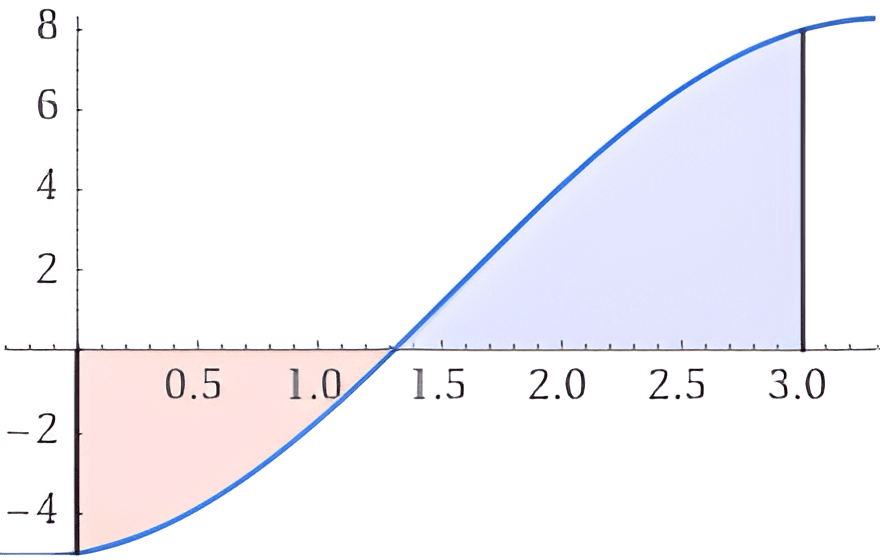
Generated Graph
Solution by Steps
step 1
To find the acceleration vector at time t=5, we need to differentiate the velocity components x′(t) and y′(t) with respect to time
step 2
The acceleration in the x-direction is x′′(t)=dtd(3cos(1+t2))
step 3
The acceleration in the y-direction is y′′(t)=dtd(−5+42+sint)
step 4
Evaluate x′′(5) and y′′(5) to find the acceleration components at t=5
[question a] Answer
The acceleration vector at t=5 is (x′′(5),y′′(5)).
Key Concept
Acceleration vector components
Explanation
The acceleration vector is found by differentiating the velocity components with respect to time.
step 1
To find the total distance traveled, we need to integrate the speed function over the given time interval
step 2
The speed function is the magnitude of the velocity vector: v(t)=(x′(t))2+(y′(t))2
step 3
Integrate v(t) from t=0 to t=4 to find the total distance traveled
[question b] Answer
The total distance traveled from t=0 to t=4 is the integral of v(t) over that interval.
Key Concept
Total distance traveled
Explanation
The total distance is the integral of the speed function over the time interval.
step 1
To find when the vertical distance above the line y=0 is greatest, we need to find the maximum value of y(t) for 0≤t≤4
step 2
Differentiate y(t) to find y′(t) and set it equal to zero to find critical points
step 3
Evaluate y(t) at the critical points and endpoints to find the maximum value
[question c] Answer
The time t when the particle's vertical distance above the line y=0 is greatest is found by evaluating y(t) at critical points and endpoints.
Key Concept
Finding maximum value of a function
Explanation
The maximum value of y(t) is found by evaluating the function at critical points and endpoints within the interval.
step 1
To determine when the tangent line is vertical, we need to find when x′(t)=0 because the slope of the tangent line is given by dxdy
step 2
Solve x′(t)=0 for t in the interval (0,4)
[question d] Answer
The time t when the tangent line to the particle's path is vertical is found by solving x′(t)=0 within the interval (0,4).
Key Concept
Vertical tangent line
Explanation
A vertical tangent line occurs when the horizontal component of velocity, x′(t), is zero.

Solution by Steps
step 1
To find the slope of the tangent line at t=1, we need to evaluate dtdW at t=1
step 2
Given dtdW=W⋅e−t and W(1)=2000, we substitute t=1 and W=2000 into the differential equation
step 3
Calculating the derivative at t=1 gives dtdWt=1=2000⋅e−1=2000⋅e1
step 4
Simplifying, we find the slope of the tangent line at t=1 is e2000
step 5
To approximate W(2), we use the tangent line at t=1: W(t)≈W(1)+dtdWt=1⋅(t−1)
step 6
Substituting t=2 into the tangent line equation gives W(2)≈2000+e2000⋅(2−1)
step 7
Simplifying, we find W(2)≈2000+e2000
[question a] Answer
The slope of the tangent line at t=1 is e2000, and the approximate value of W(2) using the tangent line is 2000+e2000.
Key Concept
Finding the slope of a tangent line to a curve at a given point using a derivative
Explanation
The slope of the tangent line to the graph of a function at a particular point is given by the value of the derivative of the function at that point.
step 8
Since \frac{d^{2}W}{dt^{2}} < 0 for t > 0, the function W(t) is concave down
step 9
A tangent line to a concave down function lies above the function
step 10
Therefore, the approximation for W(2) using the tangent line at t=1 is an overestimate
[question b] Answer
The approximation found in part (a) is an overestimate for W(2).
Key Concept
Concavity and estimation
Explanation
When a function is concave down and we use a tangent line to estimate values, the tangent line will give an overestimate because it lies above the function.
step 11
To solve the differential equation using separation of variables, we start with dtdW=W⋅e−t
step 12
Separating variables, we get W1dW=e−tdt
step 13
Integrating both sides, we have ln∣W∣=−e−t+C
step 14
Exponentiating both sides to eliminate the natural logarithm, we get W=e−e−t+C
step 15
Using the initial condition W(1)=2000, we solve for C
step 16
Substituting t=1 into W=e−e−t+C, we get 2000=e−e−1+C
step 17
Solving for C, we find C=ln(2000)+e−1
step 18
The particular solution is W(t)=e−e−t+ln(2000)+e−1
[question c] Answer
The particular solution to the differential equation with initial condition W(1)=2000 is W(t)=e−e−t+ln(2000)+e−1.
Key Concept
Separation of variables in differential equations
Explanation
Separation of variables is a method to solve a differential equation by separating the variables on different sides of the equation and then integrating.
step 19
To approximate the number of walleye as time approaches infinity, we evaluate the limit of N(t)=2+3e−t11,000 as t→∞
step 20
As t→∞, e−t→0
step 21
Substituting e−t=0 into N(t), we get N(∞)=2+3(0)11,000
step 22
Simplifying, we find N(∞)=211,000
[question d] Answer
As time approaches infinity, the number of walleye in the lake is approximately 211,000.
Key Concept
Limits at infinity for rational functions
Explanation
As t approaches infinity, terms involving e−t approach zero, simplifying the expression for the limit.

Solution by Steps
step 1
To find the average rate of change of f′ over the interval 3≤x≤12, we use the values of f′ at x=3 and x=12
step 2
The average rate of change is given by the formula x2−x1f′(x2)−f′(x1)
step 3
Substituting the given values, we get 12−39−5
step 4
Simplifying, we find the average rate of change to be 94
[question 4a] Answer
The average rate of change of f′ over the interval 3≤x≤12 is 94.
Key Concept
Average Rate of Change
Explanation
The average rate of change of a function over an interval is the change in the function values divided by the change in the input values.
step 1
To explain why there must be at least one value of x for 3≤x≤12 such that m(x)=0, we use the Intermediate Value Theorem
step 2
Since f is twice-differentiable, it is also continuous. Therefore, m(x)=f(f(x)) is continuous on the interval [3,12]
step 3
We look for sign changes in f(x) within the interval [3,12]
step 4
From the table, f(3)=−2 and f(12)=15. Since there is a sign change from negative to positive, by the Intermediate Value Theorem, there exists a c in (3,12) such that f(c)=0
step 5
If f(c)=0, then m(c)=f(f(c))=f(0). Since f is continuous, there must be at least one value of x in [3,12] where m(x)=0
[question 4b] Answer
There must be at least one value of x for 3≤x≤12 such that m(x)=0 due to the Intermediate Value Theorem.
Key Concept
Intermediate Value Theorem
Explanation
The Intermediate Value Theorem states that if a function is continuous on a closed interval and takes on different signs at the endpoints, then it must have a zero within that interval.
step 1
To approximate the value of ∫315(f′′(x))2dx using a right Riemann sum, we use the given subintervals and the values of f′′(x)
step 2
The right Riemann sum is given by the sum of the products of the function values at the right endpoints and the widths of the subintervals
step 3
For the interval [3,5], the width is 5−3=2 and the right endpoint value is (f′′(5))2=(−1)2=1
step 4
For the interval [5,12], the width is 12−5=7 and the right endpoint value is (f′′(12))2=(2)2=4
step 5
For the interval [12,15], the width is 15−12=3 and the right endpoint value is (f′′(15))2=(−6)2=36
step 6
Adding the products, we get 2⋅1+7⋅4+3⋅36
step 7
Simplifying, we find the approximate value to be 2+28+108=138
[question 4c] Answer
The approximate value of ∫315(f′′(x))2dx using a right Riemann sum is 138.
Key Concept
Right Riemann Sum
Explanation
A right Riemann sum approximates the value of an integral by summing the products of the function values at the right endpoints of subintervals and the widths of those subintervals.
step 1
To find g(5), we evaluate the integral from −2 to 3⋅5=15 of f′(t)dt and add 7
step 2
We use the values of f′(x) from the table to approximate the integral
step 3
The integral from −2 to 15 can be approximated by adding the areas under the curve represented by f′(x), which are the products of the function values and the widths of the intervals
step 4
We have intervals [−2,3], [3,5], [5,12], and [12,15]
step 5
The approximate integral is (3+2)⋅12+(5−3)⋅5+(12−5)⋅0+(15−12)⋅9
step 6
Simplifying, we get 5⋅12+2⋅5+0+3⋅9=60+10+0+27=97
step 7
Adding 7 to the integral, we find g(5)=97+7=104
step 8
To find g′(5), we use the Fundamental Theorem of Calculus which states that g′(x)=f′(3x)⋅3
step 9
Substituting x=5, we get g′(5)=f′(15)⋅3
step 10
From the table, f′(15)=2, so g′(5)=2⋅3=6
[question 4d] Answer
g(5)=104 and g′(5)=6.
Key Concept
Fundamental Theorem of Calculus
Explanation
The Fundamental Theorem of Calculus relates the derivative of an integral function to the original function, allowing us to find the derivative at a specific point.

Solution by Steps
step 1
To evaluate the limit limx→4(4−x6−2f(x)), we recognize this as the definition of a derivative at x=4
step 2
The derivative of f at x=4 is given by f′(4), which can be found in the table
step 3
Substituting the value from the table, we have f′(4)=14
step 4
Therefore, the limit is equal to −2⋅f′(4)=−2⋅14=−28
[question a] Answer
The limit is −28.
Key Concept
The limit as x approaches a value that results in the form 00 can often be evaluated using the definition of the derivative.
Explanation
The limit given is in the form of the definition of a derivative, which is the rate of change of the function at a particular point. By using the derivative value from the table, we can find the limit.
step 1
To evaluate the integral ∫04xf′′(x)dx, we use the Fundamental Theorem of Calculus and integration by parts
step 2
Let u=x and dv=f′′(x)dx. Then du=dx and we need to find v such that dv=f′′(x)dx
step 3
Since v is the antiderivative of f′′(x), v=f′(x)
step 4
Applying integration by parts, we get ∫04xf′′(x)dx=[xf′(x)]04−∫04f′(x)dx
step 5
We evaluate the first term [xf′(x)]04 using the values from the table: 4⋅f′(4)−0⋅f′(0)=4⋅14−0=56
step 6
The second term ∫04f′(x)dx is the change in f(x) from 0 to 4, which is f(4)−f(0)=3−11=−8
step 7
Combining the two terms, we get 56−(−8)=64
[question b] Answer
The value of the integral is 64.
Key Concept
Integration by parts allows us to transform the integral of a product of functions into a simpler form.
Explanation
By using integration by parts and the values from the table, we can evaluate the integral of xf′′(x) over the interval [0,4].
step 1
To evaluate the integral ∫1∞x2f′′(1/x)dx, we use the given substitution u=x1, du=−x21dx
step 2
Changing the limits of integration, when x=1, u=1 and as x→∞, u→0
step 3
The integral becomes ∫10−f′′(u)du
step 4
Since the limits are in the reverse order, we can change them and multiply by −1 to get ∫01f′′(u)du
step 5
This integral represents the change in f′(u) from 0 to 1
step 6
Using the table, we find f′(1)−f′(0)=−7−(−2)=−5
[question c] Answer
The value of the integral is −5.
Key Concept
Substitution in integrals can simplify the integral and change the limits of integration.
Explanation
By substituting u=x1, we can transform the integral into a definite integral with known values from the table, allowing us to evaluate it.

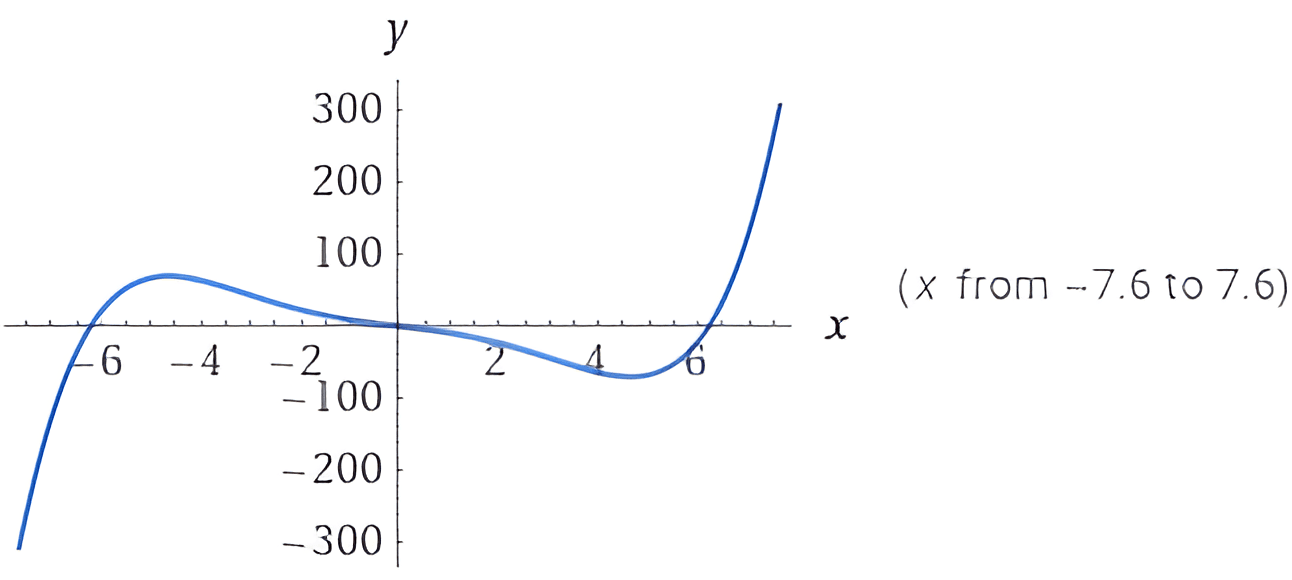
Generated Graph
Solution by Steps
step 1
To find f′(0), we differentiate the given Maclaurin series term by term
step 2
The first derivative of the function f(x)=3−4x2−4x4+192x6 is f′(x)=−8x−x3+32x5
step 3
Evaluating at x=0, we get f′(0)=0
step 4
To find f′′(0), we differentiate f′(x) to get the second derivative
step 5
The second derivative of f(x) is f′′(x)=−8−3x2+325x4
step 6
Evaluating at x=0, we get f′′(0)=−8
step 7
Since f′(0)=0 and f''(0) < 0, f has a relative maximum at x=0
[1] Answer
f′(0)=0, f′′(0)=−8, and f has a relative maximum at x=0.
Key Concept
Finding the first and second derivatives at a point to determine the nature of extrema.
Explanation
The first derivative test is used to find where the function has a slope of zero, indicating potential extrema. The second derivative test then determines whether it is a maximum or minimum.
step 8
To use the Lagrange error bound, we need the maximum value of the fifth derivative of f on the interval [−21,21]
step 9
From the graph, we see that the maximum value of ∣f(5)(x)∣ is 2
step 10
The Lagrange error bound formula is E≤n!M∣x−a∣n, where M is the maximum value of the nth derivative on the interval, x is the value we are approximating, a is the center of the Taylor series, and n is the degree of the next term not included in the polynomial
step 11
Plugging in the values, we get E≤5!2∣21−0∣5
step 12
Simplifying, we find E≤1202(21)5=2401
step 13
Since \frac{1}{240} < \frac{1}{1000}, the error bound is satisfied
[2] Answer
The Lagrange error bound shows that |f(\frac{1}{2}) - P_4(\frac{1}{2})| < \frac{1}{1000}.
Key Concept
Using the Lagrange error bound to estimate the error of a Taylor polynomial approximation.
Explanation
The Lagrange error bound provides an upper limit on the error between the actual function value and the Taylor polynomial approximation, ensuring the approximation is within a desired accuracy.
step 14
The Maclaurin series for sinx is x−3!x3+⋯. The first two nonzero terms are x and −6x3
step 15
The Maclaurin series for f′(x) is −8x−x3+32x5. The first two nonzero terms are −8x and −x3
step 16
To find the coefficient of x4 in the Maclaurin series for f′(x)sinx, we multiply the series for f′(x) and sinx and look for terms that result in x4
step 17
The x4 term comes from multiplying the −8x term from f′(x) with the −6x3 term from sinx
step 18
Multiplying these terms, we get (−8x)(−6x3)=68x4=34x4
step 19
The coefficient of x4 is 34
[3] Answer
The coefficient of the fourth-degree term in the Maclaurin series for f′(x)sinx is 34.
Key Concept
Finding the coefficient of a specific term in the product of two series.
Explanation
By multiplying corresponding terms from the series of f′(x) and sinx, we can find the coefficient of any term in the resulting series.
© 2023 AskSia.AI all rights reserved