
AskSia
Plus

- Q. 4 For each of the following functions determine whether it is convex/conca...
Sep 28, 2024



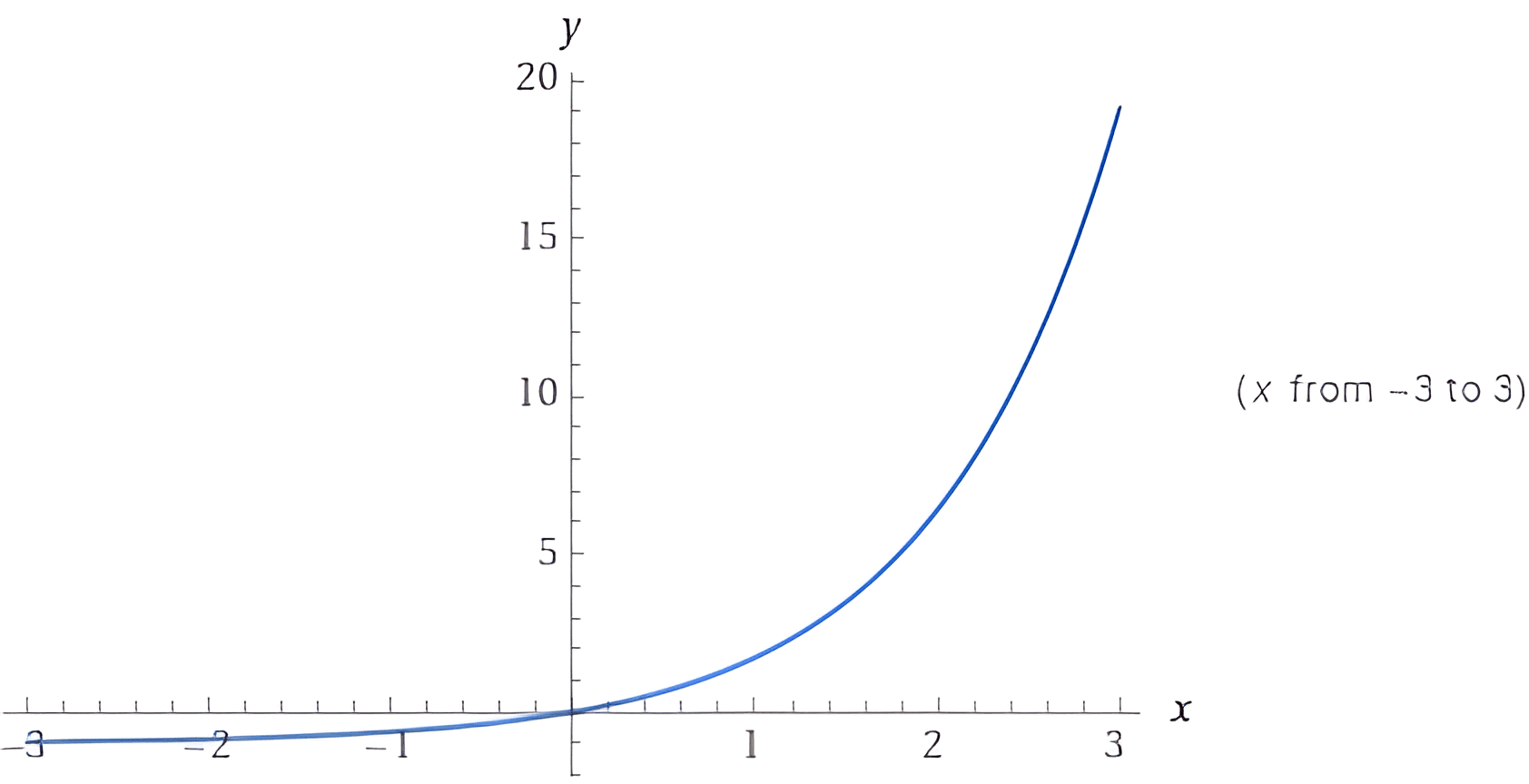
Generated Graph
Solution by Steps
step 1
To determine the convexity or concavity of the function f(x)=ex−1 on R, we compute the second derivative. The first derivative is f′(x)=ex, and the second derivative is f′′(x)=ex. Since f''(x) > 0 for all x∈R, the function is convex
step 2
For the function f(x1,x2)=x1x21 on R++2, we compute the Hessian matrix. The second partial derivatives yield a Hessian that is negative definite, indicating that the function is concave
step 3
For the function f(x1,x2)=x2x1 on R+2, we again compute the Hessian matrix. The analysis shows that the function is quasiconcave since it is increasing in x1 and decreasing in x2
Answer
(a) Convex, (b) Concave, (c) Quasiconcave
Key Concept
Convexity and concavity are properties of functions that describe their curvature and behavior in relation to lines.
Explanation
The analysis of the second derivatives and Hessian matrices helps determine the nature of the functions, leading to the classifications of convex, concave, and quasiconcave.

Generated Graph
Solution by Steps
step 1
The optimization problem is to minimize the function f(x1,x2) subject to the constraints 2x1+x2≥1, x1+3x2≥1, x1≥0, and x2≥0
step 2
The feasible region is determined by the intersection of the constraints. The inequalities can be graphed to find the feasible set
step 3
For the objective function f(x1,x2)=x1+x2, the optimal value occurs at the vertex of the feasible region that minimizes this function
step 4
For the objective function f(x1,x2)=−x1−x2, the optimal value occurs at the vertex of the feasible region that maximizes this function
step 5
For the objective function f(x1,x2)=x1, the optimal value is found at the maximum value of x1 within the feasible region
step 6
For the objective function f(x1,x2)=max{x1,x2}, the optimal value is determined by the maximum of the two variables at the vertices of the feasible region
step 7
For the objective function f(x1,x2)=x12+9x22, the optimal value is found by evaluating this function at the vertices of the feasible region
Answer
The optimal values and sets for each function depend on the vertices of the feasible region defined by the constraints.
Key Concept
Optimization problems involve minimizing or maximizing a function subject to constraints.
Explanation
The feasible set is formed by the intersection of the constraints, and the optimal values are found at the vertices of this set for each objective function.

Solution by Steps
step 2
For formulation (a), the constraints fi(x)=0 and hi(x)=0 do not violate convexity since they are equalities involving convex functions and affine functions. Thus, (a) is a convex optimization problem
step 3
In formulation (b), the constraint fi2(x)=0 implies that fi(x)=0, which is similar to (a). However, the condition that fi(.) are increasing functions does not affect convexity. Therefore, (b) is also a convex optimization problem
step 4
For formulation (c), the constraint mini{fi(x)}≤0 is a non-convex constraint since it involves the minimum of convex functions, which can lead to non-convex regions. Thus, (c) is not a convex optimization problem
step 5
In formulation (d), the constraints fi(x)≥0 are convex since they are inequalities involving convex functions. Therefore, (d) is a convex optimization problem
step 6
For formulation (e), the constraint ∑i=1nwifi(x)≤0 with wi≥0 is a convex constraint since it is a linear combination of convex functions. Thus, (e) is a convex optimization problem
[6] Answer
A
Key Concept
Convex Optimization Problems
Explanation
A convex optimization problem is characterized by a convex objective function and convex constraints, which ensures that any local minimum is also a global minimum.

Solution by Steps
step 2
For formulation (a), the constraints fi(x)=0 and hi(x)=0 do not violate the conditions for convexity, but they do not allow for a feasible region that minimizes f0(x). Thus, (a) is not a convex optimization problem
step 3
In formulation (b), since fi2(x)=0 implies fi(x)=0, this is equivalent to the constraints in (a) and thus is also not a convex optimization problem
step 4
For formulation (c), the constraint mini{fi(x)}≤0 allows for a feasible region, but it does not guarantee that the problem is convex since it involves a non-convex operation (minimum). Thus, (c) is not a convex optimization problem
step 5
In formulation (d), the constraints fi(x)≥0 and hi(x)=0 maintain the convexity of the problem, making (d) a convex optimization problem
step 6
For formulation (e), the constraint (∑i=1nwifi(x))≤0 where wi≥0 is a linear combination of convex functions, thus (e) is also a convex optimization problem
[6] Answer
D
Key Concept
Convex Optimization Problems
Explanation
A convex optimization problem is characterized by a convex objective function and convex feasible region defined by convex constraints. In this case, formulations (d) and (e) meet these criteria.

Solution by Steps
step 1
The given optimization problem is to minimize ∑i=1mϕ(aiTx−bi) subject to x∈Rn
step 2
The function ϕ is defined as:
ϕ(u)={u2,M(2∣u∣−M)amp;∣u∣≤Mamp;∣u∣gt;M
where M > 0
step 3
To show that the problem is convex, we need to demonstrate that ϕ(u) is a convex function. For ∣u∣≤M, ϕ(u)=u2 is convex since the second derivative \phi''(u) = 2 > 0
step 4
For |u| > M , we analyze ϕ(u)=M(2∣u∣−M). The derivative is ϕ′(u)=2M (for u > M ) and ϕ′(u)=−2M (for u < -M ), which indicates that ϕ(u) is linear and thus convex in this region as well
step 5
Since ϕ(u) is convex in both cases, and the sum of convex functions is convex, we conclude that ∑i=1mϕ(aiTx−bi) is convex. Therefore, the overall optimization problem is convex
Answer
The problem is a convex optimization problem.
Key Concept
Convex Optimization Problem
Explanation
The problem is convex because the objective function is a sum of convex functions, which ensures that any local minimum is also a global minimum.
© 2023 AskSia.AI all rights reserved