
AskSia
Plus

Give me the need-to-knows of periods 1-5 please
Dec 20, 2023

Give me the need-to-knows of periods 1-5 please

Answer
Period 1 (1491-1607) covers the pre-Columbian era and the early contacts between Native Americans and Europeans. Period 2 (1607-1754) focuses on the establishment of the thirteen British colonies and their early development. Period 3 (1754-1800) encompasses the events leading to the American Revolution, the war itself, and the early years of the United States under the Constitution. Period 4 (1800-1848) is characterized by westward expansion, the growth of democracy, and the beginnings of industrialization. Period 5 (1844-1877) includes the intensification of sectionalism, the Civil War, and Reconstruction.
Key Concept
Period 1: Native American societies were diverse in their political, social, and economic structures, and they adapted to and transformed their environments through innovations in agriculture, resource use, and social structure. (KC-1.1.I)
Explanation
Before European contact, Native American societies were complex and varied, with intricate belief systems and adaptations to their environments that allowed for the development of stable communities and trade networks.
Key Concept
Period 2: The British colonies participated in political, social, and economic exchanges that involved interactions with Europeans, Africans, and Native Americans, leading to a new cultural and racial mix. (KC-2.1.III)
Explanation
The colonies developed economies based on agriculture, trade, and forced labor systems, including slavery. These interactions and exchanges led to the development of a distinct Atlantic World, connecting the continents and peoples in a web of trade and cultural exchange.
Key Concept
Period 3: The American Revolution's democratic and republican ideals inspired new experiments with different forms of government. (KC-3.2.I)
Explanation
The Revolution generated ideas about liberty and equality that challenged traditional beliefs about government and led to the creation of a new constitution that laid the foundation for the United States' political system.
Key Concept
Period 4: The United States underwent significant territorial expansion, shaping national identity and leading to debates over the extension of slavery and other issues. (KC-4.1.I)
Explanation
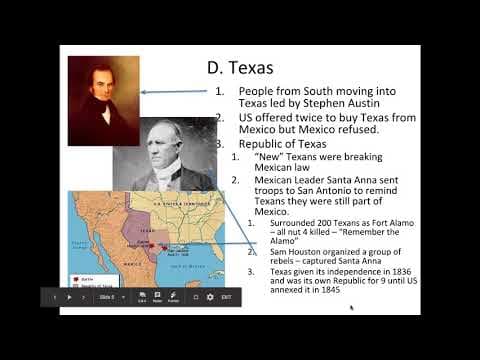
The concept of Manifest Destiny drove Americans to explore and annex new territories, which in turn led to conflicts over the spread of slavery, interactions with Native Americans, and the balance of free and slave states.
Key Concept
Period 5: The Civil War and Reconstruction transformed the United States, leading to significant changes in the Constitution and its interpretation, the abolition of slavery, and an ongoing debate about the balance of power between the federal government and the states. (KC-5.3.II)
Explanation
The Civil War resolved the issue of slavery's expansion but left unresolved many questions about states' rights and federal power. Reconstruction attempted to address these issues and the integration of African Americans into political life, but it was ultimately limited in its achievements.
Related Video

Lecture 24a - Slavery and Manifest Destiny

Manifest Destiny and Slavery Lecture
© 2023 AskSia.AI all rights reserved