
AskSia
Plus

Contextualize unit 6
Feb 1, 2024

Contextualize unit 6

Unit 6 focuses on a significant period in American history known as the Progressive Era. This era took place from the late 19th century to the early 20th century, roughly spanning from the 1890s to the 1920s. It was a time of social, political, and economic reform as Americans sought to address the problems caused by industrialization and urbanization.
During this period, there were several key developments and movements that shaped the Progressive Era. One major aspect was the rise of progressivism, a reform movement that aimed to address issues such as political corruption, economic inequality, and social injustice. Progressives believed in using government intervention to improve society and advocated for various reforms, including women's suffrage, workers' rights, and regulation of big business.
The Progressive Era also saw the emergence of muckrakers, investigative journalists who exposed corruption and social problems. Their work, such as Upton Sinclair's "The Jungle," shed light on issues like unsafe working conditions and unsanitary food production, leading to public outcry and calls for change.
Additionally, the era witnessed significant political changes, including the passage of constitutional amendments. The 16th Amendment introduced the federal income tax, while the 17th Amendment allowed for the direct election of senators. These reforms aimed to increase government accountability and reduce the influence of special interests.
Furthermore, the Progressive Era was marked by important social movements, such as the temperance movement, which sought to combat alcohol abuse, and the women's suffrage movement, which fought for women's right to vote. These movements played a crucial role in shaping American society and expanding democratic participation.
Overall, the Progressive Era was a time of significant reform and social change in the United States. It laid the foundation for many of the policies and movements that continue to shape our nation today.
Create a study guide of need to knows for unit 6
Sure! Here's a study guide of the key points you need to know for Unit 6:
1. The Progressive Era:
- Definition and goals of the Progressive movement
- Key reformers and their contributions (e.g., Jane Addams, Theodore Roosevelt)
- Major reforms achieved during this era (e.g., women's suffrage, labor rights)
2. World War I:
- Causes of the war (e.g., nationalism, imperialism)
- US entry into the war and its impact
- Treaty of Versailles and its consequences
3. The Roaring Twenties:
- Economic prosperity and consumer culture
- Social changes and cultural developments (e.g., flappers, Harlem Renaissance)
- Prohibition and the rise of organized crime
4. The Great Depression:
- Causes and impact of the stock market crash of 1929
- President Franklin D. Roosevelt's New Deal policies
- Dust Bowl and its effects on the Great Plains
5. World War II:
- Causes of the war (e.g., rise of fascism, Japanese aggression)
- US involvement and major battles (e.g., Pearl Harbor, D-Day)
- Holocaust and the impact on Europe
6. The Cold War:
- Origins and ideological differences between the US and the Soviet Union
- Key events and policies (e.g., Truman Doctrine, Marshall Plan)
- Cuban Missile Crisis and the arms race
7. Civil Rights Movement:
- Key figures and organizations (e.g., Martin Luther King Jr., NAACP)
- Major events and protests (e.g., Montgomery Bus Boycott, March on Washington)
- Civil Rights Act of 1964 and Voting Rights Act of 1965
Remember to review your class notes, textbook readings, and any additional materials we covered in class. Good luck with your studies, and feel free to ask me any specific questions you may have!
Key events of unit 6
Answer
Key events of Unit 6 in AP US History, which covers the period from the end of the Civil War through the turn of the 20th century, include the Reconstruction era, the rise of industrial capitalism, the Westward Expansion, the Gilded Age, the Progressive Era, and the beginnings of America's imperialist actions abroad.
Key Concept
The Reconstruction era (1865-1877) was a significant period following the Civil War during which the United States attempted to address the issues of integrating freed slaves into society and restoring the Southern states to the Union. (KC-5.3.I)
Explanation
Reconstruction involved political struggles over the treatment of former Confederates and the rights of freed African Americans, leading to the passage of the 13th, 14th, and 15th Amendments, which abolished slavery, granted citizenship, and protected voting rights, respectively. The period ended with the Compromise of 1877, which resulted in the withdrawal of federal troops from the South and the end of Reconstruction efforts.
Related Video

The Impact of The Emancipation Proclamation on Kansas City
03262014 Bleeding Kansas, Bleeding Missouri 2 of 3
Who are the key figures of Unit in US History?
Answer
The key figures of a unit in US History would depend on the specific time period or theme being studied. For example, key figures in the unit on the American Revolution might include George Washington, Thomas Jefferson, and Benjamin Franklin, while a unit on the Civil War might focus on Abraham Lincoln, Ulysses S. Grant, and Robert E. Lee. Please specify the unit or time period for a more detailed answer.
Key Concept
Without a specific unit or time period, it is challenging to identify key figures as US History encompasses a vast array of eras and themes, each with its own significant individuals.
Explanation
Key figures in US History are those individuals who have had a significant impact on historical events, social movements, political ideologies, or cultural developments during a specific period. Their actions and legacies are studied to understand the complexities of the past and their influence on the present.
Related Video
APUSH Unit 4 REVIEW [Period 4: 1800-1848]—Everything You NEED to Know

Foreign Policy: Crash Course Government and Politics #50

Who were the key figures of Unit 6 in US history?
Answer
Key figures of Unit 6 in US history, which typically covers the period of the Gilded Age and the early 20th century, include industrialists such as John D. Rockefeller and Andrew Carnegie, labor leaders like Samuel Gompers, reformers such as Jane Addams and Ida B. Wells, and presidents including Theodore Roosevelt, William Howard Taft, and Woodrow Wilson.
Key Concept
The Gilded Age and Progressive Era witnessed the emergence of a modern industrial economy and a transformation in social, political, and economic life. (KC-6.1.I)
Explanation
During this period, the United States experienced rapid industrialization, leading to significant economic growth, the rise of big businesses, and the development of a new class of wealthy industrialists. At the same time, the era saw the growth of labor unions, the push for women's suffrage, and a series of progressive reforms aimed at addressing the problems caused by industrialization and urbanization.
Related Video
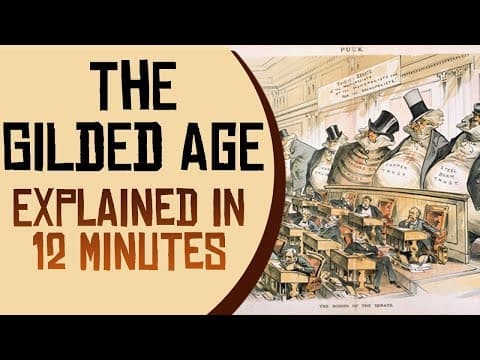
The Gilded Age: The ‘High’ Point in America’s History
The Progressive Era: Crash Course US History #27
© 2023 AskSia.AI all rights reserved